
Welcome to the Cnidaria subsite on Invertebrate Paleontology!
Please enter a genera name to retrieve more information.

Aulophyllum
Classification
Phylum:
Cnidaria
Class:
Anthozoa
Subclass:
Rugosa
Order:
Stauriida
Suborder:
Aulophyllina
Family:
Aulophyllidae
Subfamily:
Aulophyllinae
Formal Genus Name and Reference:
Aulophyllum Milne-Edwards & HAIME, 1850, p. lxx
Type Species:
Clisiophyllum prolapsum McCoy, 1849, p. 3, OD, syntypes A1817-9, 2368-9, SM, Cambridge, L.Carb., Derbyshire, =Turbinolia fungites Fleming, 1828, p. 510, †C4366, HM, Glasgow, lectotype by Smith & LANG, 1930, p. 187, L.Carb., E. Kilbride, Scot.
Images
(Click to enlarge in a new window)
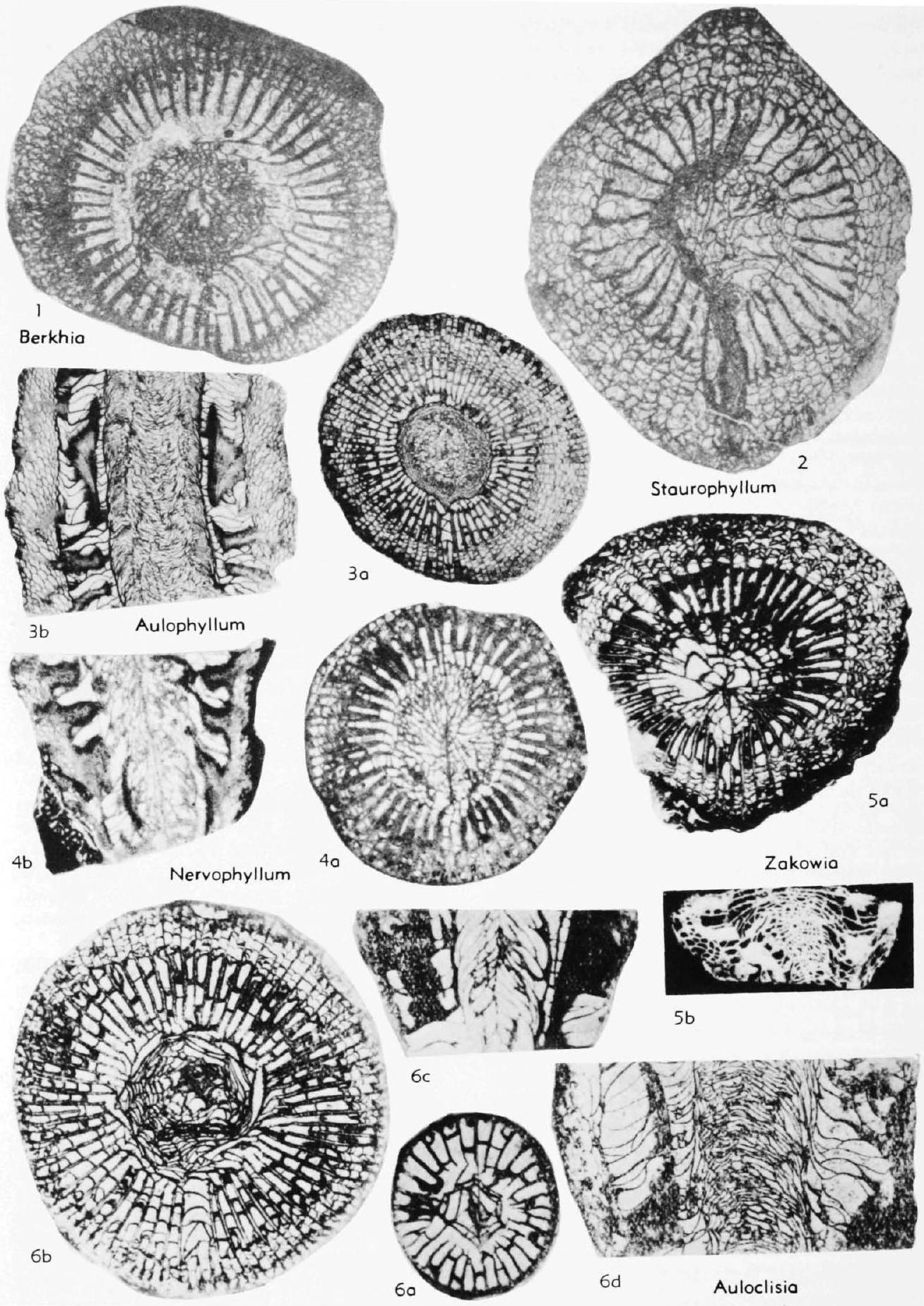 Fig. 232, 3a,b. *A. fungites (Fleming), Pendleian, Namur., Great Ls., Eng., Weardale, Durham, a, b, transv., long. secs., X 1.4 (Smith, 1913)
Synonyms
Cyclophyllum, ?Permia, ?Setamainella, ?Berkhia
Geographic Distribution
Eu.(Brit.I.-Belg.-France-Ger.-Pol.-USSR)-N.Afr.(Alg.)-Asia(Turkey-?Japan)
Age Range
Beginning Stage in Treatise Usage:
L.Carb.
Beginning International Stage:
Tournaisian
Fraction Up In Beginning Stage:
0
Beginning Date:
359.3
Ending Stage in Treatise Usage:
U.Carb.(Namur.)
Ending International Stage:
Bashkirian
Fraction Up In Ending Stage:
48.4
Ending Date:
319.4
Description
Solitary, moderately large, with numerous septa, a regular dissepimentarium with small, normal concentric dissepiments, with axial structure a well-defined and medianly depressed column, cuspidate toward fossula in transverse sections and built up of closely packed lamellae and tabellae without median plate, tabellar floors being close and domes with median depression, major septa may be dilated in tabularium, commonly in cardinal quadrants only, cardinal septum short after early stages, in fossula on convex side of corallum; tabellae between column and marginarium large, widely separated, subhorizontally based or slightly declined outward [see SMITH, ]913, p. 58].
References
Haime, Jules, 1850, Polypiers: in P. E. P. Verneuil, Note sur les fossiles dévoniens du district de Sabero (Léon): Soc. Géol. France, Bull., sér. 2, v. 7, p. 161-162.
Museum or Author Information
Classification
Phylum:
Cnidaria
Class:
Anthozoa
Subclass:
Rugosa
Order:
Stauriida
Suborder:
Aulophyllina
Family:
Aulophyllidae
Subfamily:
Aulophyllinae
Formal Genus Name and Reference:
Aulophyllum Milne-Edwards & HAIME, 1850, p. lxx
Type Species:
Clisiophyllum prolapsum McCoy, 1849, p. 3, OD, syntypes A1817-9, 2368-9, SM, Cambridge, L.Carb., Derbyshire, =Turbinolia fungites Fleming, 1828, p. 510, †C4366, HM, Glasgow, lectotype by Smith & LANG, 1930, p. 187, L.Carb., E. Kilbride, Scot.
Images
(Click to enlarge in a new window)
Fig. 232, 3a,b. *A. fungites (Fleming), Pendleian, Namur., Great Ls., Eng., Weardale, Durham, a, b, transv., long. secs., X 1.4 (Smith, 1913)
Synonyms
Cyclophyllum, ?Permia, ?Setamainella, ?Berkhia
Geographic Distribution
Eu.(Brit.I.-Belg.-France-Ger.-Pol.-USSR)-N.Afr.(Alg.)-Asia(Turkey-?Japan)
Age Range
Beginning Stage in Treatise Usage:
L.Carb.
Beginning International Stage:
Tournaisian
Fraction Up In Beginning Stage:
0
Beginning Date:
359.3
Ending Stage in Treatise Usage:
U.Carb.(Namur.)
Ending International Stage:
Bashkirian
Fraction Up In Ending Stage:
48.4
Ending Date:
319.4
Description
Solitary, moderately large, with numerous septa, a regular dissepimentarium with small, normal concentric dissepiments, with axial structure a well-defined and medianly depressed column, cuspidate toward fossula in transverse sections and built up of closely packed lamellae and tabellae without median plate, tabellar floors being close and domes with median depression, major septa may be dilated in tabularium, commonly in cardinal quadrants only, cardinal septum short after early stages, in fossula on convex side of corallum; tabellae between column and marginarium large, widely separated, subhorizontally based or slightly declined outward [see SMITH, ]913, p. 58].
References
Haime, Jules, 1850, Polypiers: in P. E. P. Verneuil, Note sur les fossiles dévoniens du district de Sabero (Léon): Soc. Géol. France, Bull., sér. 2, v. 7, p. 161-162.