
Welcome to the Cnidaria subsite on Invertebrate Paleontology!
Please enter a genera name to retrieve more information.

Calophyllum
Classification
Phylum:
Cnidaria
Class:
Anthozoa
Subclass:
Rugosa
Order:
Stauriida
Suborder:
Plerophyllina
Family:
Polycoeliidae
Subfamily:
Polycoeliinae
Formal Genus Name and Reference:
Calophyllum DANA, 1846a, p. 183
Type Species:
Turbinolia donatiana KING, 1848, p. 6; SM KING, 1850, p. 22; tneotype by FLlJGEL, 1973c, p. 62; in Hancock Museum, Newcastle-upon-Tyne; Perm., Magnesian Ls., Humbleton Hill, near Sunderland, Eng.; =Caryophillia quadrifida HowsE, 1848, p. 260, nom. oblit. (FLiiGEL, 1973c, p. 65)]
Images
(Click to enlarge in a new window)
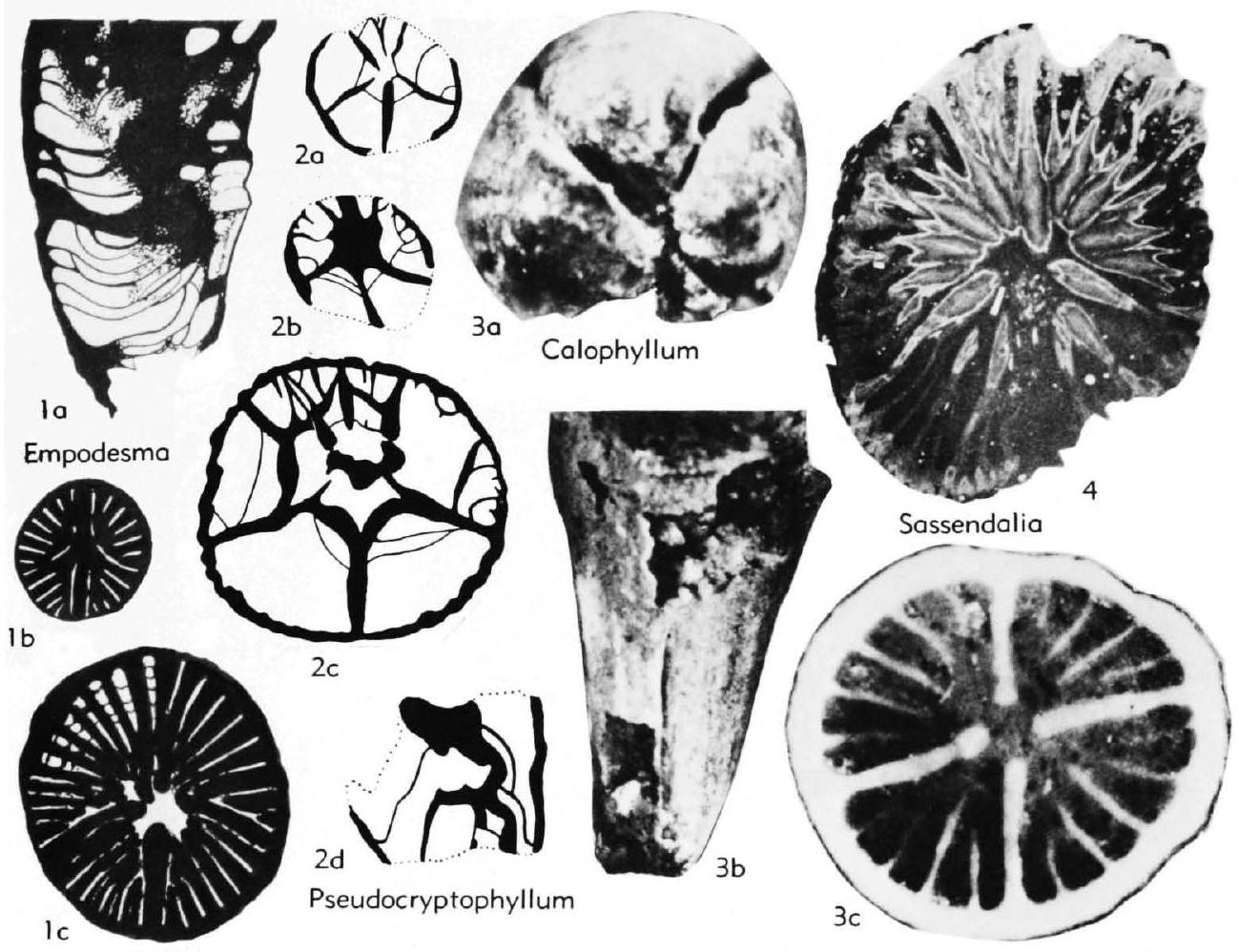 Fig. 210,3a,b. *C. donatianum (King), neotype, Perm., Magnesian Ls., Eng., Humbleton Hill, Co. Durham, a, b, internal molds of calice, X6.7,X6.0 (Flügel, 1973c).
Synonyms
Polycoelia, ?Phryganophyllum
Geographic Distribution
Eu.(Brit.I.-Ger.-USSR)-Asia
Age Range
Beginning Stage in Treatise Usage:
L.Carb.
Beginning International Stage:
Tournaisian
Fraction Up In Beginning Stage:
0
Beginning Date:
359.3
Ending Stage in Treatise Usage:
Perm.
Ending International Stage:
Changhsingian
Fraction Up In Ending Stage:
100
Ending Date:
251.9
Description
Solitary, small; cardinal, counter, and two alar protosepta almost equally spaced, longer and thicker than other major septa, but in upper third of calice shortened so that all septa appear equal; minor septa confined to wall except at calical margin; metaseptal insertion accelerated slightly in counter quadrants; tabulae complete, flat axially, with downturned margins; no dissepiments. [Septal plan in early stages of type species not known. FLUGEL, 1973c, p. 65, indicates that Cyat/,ophyllttm profundum GEINITZ, 1842, on which Calophyllum (=Polycoclia) is commonly interpreted, is not conspecific with Calophyllum donatianttm. As described from topotypes by SCHINDEWOLF (1942, p. 68), C. profttndum has more and longer metasepta than C. donatianttm, and, in its early stages, a marked cardinal fossula extending to axis. Its cardinal septum lies ?always on concave side of corallum. Russian specimens referred to C. profundttm by IVANOVSKIY (1972, p. 5) have in the midplane of their septa very fine, close trabeculae with orthogonal fibers.]
References
Museum or Author Information
Classification
Phylum:
Cnidaria
Class:
Anthozoa
Subclass:
Rugosa
Order:
Stauriida
Suborder:
Plerophyllina
Family:
Polycoeliidae
Subfamily:
Polycoeliinae
Formal Genus Name and Reference:
Calophyllum DANA, 1846a, p. 183
Type Species:
Turbinolia donatiana KING, 1848, p. 6; SM KING, 1850, p. 22; tneotype by FLlJGEL, 1973c, p. 62; in Hancock Museum, Newcastle-upon-Tyne; Perm., Magnesian Ls., Humbleton Hill, near Sunderland, Eng.; =Caryophillia quadrifida HowsE, 1848, p. 260, nom. oblit. (FLiiGEL, 1973c, p. 65)]
Images
(Click to enlarge in a new window)
Fig. 210,3a,b. *C. donatianum (King), neotype, Perm., Magnesian Ls., Eng., Humbleton Hill, Co. Durham, a, b, internal molds of calice, X6.7,X6.0 (Flügel, 1973c).
Synonyms
Polycoelia, ?Phryganophyllum
Geographic Distribution
Eu.(Brit.I.-Ger.-USSR)-Asia
Age Range
Beginning Stage in Treatise Usage:
L.Carb.
Beginning International Stage:
Tournaisian
Fraction Up In Beginning Stage:
0
Beginning Date:
359.3
Ending Stage in Treatise Usage:
Perm.
Ending International Stage:
Changhsingian
Fraction Up In Ending Stage:
100
Ending Date:
251.9
Description
Solitary, small; cardinal, counter, and two alar protosepta almost equally spaced, longer and thicker than other major septa, but in upper third of calice shortened so that all septa appear equal; minor septa confined to wall except at calical margin; metaseptal insertion accelerated slightly in counter quadrants; tabulae complete, flat axially, with downturned margins; no dissepiments. [Septal plan in early stages of type species not known. FLUGEL, 1973c, p. 65, indicates that Cyat/,ophyllttm profundum GEINITZ, 1842, on which Calophyllum (=Polycoclia) is commonly interpreted, is not conspecific with Calophyllum donatianttm. As described from topotypes by SCHINDEWOLF (1942, p. 68), C. profttndum has more and longer metasepta than C. donatianttm, and, in its early stages, a marked cardinal fossula extending to axis. Its cardinal septum lies ?always on concave side of corallum. Russian specimens referred to C. profundttm by IVANOVSKIY (1972, p. 5) have in the midplane of their septa very fine, close trabeculae with orthogonal fibers.]