
Welcome to the Cnidaria subsite on Invertebrate Paleontology!
Please enter a genera name to retrieve more information.
Calostylis
Classification
Phylum:
Cnidaria
Class:
Anthozoa
Subclass:
Rugosa
Order:
Stauriida
Suborder:
Calostylina
Superfamily:
Calostylicae
Family:
Calostylidae
Formal Genus Name and Reference:
Calostylis LINDSTRÖM, 1868, p. 421
Type Species:
C. cribraria, M, †Cn15679, RM, Stockholm, lectotype by Weyer, 1973a, p. 29, ?=Clisiophyllum denticulatum Kjerulf, 1865, p. 25, Sil., Gotl., thot traced, see Smith, 1930b, p. 267, WEYER, 1973a, p. 29
Images
(Click to enlarge in a new window)
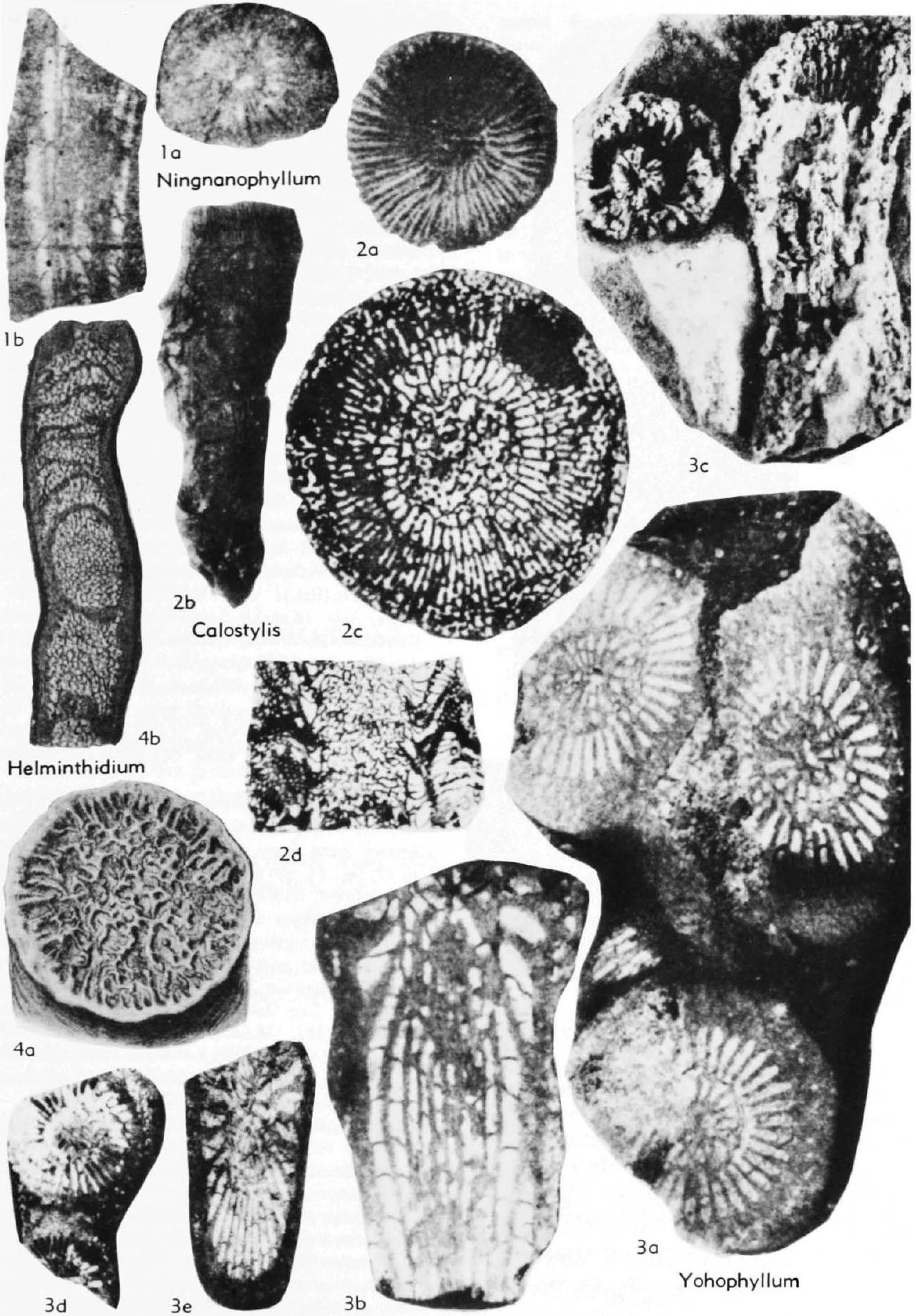 Fig. 107,2a-d. * C. cribraria, Sil., Gotl., a, lectotype, calical view, X15.0; b, another specimen, side view, X1.0, c,d, third specimen, transv., long. secs., X2.8, X1.8 (Smith, 1930b).
Synonyms
Hemiphyllum, Hemiphyllum siluriensis
Geographic Distribution
Asia(Szechwan-Kweichow), U. Ord., Eu.(Est.), Sil., Eu. (U.K.-Gotl.-Nor.-Est.-Urals)-Asia (Kazakh.-Sayan-Himalaya-Sib. Platf.-Kweichow-Szechwan)-Australia(New S.Wales)-N. Am. (Ky.-Ohio), U.Sil. or L.Dev.(Aynasu. ), Asia (Kazakh.)
Age Range
Beginning Stage in Treatise Usage:
Up.M.Ord.
Beginning International Stage:
Dapingian
Fraction Up In Beginning Stage:
0
Beginning Date:
471.26
Ending Stage in Treatise Usage:
Up.M.Ord.
Ending International Stage:
Darriwilian
Fraction Up In Ending Stage:
100
Ending Date:
458.18
Description
Solitary, not epithecate in distal region, calice being steeply everted near peripheral margin, major and minor septa slightly perforate, connected by irregular synapticulae, trabeculae ?monacanthine, connected radially in single series by synapticular extensions, axial ends of large major septa lobed and reticulate, forming spongy axial structure that may form calical boss, tabulae domed, filmy, complete and widely separated, continuous in marginarium with filmy plates parallel to distal edges of major septa.
References
Museum or Author Information
Classification
Phylum:
Cnidaria
Class:
Anthozoa
Subclass:
Rugosa
Order:
Stauriida
Suborder:
Calostylina
Superfamily:
Calostylicae
Family:
Calostylidae
Formal Genus Name and Reference:
Calostylis LINDSTRÖM, 1868, p. 421
Type Species:
C. cribraria, M, †Cn15679, RM, Stockholm, lectotype by Weyer, 1973a, p. 29, ?=Clisiophyllum denticulatum Kjerulf, 1865, p. 25, Sil., Gotl., thot traced, see Smith, 1930b, p. 267, WEYER, 1973a, p. 29
Images
(Click to enlarge in a new window)
Fig. 107,2a-d. * C. cribraria, Sil., Gotl., a, lectotype, calical view, X15.0; b, another specimen, side view, X1.0, c,d, third specimen, transv., long. secs., X2.8, X1.8 (Smith, 1930b).
Synonyms
Hemiphyllum, Hemiphyllum siluriensis
Geographic Distribution
Asia(Szechwan-Kweichow), U. Ord., Eu.(Est.), Sil., Eu. (U.K.-Gotl.-Nor.-Est.-Urals)-Asia (Kazakh.-Sayan-Himalaya-Sib. Platf.-Kweichow-Szechwan)-Australia(New S.Wales)-N. Am. (Ky.-Ohio), U.Sil. or L.Dev.(Aynasu. ), Asia (Kazakh.)
Age Range
Beginning Stage in Treatise Usage:
Up.M.Ord.
Beginning International Stage:
Dapingian
Fraction Up In Beginning Stage:
0
Beginning Date:
471.26
Ending Stage in Treatise Usage:
Up.M.Ord.
Ending International Stage:
Darriwilian
Fraction Up In Ending Stage:
100
Ending Date:
458.18
Description
Solitary, not epithecate in distal region, calice being steeply everted near peripheral margin, major and minor septa slightly perforate, connected by irregular synapticulae, trabeculae ?monacanthine, connected radially in single series by synapticular extensions, axial ends of large major septa lobed and reticulate, forming spongy axial structure that may form calical boss, tabulae domed, filmy, complete and widely separated, continuous in marginarium with filmy plates parallel to distal edges of major septa.