
Welcome to the Cnidaria subsite on Invertebrate Paleontology!
Please enter a genera name to retrieve more information.

Campophyllum
Classification
Phylum:
Cnidaria
Class:
Anthozoa
Subclass:
Rugosa
Order:
Stauriida
Suborder:
Cyathophyllina
Family:
Campophyllidae
Formal Genus Name and Reference:
Campophyllum Milne-Edwards & HAIME, 1850, p. lxviii
Type Species:
Cyathophyllum flexuosum Goldfuss, 1826, p 57, OD, †197a, Goldfuss Coll., IP, Bonn, lectotype by Hill & JULL, 1965, p. 207
Images
(Click to enlarge in a new window)
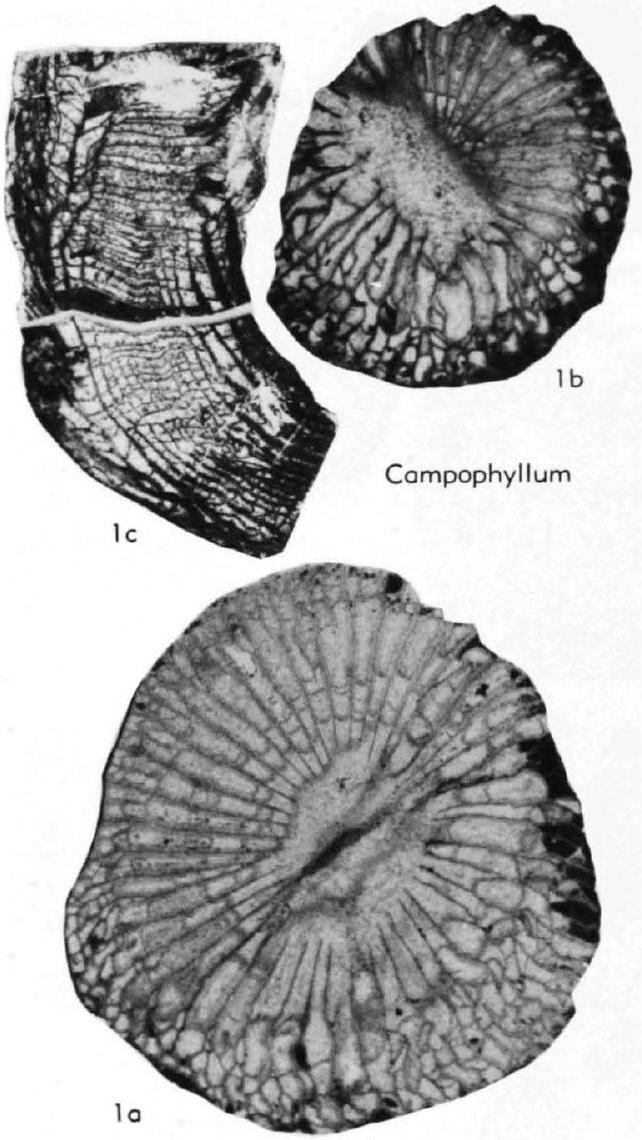 Fig. 200,1a-c. *C. flexuosum (Goldfuss), lectotype, "Heisterstein", a,b, transv. secs., X3.0, long. sec., c,(Hill& Jull, 1965)
Synonyms
Geographic Distribution
Eu.(Ger.)
Age Range
Beginning Stage in Treatise Usage:
M.Dev.
Beginning International Stage:
Eifelian
Fraction Up In Beginning Stage:
0
Beginning Date:
394.3
Ending Stage in Treatise Usage:
L.Carb.(Etroeungt.)
Ending International Stage:
Serpukhovian
Fraction Up In Ending Stage:
100
Ending Date:
323.4
Description
Solitary with beaker-form calice, major septa long but amplexoid, with caninioid dilatation in tabularium decreasing with age, and thin and flexuose in dissepimentarium, neither cardinal nor counter septum of distinctive length, and cardinal fossula not strongly marked, wide, parallel-sided and short, with slight tabular depression, minor septa also thin and flexuose but most are contratingent and except in late stages their inner ends are thickened, the thickening continuous with that of their neighboring major septa, tabulae broad and horizontal, with downturned edges, dissepimentarium narrow with steeply declined, small but unequal and not globose dissepiments. [Diagnosis based on lectotype only, from uncertain locality and horizon. See HILL & JULL, 1965, p. 207.]
References
Haime, Jules, 1850, Polypiers: in P. E. P. Verneuil, Note sur les fossiles dévoniens du district de Sabero (Léon): Soc. Géol. France, Bull., sér. 2, v. 7, p. 161-162.
Museum or Author Information
Classification
Phylum:
Cnidaria
Class:
Anthozoa
Subclass:
Rugosa
Order:
Stauriida
Suborder:
Cyathophyllina
Family:
Campophyllidae
Formal Genus Name and Reference:
Campophyllum Milne-Edwards & HAIME, 1850, p. lxviii
Type Species:
Cyathophyllum flexuosum Goldfuss, 1826, p 57, OD, †197a, Goldfuss Coll., IP, Bonn, lectotype by Hill & JULL, 1965, p. 207
Images
(Click to enlarge in a new window)
Fig. 200,1a-c. *C. flexuosum (Goldfuss), lectotype, "Heisterstein", a,b, transv. secs., X3.0, long. sec., c,(Hill& Jull, 1965)
Synonyms
Geographic Distribution
Eu.(Ger.)
Age Range
Beginning Stage in Treatise Usage:
M.Dev.
Beginning International Stage:
Eifelian
Fraction Up In Beginning Stage:
0
Beginning Date:
394.3
Ending Stage in Treatise Usage:
L.Carb.(Etroeungt.)
Ending International Stage:
Serpukhovian
Fraction Up In Ending Stage:
100
Ending Date:
323.4
Description
Solitary with beaker-form calice, major septa long but amplexoid, with caninioid dilatation in tabularium decreasing with age, and thin and flexuose in dissepimentarium, neither cardinal nor counter septum of distinctive length, and cardinal fossula not strongly marked, wide, parallel-sided and short, with slight tabular depression, minor septa also thin and flexuose but most are contratingent and except in late stages their inner ends are thickened, the thickening continuous with that of their neighboring major septa, tabulae broad and horizontal, with downturned edges, dissepimentarium narrow with steeply declined, small but unequal and not globose dissepiments. [Diagnosis based on lectotype only, from uncertain locality and horizon. See HILL & JULL, 1965, p. 207.]
References
Haime, Jules, 1850, Polypiers: in P. E. P. Verneuil, Note sur les fossiles dévoniens du district de Sabero (Léon): Soc. Géol. France, Bull., sér. 2, v. 7, p. 161-162.