
Welcome to the Cnidaria subsite on Invertebrate Paleontology!
Please enter a genera name to retrieve more information.

Caninophyllum
Classification
Phylum:
Cnidaria
Class:
Anthozoa
Subclass:
Rugosa
Order:
Stauriida
Suborder:
Caniniina
Family:
Bothrophyllidae
Formal Genus Name and Reference:
Caninophyllum LEWIS, 1929, p. 457
Type Species:
Cyathophyllum arehiaei MILNE EDWARDS & HAIME, 1852, p. 183; OD; +5462, Geol. Soc. coll., Leeds, and PF 1893-5, IGS, Leeds
Images
(Click to enlarge in a new window)
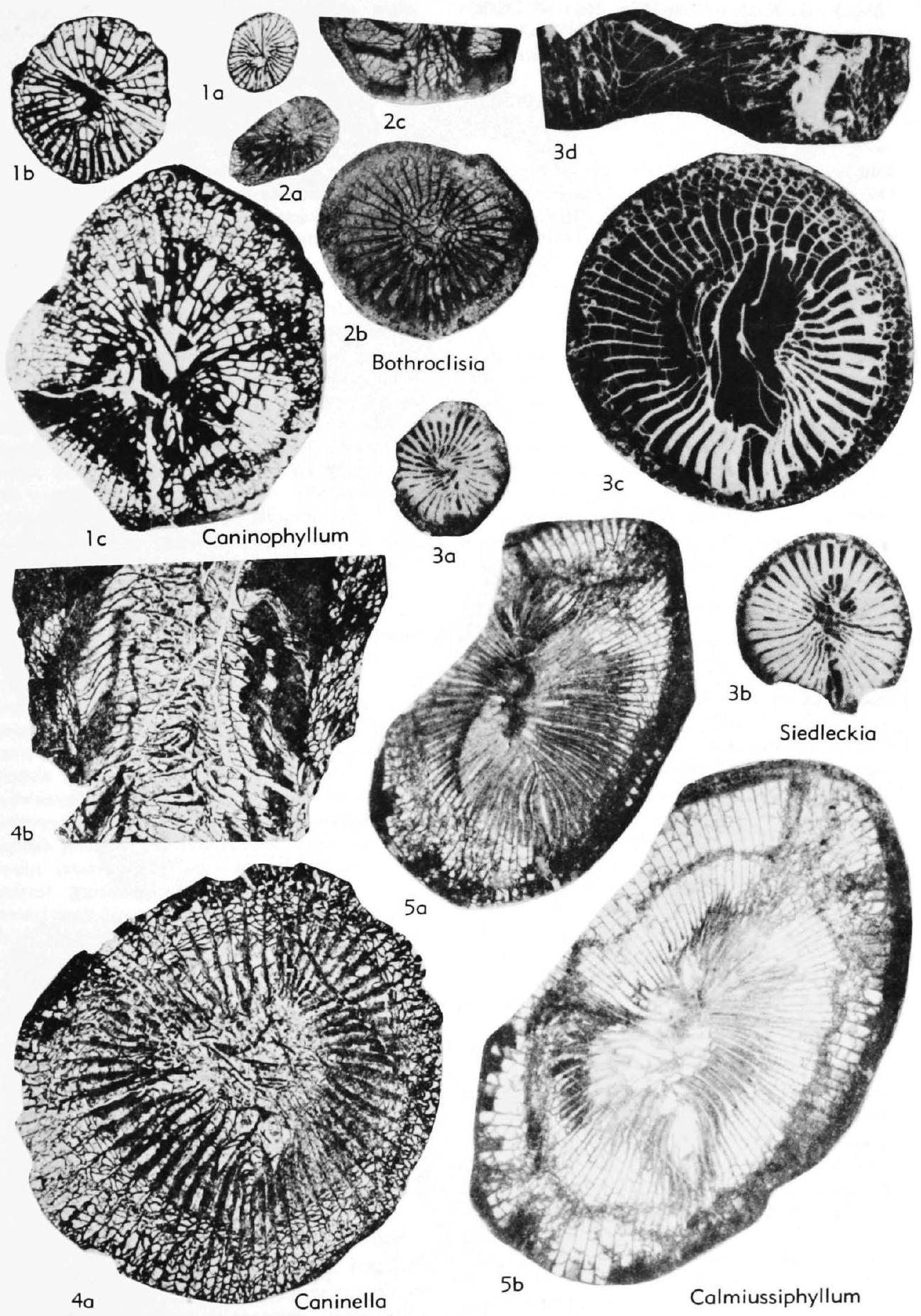 Fig. 228,la-c. *c. archiaei (MILNE- EDWARDS & HAIME), holotype, L.Carb. (Visean) , Wales, L1anymynech, near Oswestry; a-c, transv. sees., X 0.8 (Lewis, 1929).
Synonyms
Bothrophyllum
Geographic Distribution
Eu. (Brit. I.-France-Belg.-USSR)-N. Afr.(Alg.) Asia(Kuzbas-?Laos-?Viet Nam-NE.USSR)- Australia(New S.Wales); U.Carb., Eu.(Donbas- ?Spits.); ?U.Carb.-L.Perm., Eu.(Spits.-Urals-Carnic Alps
Age Range
Beginning Stage in Treatise Usage:
L. Carb.
Beginning International Stage:
Tournaisian
Fraction Up In Beginning Stage:
0
Beginning Date:
359.3
Ending Stage in Treatise Usage:
L. Carb.
Ending International Stage:
Serpukhovian
Fraction Up In Ending Stage:
100
Ending Date:
323.4
Description
Solitary, moderately large; with numerous long septa somewhat thickened in tabularium or only in counter quadrants, thinning and rarely amplexoid toward axis; cardinal septum short, in fossula expanding toward axis, axial ends of neighboring metasepta may curve around fossula but do not meet, fossula marked by depression in tabular floors that projects into dissepimentarium; counter septum may remain long; thin axial ends of major septa may come together in groups at or near axis; dissepiments variable, small, concentric, anguloconcentric, or in places an angulate plate replaced by two inosculating plates; tabular floors flat medianly, with downturned edges.
References
Museum or Author Information
Classification
Phylum:
Cnidaria
Class:
Anthozoa
Subclass:
Rugosa
Order:
Stauriida
Suborder:
Caniniina
Family:
Bothrophyllidae
Formal Genus Name and Reference:
Caninophyllum LEWIS, 1929, p. 457
Type Species:
Cyathophyllum arehiaei MILNE EDWARDS & HAIME, 1852, p. 183; OD; +5462, Geol. Soc. coll., Leeds, and PF 1893-5, IGS, Leeds
Images
(Click to enlarge in a new window)
Fig. 228,la-c. *c. archiaei (MILNE- EDWARDS & HAIME), holotype, L.Carb. (Visean) , Wales, L1anymynech, near Oswestry; a-c, transv. sees., X 0.8 (Lewis, 1929).
Synonyms
Bothrophyllum
Geographic Distribution
Eu. (Brit. I.-France-Belg.-USSR)-N. Afr.(Alg.) Asia(Kuzbas-?Laos-?Viet Nam-NE.USSR)- Australia(New S.Wales); U.Carb., Eu.(Donbas- ?Spits.); ?U.Carb.-L.Perm., Eu.(Spits.-Urals-Carnic Alps
Age Range
Beginning Stage in Treatise Usage:
L. Carb.
Beginning International Stage:
Tournaisian
Fraction Up In Beginning Stage:
0
Beginning Date:
359.3
Ending Stage in Treatise Usage:
L. Carb.
Ending International Stage:
Serpukhovian
Fraction Up In Ending Stage:
100
Ending Date:
323.4
Description
Solitary, moderately large; with numerous long septa somewhat thickened in tabularium or only in counter quadrants, thinning and rarely amplexoid toward axis; cardinal septum short, in fossula expanding toward axis, axial ends of neighboring metasepta may curve around fossula but do not meet, fossula marked by depression in tabular floors that projects into dissepimentarium; counter septum may remain long; thin axial ends of major septa may come together in groups at or near axis; dissepiments variable, small, concentric, anguloconcentric, or in places an angulate plate replaced by two inosculating plates; tabular floors flat medianly, with downturned edges.