
Welcome to the Cnidaria subsite on Invertebrate Paleontology!
Please enter a genera name to retrieve more information.

Catenipora
Classification
Phylum:
Cnidaria
Class:
Anthozoa
Subclass:
Tabulata
Order:
Heliolitida
Suborder:
Halysitina
Family:
Halysitidae
Subfamily:
Cateniporina
Formal Genus Name and Reference:
Catenipora LAMARCK, 1816, p. 206
Type Species:
C. escharoides, SD Lang, Smith, & Thomas, 1940, p. 33, †neotype, 4, Bromell Coll., PM, Uppsala, by Thomas & SMITH, 1954, p. 768
Images
(Click to enlarge in a new window)
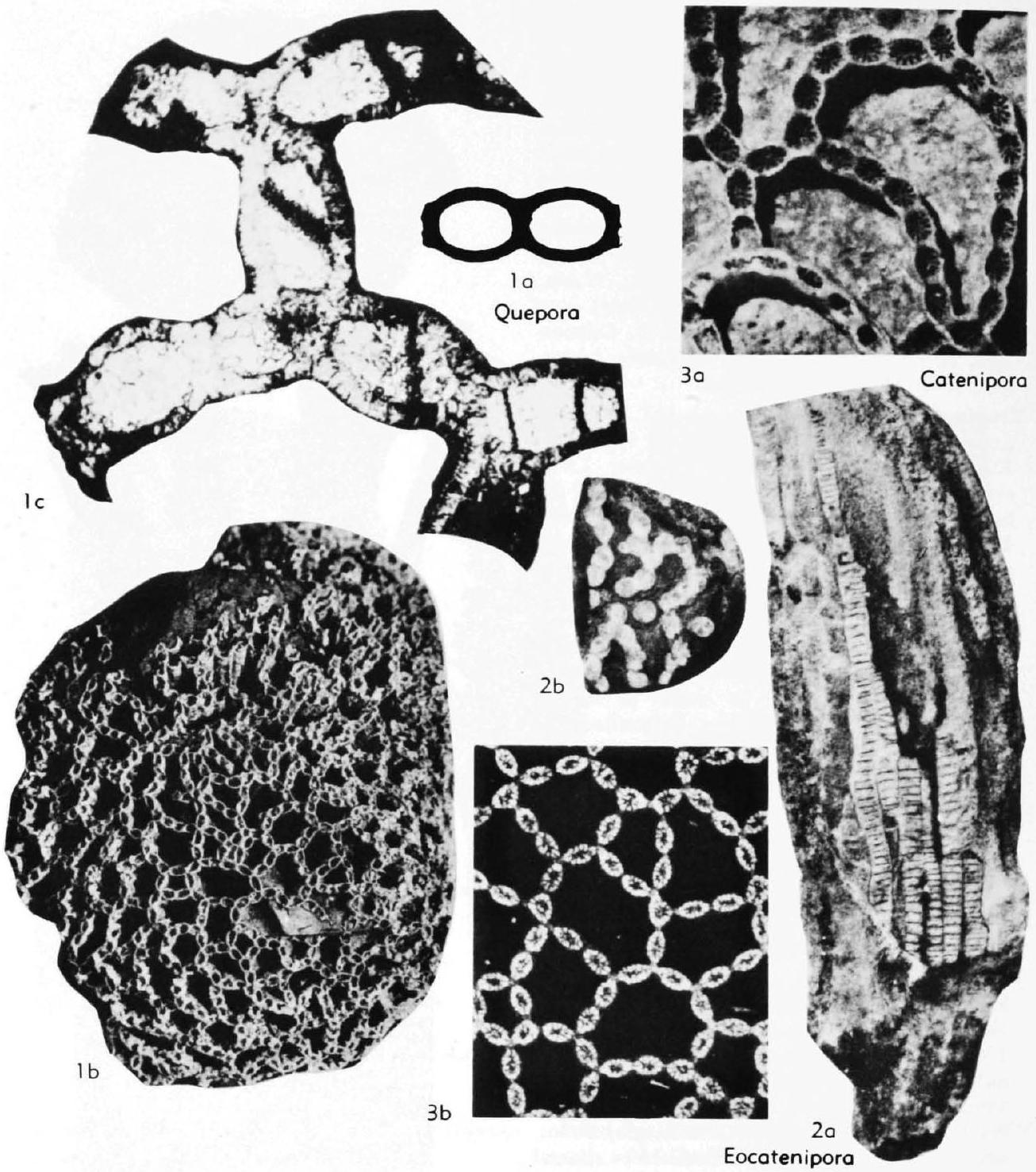 Fig. 428,3a,b. *C. escharoides, a, neotype, Sil., Gotl., ext. view, X4, b, another specimen, up. Llandov., L. Visby marls, Gotl., beach N. of Visby, transv. sec., X4 (Thomas& Smith, 1954)
Synonyms
Palaeohalysites
Geographic Distribution
N.Am.(Can.-Arctic-Texas)-Eu. (Ire.-Est. )-Asia (Taymyr-R. Kolyma-Altay Mts. )-Australia(New S.Wales), L.Sil.-M.Sil., Eu. (Eng.-Nor.-Gotl.-Est. )-Asia (Afghan.-Uzbek.-Kazakh.-N.Sib.-Taymyr)-Australia(New S.Wales)N.Am., U.Sil. (9a), Eu.(Nor.)
Age Range
Beginning Stage in Treatise Usage:
U.Ord.
Beginning International Stage:
Sandbian
Fraction Up In Beginning Stage:
0
Beginning Date:
458.18
Ending Stage in Treatise Usage:
U.Ord.
Ending International Stage:
Hirnantian
Fraction Up In Ending Stage:
100
Ending Date:
443.07
Description
Corallum halysitoid, corallites of each rank elongate and elliptical or angulate-elliptical in section, without intervening coenenchymal tubules, offsets may arise from either edge of corallite, septal spines in 12 longitudinal rows, commonly well developed, tabulae mostly horizontal [See THOMAS & SMITH, 1954, p. 768; KLAAMANN, 1966, p. 29; WEBBY & SEMENIUK, 1969, p. 357. LENZ, 1964, p. 373, illustrates short cylindrical canals connecting lacunae through lines of junction of three ranks.]
References
Museum or Author Information
Classification
Phylum:
Cnidaria
Class:
Anthozoa
Subclass:
Tabulata
Order:
Heliolitida
Suborder:
Halysitina
Family:
Halysitidae
Subfamily:
Cateniporina
Formal Genus Name and Reference:
Catenipora LAMARCK, 1816, p. 206
Type Species:
C. escharoides, SD Lang, Smith, & Thomas, 1940, p. 33, †neotype, 4, Bromell Coll., PM, Uppsala, by Thomas & SMITH, 1954, p. 768
Images
(Click to enlarge in a new window)
Fig. 428,3a,b. *C. escharoides, a, neotype, Sil., Gotl., ext. view, X4, b, another specimen, up. Llandov., L. Visby marls, Gotl., beach N. of Visby, transv. sec., X4 (Thomas& Smith, 1954)
Synonyms
Palaeohalysites
Geographic Distribution
N.Am.(Can.-Arctic-Texas)-Eu. (Ire.-Est. )-Asia (Taymyr-R. Kolyma-Altay Mts. )-Australia(New S.Wales), L.Sil.-M.Sil., Eu. (Eng.-Nor.-Gotl.-Est. )-Asia (Afghan.-Uzbek.-Kazakh.-N.Sib.-Taymyr)-Australia(New S.Wales)N.Am., U.Sil. (9a), Eu.(Nor.)
Age Range
Beginning Stage in Treatise Usage:
U.Ord.
Beginning International Stage:
Sandbian
Fraction Up In Beginning Stage:
0
Beginning Date:
458.18
Ending Stage in Treatise Usage:
U.Ord.
Ending International Stage:
Hirnantian
Fraction Up In Ending Stage:
100
Ending Date:
443.07
Description
Corallum halysitoid, corallites of each rank elongate and elliptical or angulate-elliptical in section, without intervening coenenchymal tubules, offsets may arise from either edge of corallite, septal spines in 12 longitudinal rows, commonly well developed, tabulae mostly horizontal [See THOMAS & SMITH, 1954, p. 768; KLAAMANN, 1966, p. 29; WEBBY & SEMENIUK, 1969, p. 357. LENZ, 1964, p. 373, illustrates short cylindrical canals connecting lacunae through lines of junction of three ranks.]