
Welcome to the Cnidaria subsite on Invertebrate Paleontology!
Please enter a genera name to retrieve more information.

Cyathoclisia
Classification
Phylum:
Cnidaria
Class:
Anthozoa
Subclass:
Rugosa
Order:
Stauriida
Suborder:
Aulophyllina
Family:
Aulophyllidae
Subfamily:
Clisiophyllinae
Formal Genus Name and Reference:
Cyathoclisia DINGWALL, 1926, p. 13
Type Species:
C. tabernaculum, OD, †R16756, BM(NH), London
Images
(Click to enlarge in a new window)
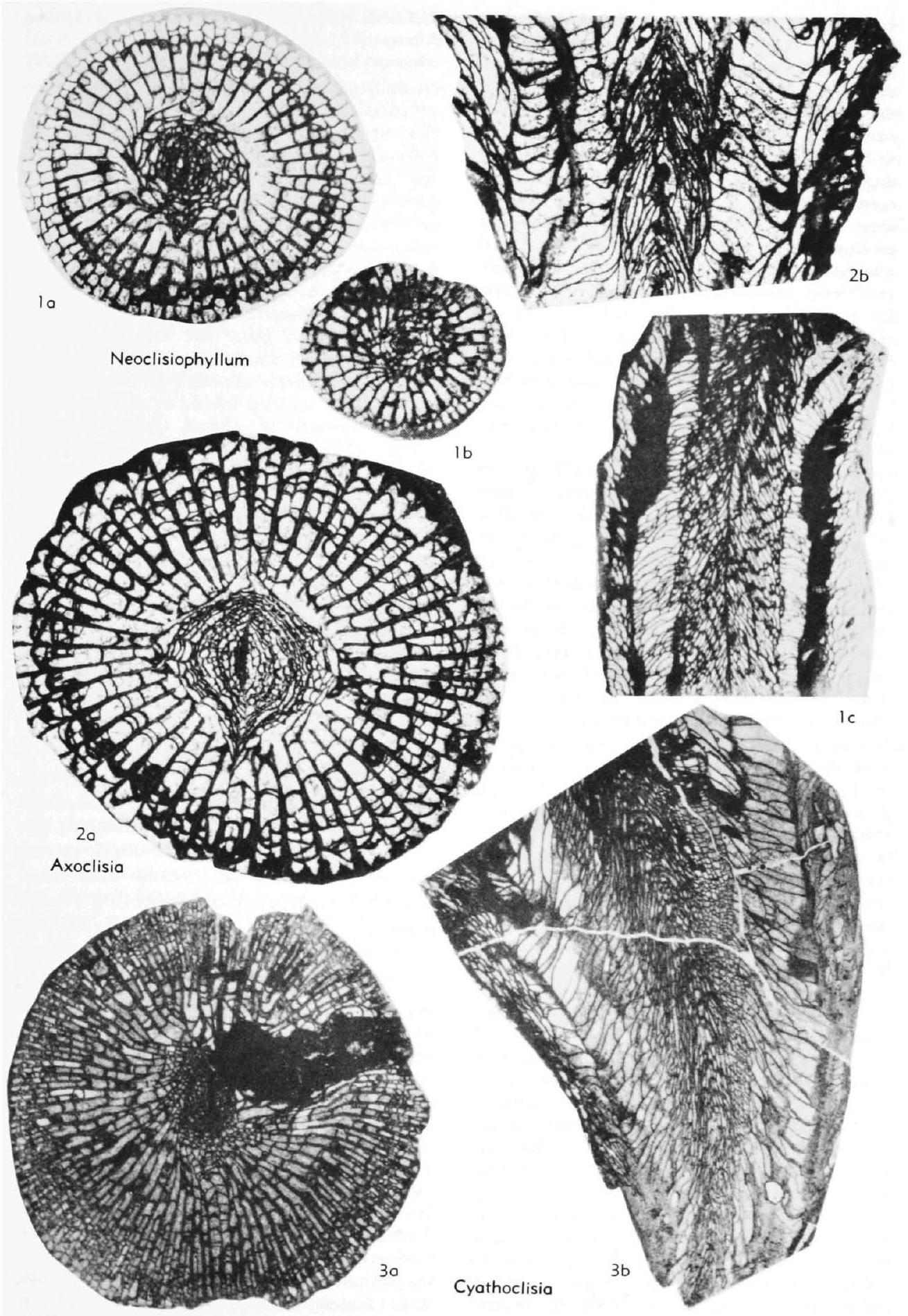 Fig. 236,3a,b. *C. tabernaculum, horizon Y, Brit. I., Burrington Combe, Somerset; a, holotype, transv. sec., X 1.8; b, another specimen, long. sec., X3.6 (Dingwall, 1926).
Synonyms
Clisaxophyllum, Clisiaxophyllum, ?Kolymophyllum
Geographic Distribution
Eu.(Brit.I.-Belg.-Donbas-Tatar. ASSR-Urals-?N. Zemlya)-Asia (Kuzbas-Armenia)
Age Range
Beginning Stage in Treatise Usage:
L.Carb.(up.Tournais.)
Beginning International Stage:
Tournaisian
Fraction Up In Beginning Stage:
66
Beginning Date:
351
Ending Stage in Treatise Usage:
L.Carb.(Visean)
Ending International Stage:
Visean
Fraction Up In Ending Stage:
100
Ending Date:
330.34
Description
Solitary, moderately large, with axial structure not defined by bounding wall, but projecting from calice as conical structure formed of short, nuclear medial plate, of very crowded, flattened, steeply declined tabellae, and of numerous septal lamellae that are continuous with major septa and somewhat convolute, fossula long, expariding into tabularium, with short or thin cardinal septum, septa may be dilated in tabularium, more markedly in cardinal quadrants, minor septa with long axial parts extending into tabularium and lying closer to counter side of major septa, dissepimentarium rather narrow with normal concentric dissepiments
References
Dingwall, J. M. M., 1926, Cyathoclisia, a new genus of Carboniferous coral: Geol. Soc. London, Q.J., v. 82, pt. 1, p. 12-21, pl. 1-3.
Museum or Author Information
Classification
Phylum:
Cnidaria
Class:
Anthozoa
Subclass:
Rugosa
Order:
Stauriida
Suborder:
Aulophyllina
Family:
Aulophyllidae
Subfamily:
Clisiophyllinae
Formal Genus Name and Reference:
Cyathoclisia DINGWALL, 1926, p. 13
Type Species:
C. tabernaculum, OD, †R16756, BM(NH), London
Images
(Click to enlarge in a new window)
Fig. 236,3a,b. *C. tabernaculum, horizon Y, Brit. I., Burrington Combe, Somerset; a, holotype, transv. sec., X 1.8; b, another specimen, long. sec., X3.6 (Dingwall, 1926).
Synonyms
Clisaxophyllum, Clisiaxophyllum, ?Kolymophyllum
Geographic Distribution
Eu.(Brit.I.-Belg.-Donbas-Tatar. ASSR-Urals-?N. Zemlya)-Asia (Kuzbas-Armenia)
Age Range
Beginning Stage in Treatise Usage:
L.Carb.(up.Tournais.)
Beginning International Stage:
Tournaisian
Fraction Up In Beginning Stage:
66
Beginning Date:
351
Ending Stage in Treatise Usage:
L.Carb.(Visean)
Ending International Stage:
Visean
Fraction Up In Ending Stage:
100
Ending Date:
330.34
Description
Solitary, moderately large, with axial structure not defined by bounding wall, but projecting from calice as conical structure formed of short, nuclear medial plate, of very crowded, flattened, steeply declined tabellae, and of numerous septal lamellae that are continuous with major septa and somewhat convolute, fossula long, expariding into tabularium, with short or thin cardinal septum, septa may be dilated in tabularium, more markedly in cardinal quadrants, minor septa with long axial parts extending into tabularium and lying closer to counter side of major septa, dissepimentarium rather narrow with normal concentric dissepiments
References
Dingwall, J. M. M., 1926, Cyathoclisia, a new genus of Carboniferous coral: Geol. Soc. London, Q.J., v. 82, pt. 1, p. 12-21, pl. 1-3.