
Welcome to the Cnidaria subsite on Invertebrate Paleontology!
Please enter a genera name to retrieve more information.
Dinophyllum
Classification
Phylum:
Cnidaria
Class:
Anthozoa
Subclass:
Rugosa
Order:
Stauriida
Suborder:
Streptelasmatina
Family:
Streptelasmatidae
Subfamily:
Dinophyllinae
Formal Genus Name and Reference:
Dinophyllum LINDSTRÖM, 1882b, p. 21
Type Species:
D. involutum; M; figured syntypes Cn44a, 20687-20693, 55155-55157, RM, Stockholm
Images
(Click to enlarge in a new window)
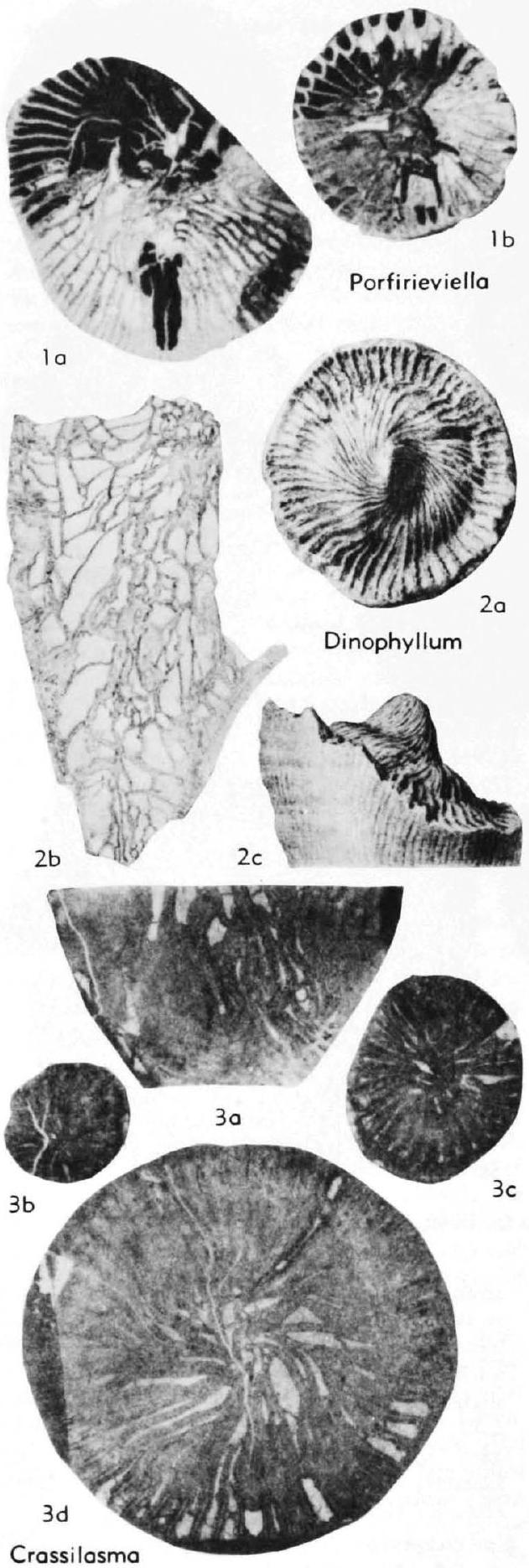 Fig. 91,2a-c.*D. hisingeri (MILNE-EDWARDS & HAIME), L.Sil., Gotl.; a,c, calical views, X1; b, long. sec., X2 (Lindstrom, 1896b).
Synonyms
Streptophyllum, Dinophyllum involutum, ?Neobrachyelasma, ?Porfirieviella, ?Tenuilasma
Geographic Distribution
Eu. (Gotl.-Nor.-Vaygach I.) Asia (Sib.Platf.)-Australia(Queensl.); ?M.Sil., Eu.-Asia(Sib.Platf.)-Australia (Queensl.)
Age Range
Beginning Stage in Treatise Usage:
L. Sil.
Beginning International Stage:
Rhuddanian
Fraction Up In Beginning Stage:
0
Beginning Date:
443.07
Ending Stage in Treatise Usage:
L. Sil.
Ending International Stage:
Homerian
Fraction Up In Ending Stage:
100
Ending Date:
426.74
Description
Solitary, curved, conical or conicocylindrical coralla, cardinal fossula moderately deep and wide, on convex side, major septa long, thin in late stages, reaching to axis where, with or without convolution of their axial ends, they form an axial structure (and calical boss) with steeply conical tabulae, septal lamellae, ?and vermiform lobes; minor septa extremely short; no dissepiments.
References
Museum or Author Information
Classification
Phylum:
Cnidaria
Class:
Anthozoa
Subclass:
Rugosa
Order:
Stauriida
Suborder:
Streptelasmatina
Family:
Streptelasmatidae
Subfamily:
Dinophyllinae
Formal Genus Name and Reference:
Dinophyllum LINDSTRÖM, 1882b, p. 21
Type Species:
D. involutum; M; figured syntypes Cn44a, 20687-20693, 55155-55157, RM, Stockholm
Images
(Click to enlarge in a new window)
Fig. 91,2a-c.*D. hisingeri (MILNE-EDWARDS & HAIME), L.Sil., Gotl.; a,c, calical views, X1; b, long. sec., X2 (Lindstrom, 1896b).
Synonyms
Streptophyllum, Dinophyllum involutum, ?Neobrachyelasma, ?Porfirieviella, ?Tenuilasma
Geographic Distribution
Eu. (Gotl.-Nor.-Vaygach I.) Asia (Sib.Platf.)-Australia(Queensl.); ?M.Sil., Eu.-Asia(Sib.Platf.)-Australia (Queensl.)
Age Range
Beginning Stage in Treatise Usage:
L. Sil.
Beginning International Stage:
Rhuddanian
Fraction Up In Beginning Stage:
0
Beginning Date:
443.07
Ending Stage in Treatise Usage:
L. Sil.
Ending International Stage:
Homerian
Fraction Up In Ending Stage:
100
Ending Date:
426.74
Description
Solitary, curved, conical or conicocylindrical coralla, cardinal fossula moderately deep and wide, on convex side, major septa long, thin in late stages, reaching to axis where, with or without convolution of their axial ends, they form an axial structure (and calical boss) with steeply conical tabulae, septal lamellae, ?and vermiform lobes; minor septa extremely short; no dissepiments.