
Welcome to the Cnidaria subsite on Invertebrate Paleontology!
Please enter a genera name to retrieve more information.

Disphyllum
Classification
Phylum:
Cnidaria
Class:
Anthozoa
Subclass:
Rugosa
Order:
Stauriida
Suborder:
Columnariina
Family:
Disphyllidae
Subfamily:
Disphyllinae
Formal Genus Name and Reference:
Disphyllum de FROMENTEL, 1861, p. 302
Type Species:
Cyathophyllum caespitosum Goldfuss, 1826, p. 60, SD Lang & Smith, 1934, p. 80, †205, Goldfuss Coll., IP, Bonn, lectotype by Lang & SMITH, 1934, p. 80
Images
(Click to enlarge in a new window)
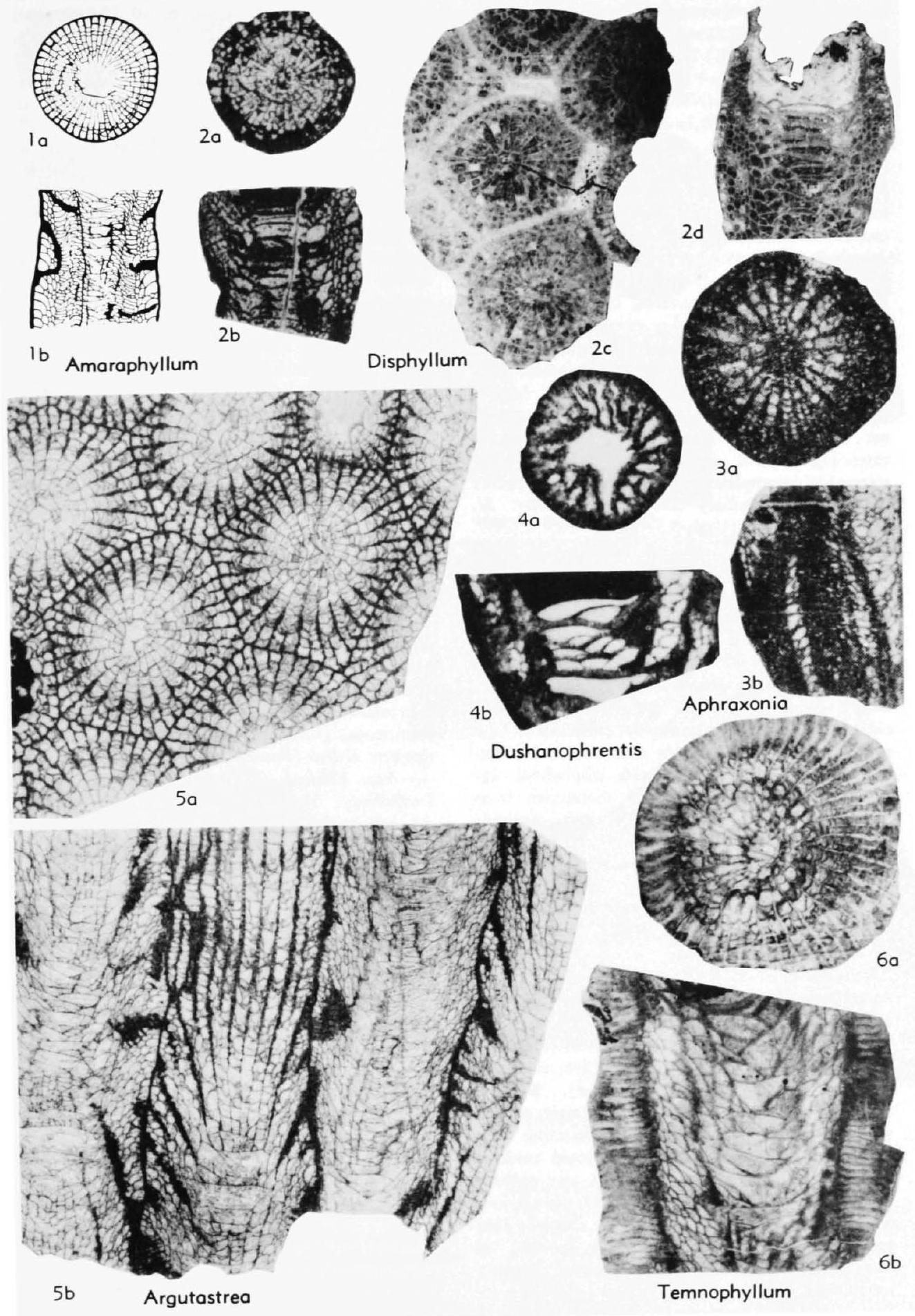 Fig. 169,2a-d. *D. caespitosum (GOLDFUSS), lectotype, M.Dev. or ?Frasn., Ger., Bensberg; a, transv. sec., X2 (Smith, 1946), b, long. sec., X2 (Lang & Smith, 1935), c,d, transv., long. secs., X2 (Hill, n; photographs courtesy R. Birenheide).
Synonyms
Cannophyllum, Schlueteria, Megaphyllum, ?Pseudostringophyllum, ?Minussiella, ?Solominella, ?Amaraphyllum, ?Pseudodisphyllum, ?Temnophylloides
Geographic Distribution
Asia(NE.USSR); M.Dev.(Couvin.}, Eu.(Belg.); M.Dev.(Givet.}, Eu. (U.K.-Belg.-Ger.-Pol.-Czech.-Aus.) Asia (Kazakh.-Kuzbas-Szechwan-Kwangsi)-Australia (W. Australia-Queens!.); V.Dev.(Fram.), Eu.(U.K. Belg.-Ger.-Spain-Pol-USSR)-N. Afr. (Alg.)-Asia (Armenia-Turkey-Kuzbas-Pak.-Kwangsi-NE. USSR)-W. Australia-N. Am.(NW. Terr.-Iowa-Nev.-?Que.-Mich.
Age Range
Beginning Stage in Treatise Usage:
L.Dev.(Ems.)
Beginning International Stage:
Emsian
Fraction Up In Beginning Stage:
0
Beginning Date:
410.51
Ending Stage in Treatise Usage:
L.Dev.(Ems.)
Ending International Stage:
Emsian
Fraction Up In Ending Stage:
100
Ending Date:
394.3
Description
Phaceloid to subcerioid, with lateral or peripheral increase; septa complete, dilated in some, carinae absent or weak; trabeculae monacanths commonly arranged in half fans; dissepiments in several series of small, subequal plates, globose and subglobose, innermost being highly inclined and outermost commonly somewhat peneckielloid; horseshoe dissepiments not developed; tabulae commonly in two series, axial series of flat, concave, or slightly mesa-shaped plates and periaxial series of large, inclined, and dissepimentlike plates [see HILL & JELL, 1970b, p. 37; ROZKOWSKA & FEDOROWSKI, 1972, p. 296]
References
Museum or Author Information
Classification
Phylum:
Cnidaria
Class:
Anthozoa
Subclass:
Rugosa
Order:
Stauriida
Suborder:
Columnariina
Family:
Disphyllidae
Subfamily:
Disphyllinae
Formal Genus Name and Reference:
Disphyllum de FROMENTEL, 1861, p. 302
Type Species:
Cyathophyllum caespitosum Goldfuss, 1826, p. 60, SD Lang & Smith, 1934, p. 80, †205, Goldfuss Coll., IP, Bonn, lectotype by Lang & SMITH, 1934, p. 80
Images
(Click to enlarge in a new window)
Fig. 169,2a-d. *D. caespitosum (GOLDFUSS), lectotype, M.Dev. or ?Frasn., Ger., Bensberg; a, transv. sec., X2 (Smith, 1946), b, long. sec., X2 (Lang & Smith, 1935), c,d, transv., long. secs., X2 (Hill, n; photographs courtesy R. Birenheide).
Synonyms
Cannophyllum, Schlueteria, Megaphyllum, ?Pseudostringophyllum, ?Minussiella, ?Solominella, ?Amaraphyllum, ?Pseudodisphyllum, ?Temnophylloides
Geographic Distribution
Asia(NE.USSR); M.Dev.(Couvin.}, Eu.(Belg.); M.Dev.(Givet.}, Eu. (U.K.-Belg.-Ger.-Pol.-Czech.-Aus.) Asia (Kazakh.-Kuzbas-Szechwan-Kwangsi)-Australia (W. Australia-Queens!.); V.Dev.(Fram.), Eu.(U.K. Belg.-Ger.-Spain-Pol-USSR)-N. Afr. (Alg.)-Asia (Armenia-Turkey-Kuzbas-Pak.-Kwangsi-NE. USSR)-W. Australia-N. Am.(NW. Terr.-Iowa-Nev.-?Que.-Mich.
Age Range
Beginning Stage in Treatise Usage:
L.Dev.(Ems.)
Beginning International Stage:
Emsian
Fraction Up In Beginning Stage:
0
Beginning Date:
410.51
Ending Stage in Treatise Usage:
L.Dev.(Ems.)
Ending International Stage:
Emsian
Fraction Up In Ending Stage:
100
Ending Date:
394.3
Description
Phaceloid to subcerioid, with lateral or peripheral increase; septa complete, dilated in some, carinae absent or weak; trabeculae monacanths commonly arranged in half fans; dissepiments in several series of small, subequal plates, globose and subglobose, innermost being highly inclined and outermost commonly somewhat peneckielloid; horseshoe dissepiments not developed; tabulae commonly in two series, axial series of flat, concave, or slightly mesa-shaped plates and periaxial series of large, inclined, and dissepimentlike plates [see HILL & JELL, 1970b, p. 37; ROZKOWSKA & FEDOROWSKI, 1972, p. 296]