
Welcome to the Cnidaria subsite on Invertebrate Paleontology!
Please enter a genera name to retrieve more information.
Donacophyllum
Classification
Phylum:
Cnidaria
Class:
Anthozoa
Subclass:
Rugosa
Order:
Stauriida
Suborder:
Ketophyllina
Family:
Kyphophyllidae
Formal Genus Name and Reference:
Donacophyllum Dybowski, 1873c, p. 336, 1874, p. 460
Type Species:
D. Schrenkii, SD WEDEKIND, 1927, p. 34, +Co1281, EGM, Tallinn
Images
(Click to enlarge in a new window)
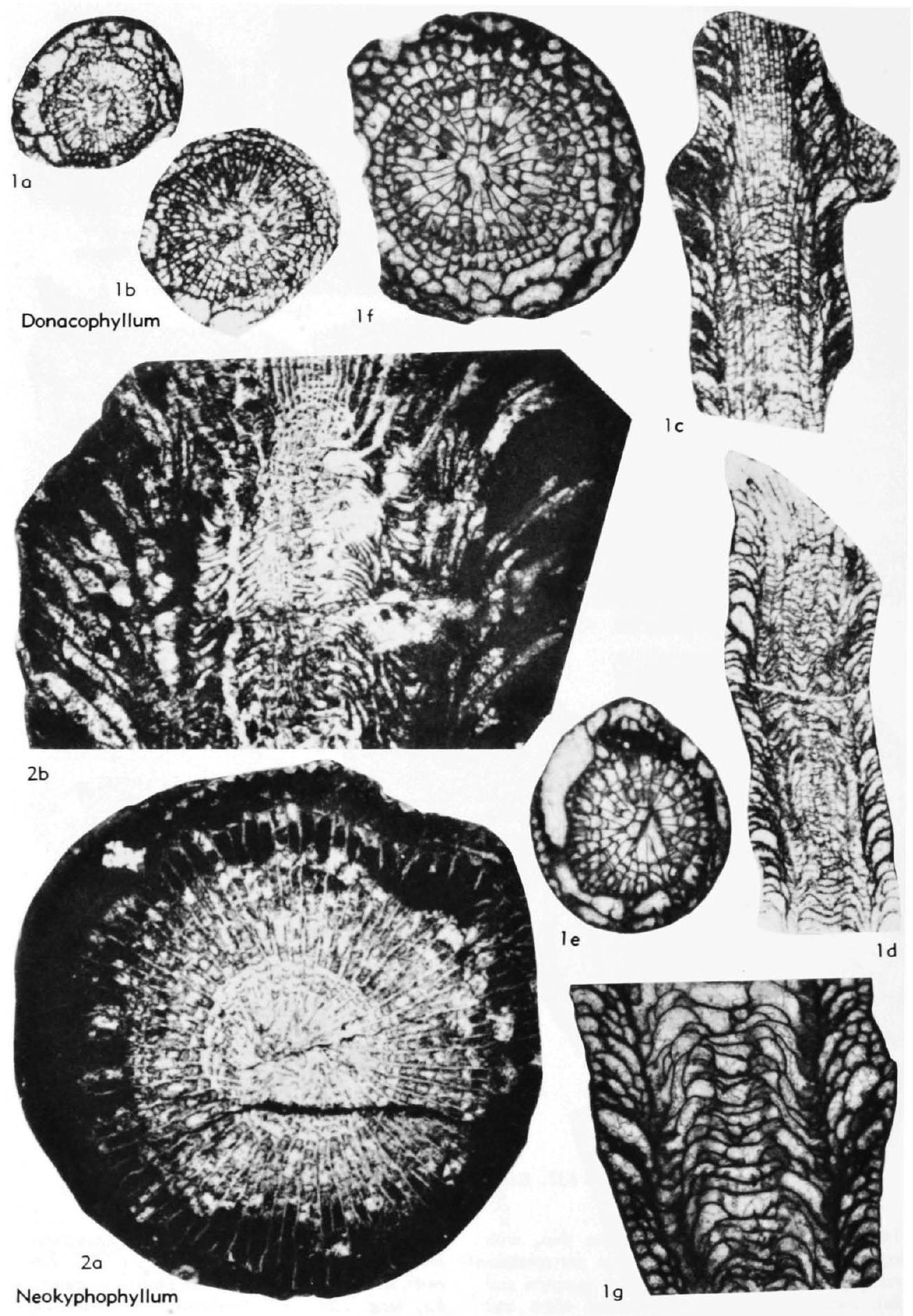 Fig. 138,1a-d. *D. schrenkii, monotype, L.Sil. (Llandov., G3), Est., Pühhat, a, b, transv. secs., X2.3, c, d, long. secs., X2.4, X2.0 (Kaljo, 1958b). --Fig. 138,le-g. D. lindstroemi (Wedekind), holotype, Hogklint beds, Gotl., N. of Stenkyrke huk, e, f, transv. secs., g, long. sec., all X3.0 (Hill, n; negatives courtesy Riksmuseet, Stockholm, RM Cn54877-54879).
Synonyms
Strombodes, Kyphophyllum, Cyphophyllum
Geographic Distribution
Eu.(Est.), L.Sil., Eu.(Est.)-Asia (Sib.Platf.)-Australia(New S.Wales), M.Sil., Eu. (Gotl.), U.Sil., ?Eu. (Podolia)-Asia (Kazakh.-Tadzhik.-Urals)-?Australia (New S. Wales)
Age Range
Beginning Stage in Treatise Usage:
U.Ord.
Beginning International Stage:
Sandbian
Fraction Up In Beginning Stage:
0
Beginning Date:
458.18
Ending Stage in Treatise Usage:
U.Ord.
Ending International Stage:
Hirnantian
Fraction Up In Ending Stage:
100
Ending Date:
443.07
Description
Phaceloid, in type species with periodic rejuvenescence of corallites indicated by expansions and subsequent contractions of dissepimentaria, or solitary, septa thin, not carinate, long major septa not convolute but a little withdrawn from axis, one may be longer, tabular floors domes with axial depression and margins turned out or up, of large tabellae, dissepimentarium moderately wide, with large lonsdaleoid dissepiments as well as small globose interseptal dissepiments, cardinal fossula not distinct.
References
Museum or Author Information
Classification
Phylum:
Cnidaria
Class:
Anthozoa
Subclass:
Rugosa
Order:
Stauriida
Suborder:
Ketophyllina
Family:
Kyphophyllidae
Formal Genus Name and Reference:
Donacophyllum Dybowski, 1873c, p. 336, 1874, p. 460
Type Species:
D. Schrenkii, SD WEDEKIND, 1927, p. 34, +Co1281, EGM, Tallinn
Images
(Click to enlarge in a new window)
Fig. 138,1a-d. *D. schrenkii, monotype, L.Sil. (Llandov., G3), Est., Pühhat, a, b, transv. secs., X2.3, c, d, long. secs., X2.4, X2.0 (Kaljo, 1958b). --Fig. 138,le-g. D. lindstroemi (Wedekind), holotype, Hogklint beds, Gotl., N. of Stenkyrke huk, e, f, transv. secs., g, long. sec., all X3.0 (Hill, n; negatives courtesy Riksmuseet, Stockholm, RM Cn54877-54879).
Synonyms
Strombodes, Kyphophyllum, Cyphophyllum
Geographic Distribution
Eu.(Est.), L.Sil., Eu.(Est.)-Asia (Sib.Platf.)-Australia(New S.Wales), M.Sil., Eu. (Gotl.), U.Sil., ?Eu. (Podolia)-Asia (Kazakh.-Tadzhik.-Urals)-?Australia (New S. Wales)
Age Range
Beginning Stage in Treatise Usage:
U.Ord.
Beginning International Stage:
Sandbian
Fraction Up In Beginning Stage:
0
Beginning Date:
458.18
Ending Stage in Treatise Usage:
U.Ord.
Ending International Stage:
Hirnantian
Fraction Up In Ending Stage:
100
Ending Date:
443.07
Description
Phaceloid, in type species with periodic rejuvenescence of corallites indicated by expansions and subsequent contractions of dissepimentaria, or solitary, septa thin, not carinate, long major septa not convolute but a little withdrawn from axis, one may be longer, tabular floors domes with axial depression and margins turned out or up, of large tabellae, dissepimentarium moderately wide, with large lonsdaleoid dissepiments as well as small globose interseptal dissepiments, cardinal fossula not distinct.