
Welcome to the Cnidaria subsite on Invertebrate Paleontology!
Please enter a genera name to retrieve more information.
Embolophyllum
Classification
Phylum:
Cnidaria
Class:
Anthozoa
Subclass:
Rugosa
Order:
Stauriida
Suborder:
Ptenophyllina
Family:
Ptenophyllidae
Subfamily:
Ptenophyllinae
Formal Genus Name and Reference:
Embolophyllum PEDDER, 1967a, p. 10
Type Species:
Acanthophyllum asper HILL, 1940b, p. 252, OD, †F4270, UQ, Brisbane
Images
(Click to enlarge in a new window)
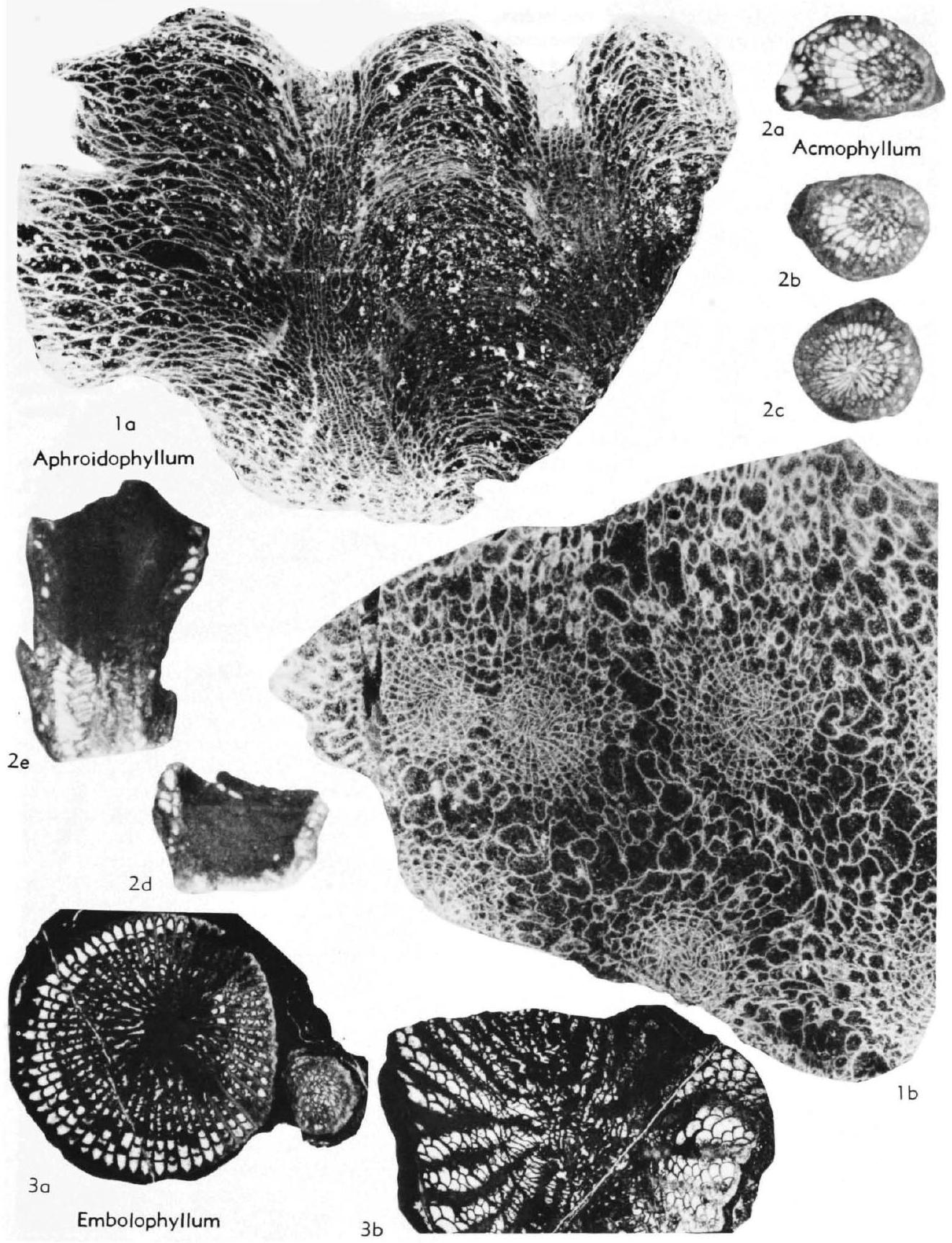 Fig. 147,3a,b. *E. asper (Hill), holotype, Ems., New S.Wales, Cave Flat road from Wee Jasper, a, b, transv., long. secs., X2 (Hill, 1940b).
Synonyms
Geographic Distribution
N.Am. (Calif.), L.Dev., Australia(Vict.-New S.Wales-Queensl.)-N.Am.(Md.)-Asia(NE.USSR), ?M.Dev., Asia(NE.USSR)
Age Range
Beginning Stage in Treatise Usage:
U.Sil.
Beginning International Stage:
Gorstian
Fraction Up In Beginning Stage:
0
Beginning Date:
426.74
Ending Stage in Treatise Usage:
U.Sil.
Ending International Stage:
Pridoli
Fraction Up In Ending Stage:
100
Ending Date:
419
Description
Corallum dendroid or phaceloid, corallites large, at first ceratoid to trochoid, later subcylindrical, calice deep, steep-sided, peripheral stereozone thin to moderately thick, septa radial to weakly pinnate in arrangement, typically expanded at peripheral edge and rarely withdrawn from periphery, septal flanges strongly to moderately developed in tabularium, $K m$ may be longer than other minor septa, septa of contiguous monacanthine trabeculae directed inward and upward and also curving slightly toward axis, dissepimentarium wide, dissepiments numerous, small, subglobose, tabulae incomplete, of wide subplanar tabellae, closely spaced and characteristically declined toward axis
References
Museum or Author Information
Classification
Phylum:
Cnidaria
Class:
Anthozoa
Subclass:
Rugosa
Order:
Stauriida
Suborder:
Ptenophyllina
Family:
Ptenophyllidae
Subfamily:
Ptenophyllinae
Formal Genus Name and Reference:
Embolophyllum PEDDER, 1967a, p. 10
Type Species:
Acanthophyllum asper HILL, 1940b, p. 252, OD, †F4270, UQ, Brisbane
Images
(Click to enlarge in a new window)
Fig. 147,3a,b. *E. asper (Hill), holotype, Ems., New S.Wales, Cave Flat road from Wee Jasper, a, b, transv., long. secs., X2 (Hill, 1940b).
Synonyms
Geographic Distribution
N.Am. (Calif.), L.Dev., Australia(Vict.-New S.Wales-Queensl.)-N.Am.(Md.)-Asia(NE.USSR), ?M.Dev., Asia(NE.USSR)
Age Range
Beginning Stage in Treatise Usage:
U.Sil.
Beginning International Stage:
Gorstian
Fraction Up In Beginning Stage:
0
Beginning Date:
426.74
Ending Stage in Treatise Usage:
U.Sil.
Ending International Stage:
Pridoli
Fraction Up In Ending Stage:
100
Ending Date:
419
Description
Corallum dendroid or phaceloid, corallites large, at first ceratoid to trochoid, later subcylindrical, calice deep, steep-sided, peripheral stereozone thin to moderately thick, septa radial to weakly pinnate in arrangement, typically expanded at peripheral edge and rarely withdrawn from periphery, septal flanges strongly to moderately developed in tabularium, $K m$ may be longer than other minor septa, septa of contiguous monacanthine trabeculae directed inward and upward and also curving slightly toward axis, dissepimentarium wide, dissepiments numerous, small, subglobose, tabulae incomplete, of wide subplanar tabellae, closely spaced and characteristically declined toward axis