
Welcome to the Cnidaria subsite on Invertebrate Paleontology!
Please enter a genera name to retrieve more information.
Emmonsia
Classification
Phylum:
Cnidaria
Class:
Anthozoa
Subclass:
Tabulata
Order:
Favositida
Suborder:
Favositina
Superfamily:
Favositicae
Family:
Favositidae
Subfamily:
Emmonsiinae
Formal Genus Name and Reference:
Emmonsia Milne-Edwards & HAIME, 1851, p. 152
Type Species:
E. hemispherica (Yandell & Shumard) Milne-Edwards & Haime, 1851, p. 247, SD ROEMER, 1883, p. 423
Images
(Click to enlarge in a new window)
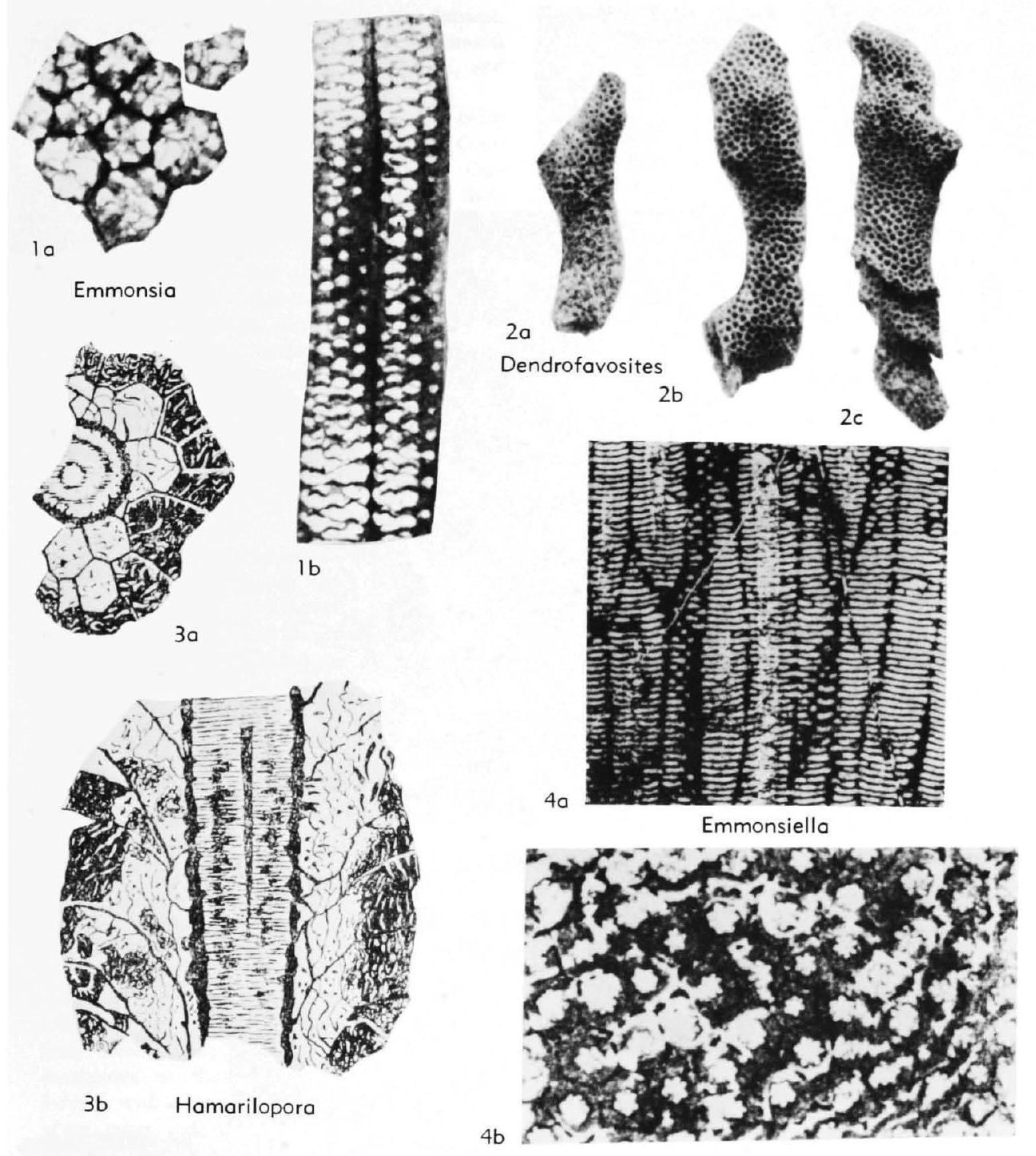 Fig. 364,1a,b. *E. emmonsii (Rominger), M.Dev., Ind., Ky., Falls of the Ohio, a, b, transv., long. secs., X5 (Hill,mathrm{n}, UQF4357). [E. hemispherica MILNE-EDWARDS & HAIME embraces two forms, Favosites alveolaris (GOLDFUSS) HALL, 1843, p. 158 (renamed Favosites emmonsii HALL, 1876, explanation of pI. ix) and F. hemispherica YANDELL & SHUMARD, 1847, p. 7; F. emmonsii HALL also embraces two forms, Emmonsia emmonsii (HALL) and Favosites halli FENTON & FENTON, 1936, p. 27; FENTON & FENTON (1936, p. 23) designated E. emmonsii (HALL) restricted FENTON & FENTON (1936, p. 35) as lectotype species of Emmonsia, and chose 3426/8, NYSM, Albany, as its lectotype. See LANG, SMITH, & THOMAS, 1940, p. 56. STUMM, 1965, p. 66, regards Favosites emmonsii ROMINGER, 1876 (p. 27, pI. 7, fig. 1, 8449, lectotype, UMMP, Ann Arbor, by STUMM, 1965, p. 66} as conspecific with E. emmonsii (HALL) as restricted by FENTON & FENTON, and also as having priority in publication.]
Synonyms
Geographic Distribution
Asia(Urals-Viet Nam), N. Am. (N. Y.-Ind.-Ky.-Ohio-Mich.-Ont.)
Age Range
Beginning Stage in Treatise Usage:
M.Dev.
Beginning International Stage:
Eifelian
Fraction Up In Beginning Stage:
0
Beginning Date:
394.3
Ending Stage in Treatise Usage:
M.Dev.
Ending International Stage:
Givetian
Fraction Up In Ending Stage:
100
Ending Date:
378.9
Description
Corallum cerioid, hemispherical or tuberose, corallites prismatic, walls thin to moderately thick, with squamulae that project almost to axis, favositoid spines rare to ?absent, pores numerous, large, commonly triserial, tabulae thin, subordinate to and commonly suspended from inner ends of squamulae.
References
Museum or Author Information
Classification
Phylum:
Cnidaria
Class:
Anthozoa
Subclass:
Tabulata
Order:
Favositida
Suborder:
Favositina
Superfamily:
Favositicae
Family:
Favositidae
Subfamily:
Emmonsiinae
Formal Genus Name and Reference:
Emmonsia Milne-Edwards & HAIME, 1851, p. 152
Type Species:
E. hemispherica (Yandell & Shumard) Milne-Edwards & Haime, 1851, p. 247, SD ROEMER, 1883, p. 423
Images
(Click to enlarge in a new window)
Fig. 364,1a,b. *E. emmonsii (Rominger), M.Dev., Ind., Ky., Falls of the Ohio, a, b, transv., long. secs., X5 (Hill,mathrm{n}, UQF4357). [E. hemispherica MILNE-EDWARDS & HAIME embraces two forms, Favosites alveolaris (GOLDFUSS) HALL, 1843, p. 158 (renamed Favosites emmonsii HALL, 1876, explanation of pI. ix) and F. hemispherica YANDELL & SHUMARD, 1847, p. 7; F. emmonsii HALL also embraces two forms, Emmonsia emmonsii (HALL) and Favosites halli FENTON & FENTON, 1936, p. 27; FENTON & FENTON (1936, p. 23) designated E. emmonsii (HALL) restricted FENTON & FENTON (1936, p. 35) as lectotype species of Emmonsia, and chose 3426/8, NYSM, Albany, as its lectotype. See LANG, SMITH, & THOMAS, 1940, p. 56. STUMM, 1965, p. 66, regards Favosites emmonsii ROMINGER, 1876 (p. 27, pI. 7, fig. 1, 8449, lectotype, UMMP, Ann Arbor, by STUMM, 1965, p. 66} as conspecific with E. emmonsii (HALL) as restricted by FENTON & FENTON, and also as having priority in publication.]
Synonyms
Geographic Distribution
Asia(Urals-Viet Nam), N. Am. (N. Y.-Ind.-Ky.-Ohio-Mich.-Ont.)
Age Range
Beginning Stage in Treatise Usage:
M.Dev.
Beginning International Stage:
Eifelian
Fraction Up In Beginning Stage:
0
Beginning Date:
394.3
Ending Stage in Treatise Usage:
M.Dev.
Ending International Stage:
Givetian
Fraction Up In Ending Stage:
100
Ending Date:
378.9
Description
Corallum cerioid, hemispherical or tuberose, corallites prismatic, walls thin to moderately thick, with squamulae that project almost to axis, favositoid spines rare to ?absent, pores numerous, large, commonly triserial, tabulae thin, subordinate to and commonly suspended from inner ends of squamulae.