
Welcome to the Cnidaria subsite on Invertebrate Paleontology!
Please enter a genera name to retrieve more information.

Entelophyllum
Classification
Phylum:
Cnidaria
Class:
Anthozoa
Subclass:
Rugosa
Order:
Stauriida
Suborder:
Arachinophyllina
Family:
Entelophyllidae
Formal Genus Name and Reference:
Entelophyllum WEDEKIND, 1927, p. 22
Type Species:
Madreporites articulatus Wahlenberg, 1821, p. 97, SD Lang, Smith, & Thomas, 1940, p. 57, tneotype, Cn54823, Hisinger Coll., RM, Stockholm, by Smith & TREMBERTH, 1929, p. 363
Images
(Click to enlarge in a new window)
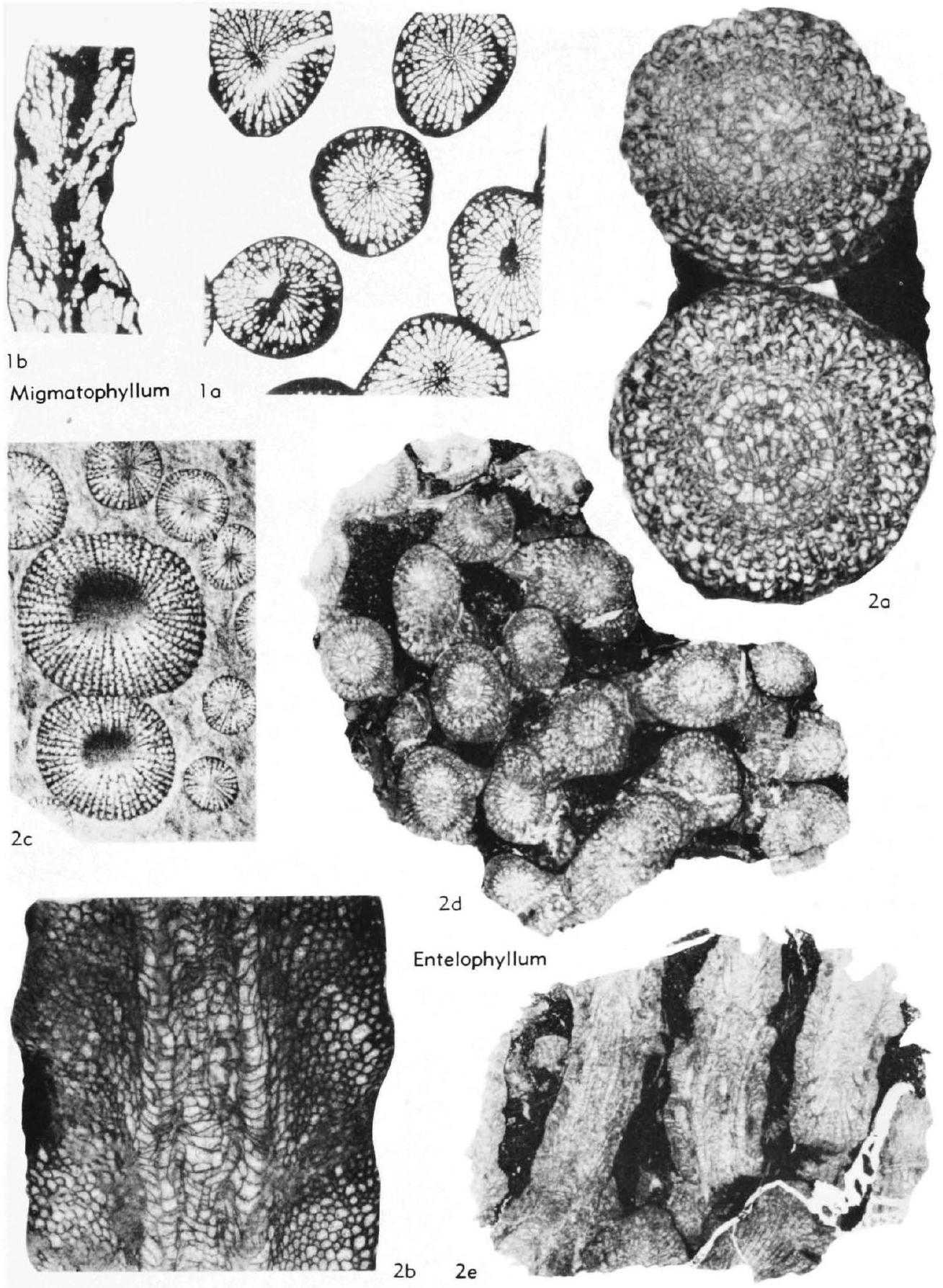
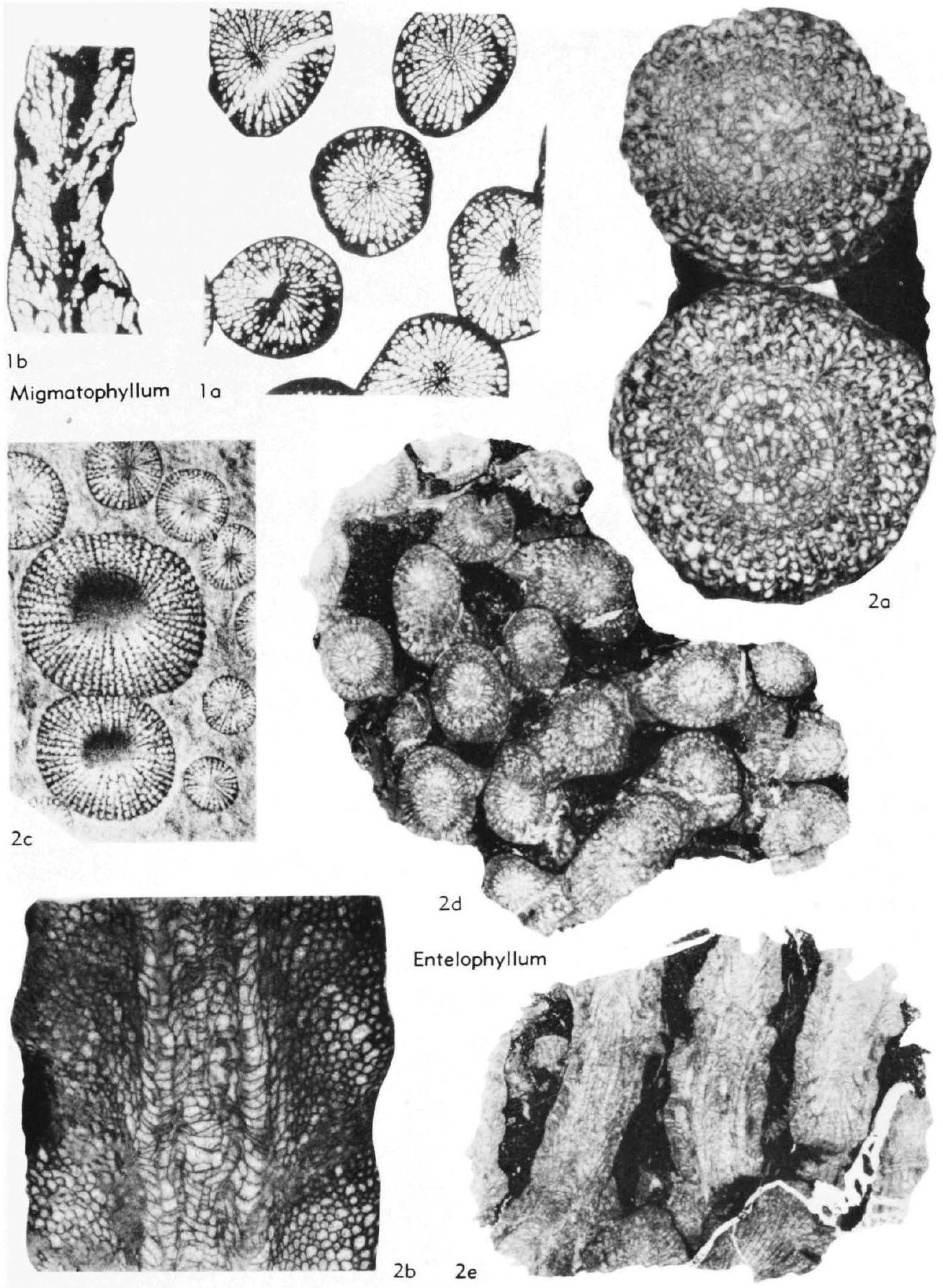 Fig. 127,2a,b. *E. articulatum (Wahlenberg), neotype, Gotl., a, b, transv., long. secs., X3 (Hill, n).-Fıg. 127,2c. ?E. pseudodianthus (Weissermel), lectotype, Pleist. drift, E. Prussia, Lauth, calical view, X2 (Weissermel, 1894). --Fig. 127,2d,e. ?E. confusum (Počta), syntypes, U.Sil., Czech., d, e, transv., long. secs., X2 (Hill, Altaja Zheltonogova in Markovskiy, 1960) n; photographs courtesy W. A. Oliver)
Synonyms
Xylodes, ?Stereoxylodes , ?Carinophyllum
Geographic Distribution
Eu. (U.K.-Nor.-Swed.-Est.-Podolia-Urals)-Asia (Sib. Platf.-C. Asia-China)-?Australia (New S. Wales-Queensl.)-N. Am. (Que.-Alaska)
Age Range
Beginning Stage in Treatise Usage:
Sil.
Beginning International Stage:
Rhuddanian
Fraction Up In Beginning Stage:
0
Beginning Date:
443.07
Ending Stage in Treatise Usage:
Sil.
Ending International Stage:
Pridoli
Fraction Up In Ending Stage:
100
Ending Date:
419
Description
Fasciculate, septa long, radially arranged, smooth or asymmetrically carinate, major septa slightly withdrawn from axis, minor septa may be contratingent in some, tabular floors broad domes commonly with depressed centers and marginal troughs formed by small subhorizontal or concave peripheral tabellae, dissepiments small, globose, numerous, and interseptal, fossula commonly indistinct
References
Museum or Author Information
Classification
Phylum:
Cnidaria
Class:
Anthozoa
Subclass:
Rugosa
Order:
Stauriida
Suborder:
Arachinophyllina
Family:
Entelophyllidae
Formal Genus Name and Reference:
Entelophyllum WEDEKIND, 1927, p. 22
Type Species:
Madreporites articulatus Wahlenberg, 1821, p. 97, SD Lang, Smith, & Thomas, 1940, p. 57, tneotype, Cn54823, Hisinger Coll., RM, Stockholm, by Smith & TREMBERTH, 1929, p. 363
Images
(Click to enlarge in a new window)
Fig. 127,2a,b. *E. articulatum (Wahlenberg), neotype, Gotl., a, b, transv., long. secs., X3 (Hill, n).-Fıg. 127,2c. ?E. pseudodianthus (Weissermel), lectotype, Pleist. drift, E. Prussia, Lauth, calical view, X2 (Weissermel, 1894). --Fig. 127,2d,e. ?E. confusum (Počta), syntypes, U.Sil., Czech., d, e, transv., long. secs., X2 (Hill, Altaja Zheltonogova in Markovskiy, 1960) n; photographs courtesy W. A. Oliver)
Synonyms
Xylodes, ?Stereoxylodes , ?Carinophyllum
Geographic Distribution
Eu. (U.K.-Nor.-Swed.-Est.-Podolia-Urals)-Asia (Sib. Platf.-C. Asia-China)-?Australia (New S. Wales-Queensl.)-N. Am. (Que.-Alaska)
Age Range
Beginning Stage in Treatise Usage:
Sil.
Beginning International Stage:
Rhuddanian
Fraction Up In Beginning Stage:
0
Beginning Date:
443.07
Ending Stage in Treatise Usage:
Sil.
Ending International Stage:
Pridoli
Fraction Up In Ending Stage:
100
Ending Date:
419
Description
Fasciculate, septa long, radially arranged, smooth or asymmetrically carinate, major septa slightly withdrawn from axis, minor septa may be contratingent in some, tabular floors broad domes commonly with depressed centers and marginal troughs formed by small subhorizontal or concave peripheral tabellae, dissepiments small, globose, numerous, and interseptal, fossula commonly indistinct