
Welcome to the Cnidaria subsite on Invertebrate Paleontology!
Please enter a genera name to retrieve more information.
Enterolasma
Classification
Phylum:
Cnidaria
Class:
Anthozoa
Subclass:
Rugosa
Order:
Stauriida
Suborder:
Streptelasmatina
Family:
Streptelasmatidae
Subfamily:
Enterolasmatinae
Formal Genus Name and Reference:
Enterolasma SIMPSON, 1900, p. 203
Type Species:
Streptelasma strictum HALL, 1874, p. 114, OD, syntypes, 258259, 11051-11053, NYSM, Albany, and 2283, AMNH, New York
Images
(Click to enlarge in a new window)
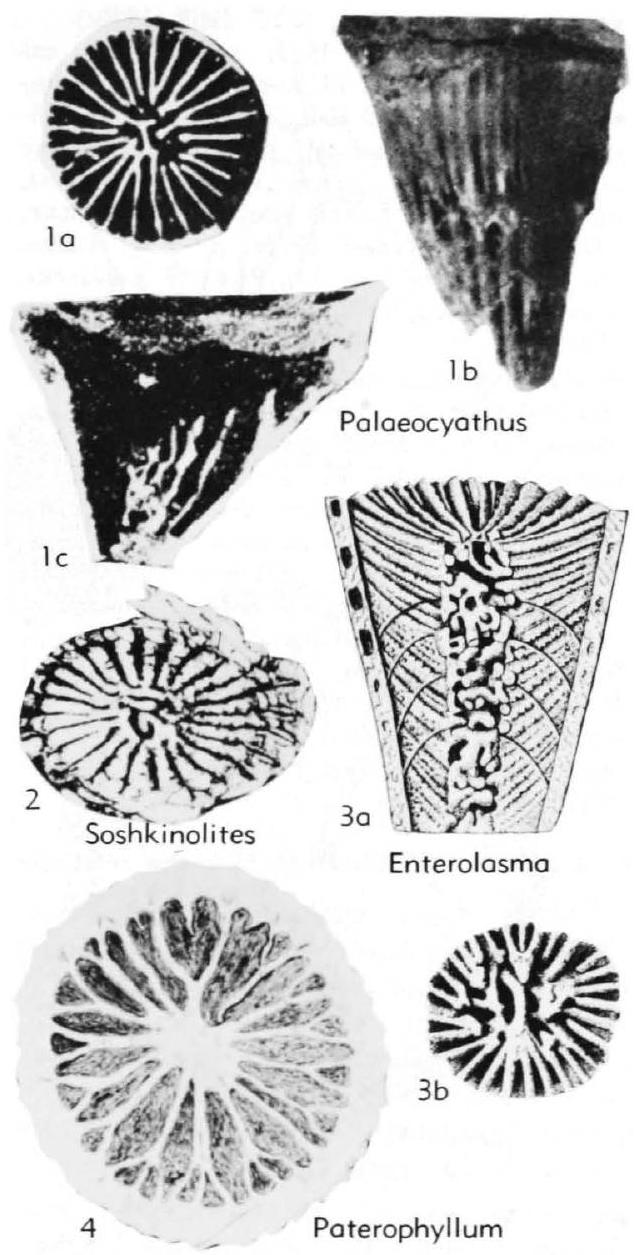 Fig. 94, 3a.b. *E. strictum (Hall), L.Dev.(Helderberg.), N.Y., Clarksville, a, natural long. sec., enl., b, axial ends of major septa in natural transv. sec., enl. (Simpson, 1900)
Synonyms
Palaeocyathus
Geographic Distribution
N.Am.(N.Y.-Okla.Tenn.), L.Dev.(Ems.), Eu.(Spain)
Age Range
Beginning Stage in Treatise Usage:
U.Sil.
Beginning International Stage:
Gorstian
Fraction Up In Beginning Stage:
0
Beginning Date:
426.74
Ending Stage in Treatise Usage:
L.Dev.
Ending International Stage:
Emsian
Fraction Up In Ending Stage:
100
Ending Date:
394.3
Description
Small, cylindroconical, commonly erect, narrow peripheral stereozone formed by thickening of peripheral ends of major and short minor septa, major septa ridged, furrowed or waved parallel to distal edges, their axial edges lobed and variably coalescent, axial edges of minor septa free, cardinal and counter septa long, tabulae domed, or, in some, tabular films parallel to distal edges of septa [see SUTHERLAND, 1965, p. 22; WEYER,
1974a, p. 161]
References
Simpson, G. B., 1900, Preliminary descriptions of new genera of Palaeozoic rugose corals: N.Y. State Mus., Bull., v. 8, no. 39, p. 199-222, textfig. 1-45.
Museum or Author Information
Classification
Phylum:
Cnidaria
Class:
Anthozoa
Subclass:
Rugosa
Order:
Stauriida
Suborder:
Streptelasmatina
Family:
Streptelasmatidae
Subfamily:
Enterolasmatinae
Formal Genus Name and Reference:
Enterolasma SIMPSON, 1900, p. 203
Type Species:
Streptelasma strictum HALL, 1874, p. 114, OD, syntypes, 258259, 11051-11053, NYSM, Albany, and 2283, AMNH, New York
Images
(Click to enlarge in a new window)
Fig. 94, 3a.b. *E. strictum (Hall), L.Dev.(Helderberg.), N.Y., Clarksville, a, natural long. sec., enl., b, axial ends of major septa in natural transv. sec., enl. (Simpson, 1900)
Synonyms
Palaeocyathus
Geographic Distribution
N.Am.(N.Y.-Okla.Tenn.), L.Dev.(Ems.), Eu.(Spain)
Age Range
Beginning Stage in Treatise Usage:
U.Sil.
Beginning International Stage:
Gorstian
Fraction Up In Beginning Stage:
0
Beginning Date:
426.74
Ending Stage in Treatise Usage:
L.Dev.
Ending International Stage:
Emsian
Fraction Up In Ending Stage:
100
Ending Date:
394.3
Description
Small, cylindroconical, commonly erect, narrow peripheral stereozone formed by thickening of peripheral ends of major and short minor septa, major septa ridged, furrowed or waved parallel to distal edges, their axial edges lobed and variably coalescent, axial edges of minor septa free, cardinal and counter septa long, tabulae domed, or, in some, tabular films parallel to distal edges of septa [see SUTHERLAND, 1965, p. 22; WEYER,
1974a, p. 161]
References
Simpson, G. B., 1900, Preliminary descriptions of new genera of Palaeozoic rugose corals: N.Y. State Mus., Bull., v. 8, no. 39, p. 199-222, textfig. 1-45.