
Welcome to the Cnidaria subsite on Invertebrate Paleontology!
Please enter a genera name to retrieve more information.

Halysites
Classification
Phylum:
Cnidaria
Class:
Anthozoa
Subclass:
Tabulata
Order:
Heliolitida
Suborder:
Halysitina
Family:
Halysitidae
Subfamily:
Halysitinae
Formal Genus Name and Reference:
Halysites Fischer von WALDHEIM, 1828, p. 15
Type Species:
Tubipora catenularia Linné, 1767a, p. 1270, OD, tneotype, 1, Bromell Coll., PM, Uppsala, by Thomas & SMITH, 1954, p. 797
Images
(Click to enlarge in a new window)
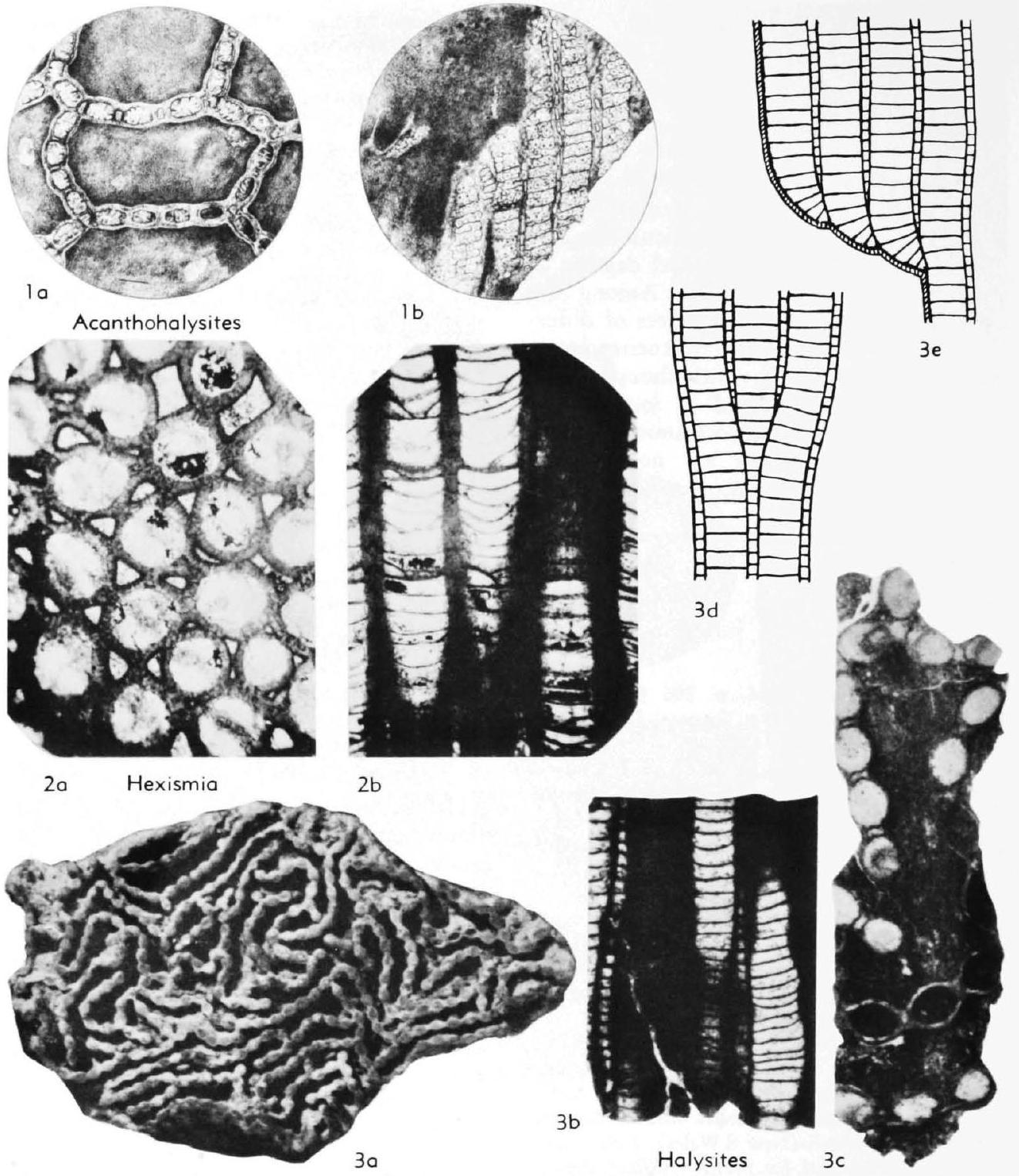 Fig. 429,3a-e. *H. catenularius (Linné), Sil., Gotl., a-c, neotype, a, ext. view, X1, b, c, long., transv. secs., X4 (Thomas & Smith, 1954); d,e, diagr., interstitial and peripheral increase (Webby & Semeniuk, 1969).
Synonyms
Alyssites
Geographic Distribution
Australia (New S. Wales)-New Guinea (W.Irian), L.Sil.-U.Sil., cosmop.
Age Range
Beginning Stage in Treatise Usage:
M.Ord.(up. Easton.)
Beginning International Stage:
Sandbian
Fraction Up In Beginning Stage:
96.1
Beginning Date:
452.96
Ending Stage in Treatise Usage:
M.Ord.(up. Easton.)
Ending International Stage:
Katian
Fraction Up In Ending Stage:
56.9
Ending Date:
448.46
Description
Corallum with corallites rounded to elliptical in section, arranged uniserially in ranks that connect with one another to enclose longitudinal lacunae, corallites with thick walls and complete tabulae, septal ridges or septal spines weakly developed to absent, corallites within ranks separated by a single prismatic coenenchymal tubule, which is quadrangular and either square or oblong in section, at connections between ranks is a larger interstitial tubule of less regular section, within ranks, new corallites arise by expansion in diameter of coenenchymal tubule and subsequently a new coenenchymal tubule develops on each side of the offset, other new corallites may arise peripherally from the corallite at the end of a rank, a dividing tubule being subsequently developed, diaphragms in tubules horizontal, complete.
References
Museum or Author Information
Classification
Phylum:
Cnidaria
Class:
Anthozoa
Subclass:
Tabulata
Order:
Heliolitida
Suborder:
Halysitina
Family:
Halysitidae
Subfamily:
Halysitinae
Formal Genus Name and Reference:
Halysites Fischer von WALDHEIM, 1828, p. 15
Type Species:
Tubipora catenularia Linné, 1767a, p. 1270, OD, tneotype, 1, Bromell Coll., PM, Uppsala, by Thomas & SMITH, 1954, p. 797
Images
(Click to enlarge in a new window)
Fig. 429,3a-e. *H. catenularius (Linné), Sil., Gotl., a-c, neotype, a, ext. view, X1, b, c, long., transv. secs., X4 (Thomas & Smith, 1954); d,e, diagr., interstitial and peripheral increase (Webby & Semeniuk, 1969).
Synonyms
Alyssites
Geographic Distribution
Australia (New S. Wales)-New Guinea (W.Irian), L.Sil.-U.Sil., cosmop.
Age Range
Beginning Stage in Treatise Usage:
M.Ord.(up. Easton.)
Beginning International Stage:
Sandbian
Fraction Up In Beginning Stage:
96.1
Beginning Date:
452.96
Ending Stage in Treatise Usage:
M.Ord.(up. Easton.)
Ending International Stage:
Katian
Fraction Up In Ending Stage:
56.9
Ending Date:
448.46
Description
Corallum with corallites rounded to elliptical in section, arranged uniserially in ranks that connect with one another to enclose longitudinal lacunae, corallites with thick walls and complete tabulae, septal ridges or septal spines weakly developed to absent, corallites within ranks separated by a single prismatic coenenchymal tubule, which is quadrangular and either square or oblong in section, at connections between ranks is a larger interstitial tubule of less regular section, within ranks, new corallites arise by expansion in diameter of coenenchymal tubule and subsequently a new coenenchymal tubule develops on each side of the offset, other new corallites may arise peripherally from the corallite at the end of a rank, a dividing tubule being subsequently developed, diaphragms in tubules horizontal, complete.