
Welcome to the Cnidaria subsite on Invertebrate Paleontology!
Please enter a genera name to retrieve more information.

Hapsiphyllum
Classification
Phylum:
Cnidaria
Class:
Anthozoa
Subclass:
Rugosa
Order:
Stauriida
Suborder:
Stereolasmatina
Family:
Hapsiphyllidae
Subfamily:
Hapsiphyllinae
Formal Genus Name and Reference:
Hapsiphyllum SIMPSON, 1900, p. 203
Type Species:
Zaphrentis calcariformis HALL, 1882, p. 33, OD; SIMPSON'S specimens, which may be HALL'S syntypes, are probably 11969-11976, NYSM, Albany, fide B. M. BELL, written commun.; HALL'S designated horizon and locality of "Comiferous limestone; Falls of the Ohio" is in error, see WORTHEN, 1890, p. 76; =Zaphrentis cassedayi MILNE EDWARDS, 1860, p. 341, +not traced, ?Paris, L.Carb., St. Louis Gr., Ind., see GROVE, 1935, p. 362
Images
(Click to enlarge in a new window)
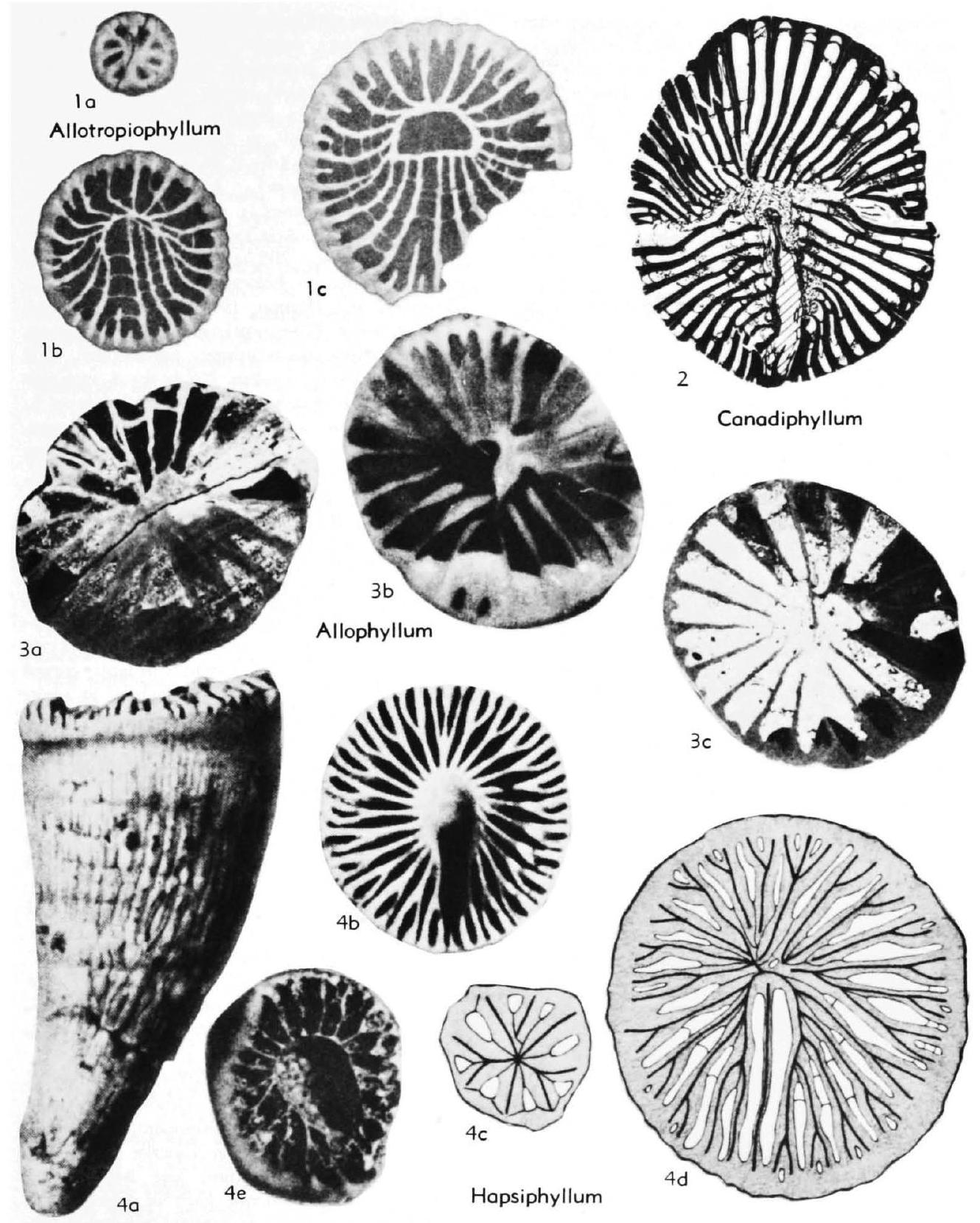 Fig. 204,4a-d. * H. cassedayi (MILNE-EDWARDS), Miss., Ind., St. Louis Gr.; a,b, lat., calical views, X4; c,d, transv. sees., XIS,
X8 (Schindewolf, 1938). --Fig. 204,4e. H. grabaui (GREENE), lectotype; calical view, X4 (Stumm, 1948d).
Fig. 204,4a-d. * H. cassedayi (MILNE-EDWARDS), Miss., Ind., St. Louis Gr.; a,b, lat., calical views, X4; c,d, transv. sees., XIS,
X8 (Schindewolf, 1938). --Fig. 204,4e. H. grabaui (GREENE), lectotype; calical view, X4 (Stumm, 1948d).
Synonyms
Enallophyllum
Geographic Distribution
Eu.(Spain); Miss., N.Am.(lnd.- Ky.-?N.Mex)
Age Range
Beginning Stage in Treatise Usage:
M.Dev.
Beginning International Stage:
Eifelian
Fraction Up In Beginning Stage:
0
Beginning Date:
394.3
Ending Stage in Treatise Usage:
M.Dev.
Ending International Stage:
Givetian
Fraction Up In Ending Stage:
100
Ending Date:
378.9
Description
Small, solitary, ceratoid or trochoid, fossula large on concave side, expanded axially, containing cardinal septum long in early stages, short in late stages, and bounded laterally and axially, in early stages at least, by fused axial ends of remaining major septa, minor septa long, contratingent, tabulae incomplete, floors conical with apex at inner edge of fossula, no dissepiments
References
Simpson, G. B., 1900, Preliminary descriptions of new genera of Palaeozoic rugose corals: N.Y. State Mus., Bull., v. 8, no. 39, p. 199-222, textfig. 1-45.
Museum or Author Information
Classification
Phylum:
Cnidaria
Class:
Anthozoa
Subclass:
Rugosa
Order:
Stauriida
Suborder:
Stereolasmatina
Family:
Hapsiphyllidae
Subfamily:
Hapsiphyllinae
Formal Genus Name and Reference:
Hapsiphyllum SIMPSON, 1900, p. 203
Type Species:
Zaphrentis calcariformis HALL, 1882, p. 33, OD; SIMPSON'S specimens, which may be HALL'S syntypes, are probably 11969-11976, NYSM, Albany, fide B. M. BELL, written commun.; HALL'S designated horizon and locality of "Comiferous limestone; Falls of the Ohio" is in error, see WORTHEN, 1890, p. 76; =Zaphrentis cassedayi MILNE EDWARDS, 1860, p. 341, +not traced, ?Paris, L.Carb., St. Louis Gr., Ind., see GROVE, 1935, p. 362
Images
(Click to enlarge in a new window)
Fig. 204,4a-d. * H. cassedayi (MILNE-EDWARDS), Miss., Ind., St. Louis Gr.; a,b, lat., calical views, X4; c,d, transv. sees., XIS,
X8 (Schindewolf, 1938). --Fig. 204,4e. H. grabaui (GREENE), lectotype; calical view, X4 (Stumm, 1948d).
Synonyms
Enallophyllum
Geographic Distribution
Eu.(Spain); Miss., N.Am.(lnd.- Ky.-?N.Mex)
Age Range
Beginning Stage in Treatise Usage:
M.Dev.
Beginning International Stage:
Eifelian
Fraction Up In Beginning Stage:
0
Beginning Date:
394.3
Ending Stage in Treatise Usage:
M.Dev.
Ending International Stage:
Givetian
Fraction Up In Ending Stage:
100
Ending Date:
378.9
Description
Small, solitary, ceratoid or trochoid, fossula large on concave side, expanded axially, containing cardinal septum long in early stages, short in late stages, and bounded laterally and axially, in early stages at least, by fused axial ends of remaining major septa, minor septa long, contratingent, tabulae incomplete, floors conical with apex at inner edge of fossula, no dissepiments
References
Simpson, G. B., 1900, Preliminary descriptions of new genera of Palaeozoic rugose corals: N.Y. State Mus., Bull., v. 8, no. 39, p. 199-222, textfig. 1-45.