
Welcome to the Cnidaria subsite on Invertebrate Paleontology!
Please enter a genera name to retrieve more information.

Heterastridium
Classification
Phylum:
Cnidaria
Class:
Hydrozoa
Order:
Hydroida
Suborder:
Gymnoblastina
Family:
Hydractiniidae
Formal Genus Name and Reference:
Heterastridium REUSS, 1865
Type Species:
H. conglobatum, SD DIENER, 1921
Images
(Click to enlarge in a new window)
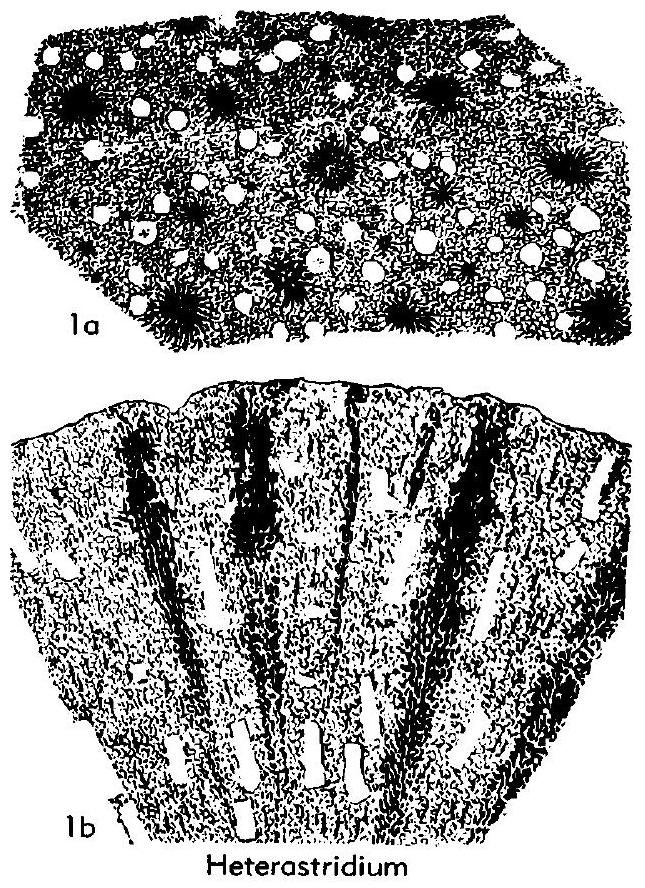 Fig. 72. *H. conglobatum [= H. pachystylum FRECH], U.Trias., Aus.; a,b, transv. and long sees., x5 (STEINMANN).
Synonyms
Stoliczkaria, Syringosphaera
Geographic Distribution
Eu.-Asia-Timor
Age Range
Beginning Stage in Treatise Usage:
Trias.
Beginning International Stage:
Induan
Fraction Up In Beginning Stage:
0
Beginning Date:
251.9
Ending Stage in Treatise Usage:
Trias.
Ending International Stage:
Rhaetian
Fraction Up In Ending Stage:
100
Ending Date:
201.36
Description
Spherical or nodular, commonly with minute cephalopod shell as nucleus, laminae and pillars finely perforate, the perforations of successive laminae lying above one another, forming fine, radial unwalled tubules (?dactylopores), with large radial cylindrical unwalled, discontinuous tubes (?gastropores, ?gonopores), without tabulae, surface tuberculations markedly stellate with skeletal tissue below them much thickened but not astrorhizal.
References
Museum or Author Information
Classification
Phylum:
Cnidaria
Class:
Hydrozoa
Order:
Hydroida
Suborder:
Gymnoblastina
Family:
Hydractiniidae
Formal Genus Name and Reference:
Heterastridium REUSS, 1865
Type Species:
H. conglobatum, SD DIENER, 1921
Images
(Click to enlarge in a new window)
Fig. 72. *H. conglobatum [= H. pachystylum FRECH], U.Trias., Aus.; a,b, transv. and long sees., x5 (STEINMANN).
Synonyms
Stoliczkaria, Syringosphaera
Geographic Distribution
Eu.-Asia-Timor
Age Range
Beginning Stage in Treatise Usage:
Trias.
Beginning International Stage:
Induan
Fraction Up In Beginning Stage:
0
Beginning Date:
251.9
Ending Stage in Treatise Usage:
Trias.
Ending International Stage:
Rhaetian
Fraction Up In Ending Stage:
100
Ending Date:
201.36
Description
Spherical or nodular, commonly with minute cephalopod shell as nucleus, laminae and pillars finely perforate, the perforations of successive laminae lying above one another, forming fine, radial unwalled tubules (?dactylopores), with large radial cylindrical unwalled, discontinuous tubes (?gastropores, ?gonopores), without tabulae, surface tuberculations markedly stellate with skeletal tissue below them much thickened but not astrorhizal.