
Welcome to the Cnidaria subsite on Invertebrate Paleontology!
Please enter a genera name to retrieve more information.

Heterocaninia
Classification
Phylum:
Cnidaria
Class:
Anthozoa
Subclass:
Rugosa
Order:
Stauriida
Suborder:
Aulophyllina
Family:
Aulophyllidae
Subfamily:
Heterocaniniinae
Formal Genus Name and Reference:
Heterocaninia Yabe & HAYASAKA, 1920, pl. xi, fig. 2a-d
Type Species:
H. tholusitabulata, M, 147151, TohU, Sendai
Images
(Click to enlarge in a new window)
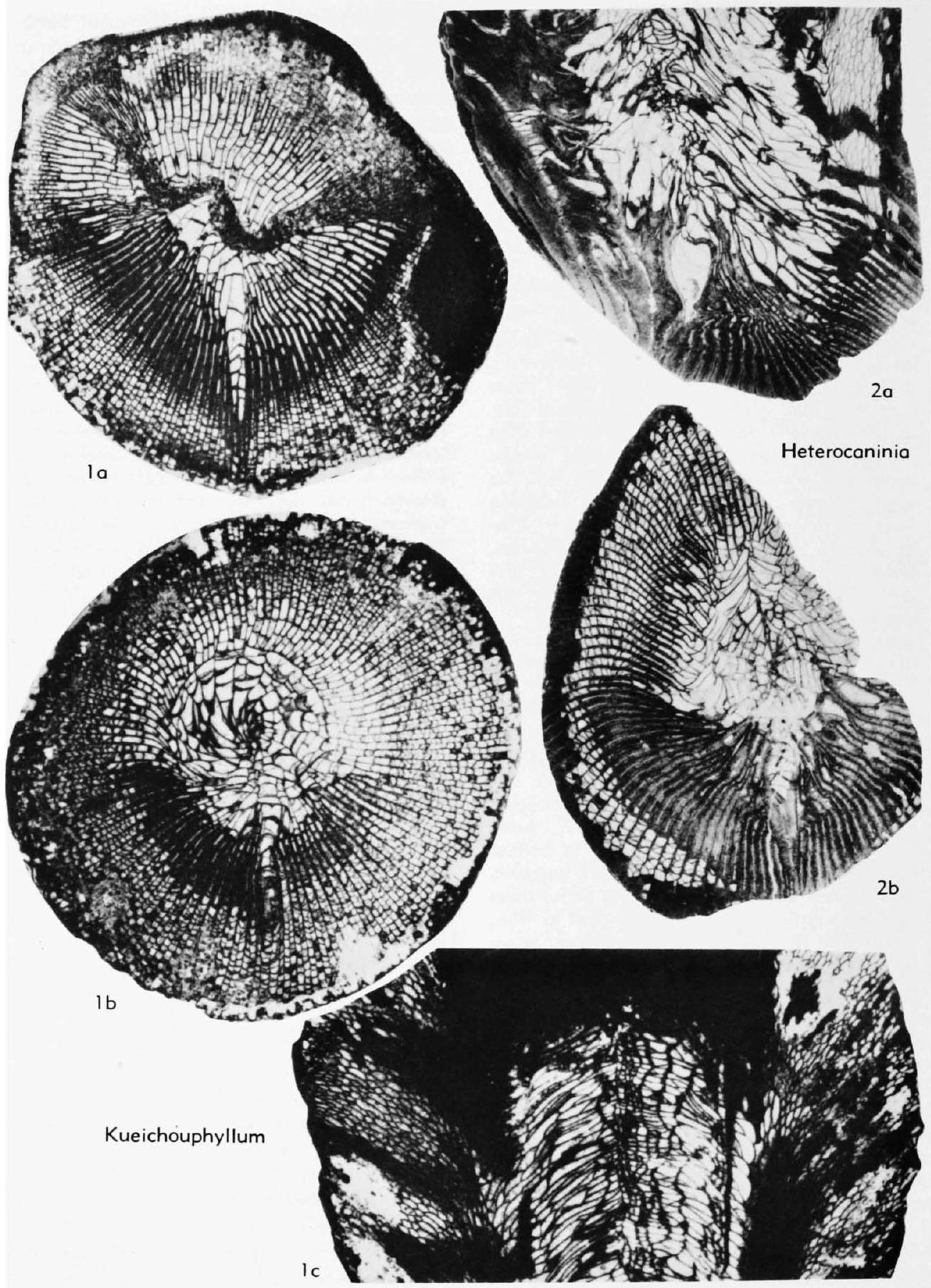 Fig. 243,2a,b. * H. tholusitabulata, ?holotype, Visean, Hunan, Hsia-lo shi-chiao, Chi-yang-hsien, a,b, long., transv. secs., X1.5 (Yabe& Hayasaka, 1920)
Synonyms
Kesenella
Geographic Distribution
Asia (Hunan, Sinkiang, ?Thailand, Japan)
Age Range
Beginning Stage in Treatise Usage:
L.Carb.(Visean)
Beginning International Stage:
Visean
Fraction Up In Beginning Stage:
0
Beginning Date:
346.73
Ending Stage in Treatise Usage:
L.Carb.(Visean)
Ending International Stage:
Visean
Fraction Up In Ending Stage:
100
Ending Date:
330.34
Description
Solitary, moderately large to large, curved, convex side cardinal, with very numerous, closely spaced, long major septa commonly thickened only in cardinal quadrants of outer tabularium, minor septa present only as ridges on inner side of wall, or sparsely as crests on anguloconcentric dissepiments of narrow to moderately wide dissepimentarium, tabularium wide with wide, loose axial structure, somewhat irregularly arachnoid and composed of axial ends of septal lamellae of minority of major septa, fossula long, narrow, open and somewhat expanded adaxially, may invade dissepimentarial zone, tabular floors rising from dissepimentarial boundary to eccentric axis or irregular median ridge, except in fossula where they are less steep, subhorizontal, or rising slightly toward periphery [see also KATO, 1959a, p. 279].
References
Museum or Author Information
Classification
Phylum:
Cnidaria
Class:
Anthozoa
Subclass:
Rugosa
Order:
Stauriida
Suborder:
Aulophyllina
Family:
Aulophyllidae
Subfamily:
Heterocaniniinae
Formal Genus Name and Reference:
Heterocaninia Yabe & HAYASAKA, 1920, pl. xi, fig. 2a-d
Type Species:
H. tholusitabulata, M, 147151, TohU, Sendai
Images
(Click to enlarge in a new window)
Fig. 243,2a,b. * H. tholusitabulata, ?holotype, Visean, Hunan, Hsia-lo shi-chiao, Chi-yang-hsien, a,b, long., transv. secs., X1.5 (Yabe& Hayasaka, 1920)
Synonyms
Kesenella
Geographic Distribution
Asia (Hunan, Sinkiang, ?Thailand, Japan)
Age Range
Beginning Stage in Treatise Usage:
L.Carb.(Visean)
Beginning International Stage:
Visean
Fraction Up In Beginning Stage:
0
Beginning Date:
346.73
Ending Stage in Treatise Usage:
L.Carb.(Visean)
Ending International Stage:
Visean
Fraction Up In Ending Stage:
100
Ending Date:
330.34
Description
Solitary, moderately large to large, curved, convex side cardinal, with very numerous, closely spaced, long major septa commonly thickened only in cardinal quadrants of outer tabularium, minor septa present only as ridges on inner side of wall, or sparsely as crests on anguloconcentric dissepiments of narrow to moderately wide dissepimentarium, tabularium wide with wide, loose axial structure, somewhat irregularly arachnoid and composed of axial ends of septal lamellae of minority of major septa, fossula long, narrow, open and somewhat expanded adaxially, may invade dissepimentarial zone, tabular floors rising from dissepimentarial boundary to eccentric axis or irregular median ridge, except in fossula where they are less steep, subhorizontal, or rising slightly toward periphery [see also KATO, 1959a, p. 279].