
Welcome to the Cnidaria subsite on Invertebrate Paleontology!
Please enter a genera name to retrieve more information.
Hexagonaria
Classification
Phylum:
Cnidaria
Class:
Anthozoa
Subclass:
Rugosa
Order:
Stauriida
Suborder:
Columnariina
Family:
Disphyllidae
Subfamily:
Hexagonariinae
Formal Genus Name and Reference:
Hexagonaria GÜRICH, 1896, p. 171
Type Species:
Cyathophyllum hexagonum Goldfuss, 1826, p. 61, SD Lang, Smith, & Thomas, 1940, p. 69, †neotype, 270c1, Goldfuss Coll., IP, Bonn, by PICKETT, 1967b, p. 58
Images
(Click to enlarge in a new window)
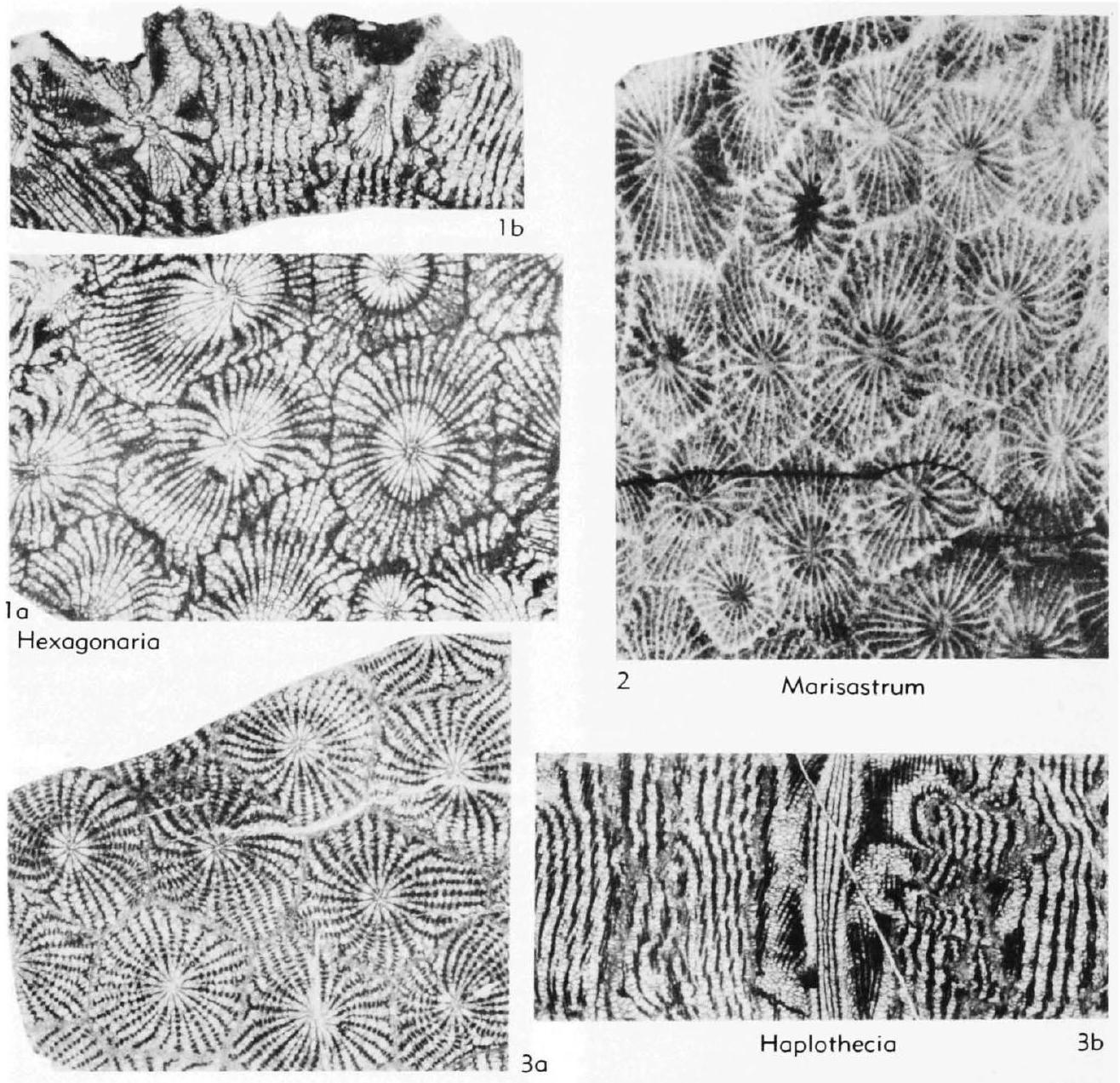 Fig. 176,1a,b. *H. hexagona (Goldfuss), neotype, probably up. Givet. or low. Frasn. Refrath beds, Ger., Bensberg, a, b, transv., long. secs., X1.7 (Hill& Jell, 1970b).
Synonyms
Polyphyllum, Hexagoniella, Hexagoniophyllum
Geographic Distribution
Eu. (?U.K.-France-Belg.-Ger.-Pol.-Urals)Asia (Kuzbas-Yunnan)-W.Australia-N.Am.(Wash.-NW.Terr.)
Age Range
Beginning Stage in Treatise Usage:
M.Dev.(Givet.)
Beginning International Stage:
Givetian
Fraction Up In Beginning Stage:
0
Beginning Date:
385.3
Ending Stage in Treatise Usage:
U.Dev.(Frasn.)
Ending International Stage:
Frasnian
Fraction Up In Ending Stage:
100
Ending Date:
371.1
Description
Cerioid, with septa fusiform in transverse section, thickest in inner parts of dissepimentarium, radially arranged and typically closely carinate with predominantly yardarm carinae formed by lateral extension of fibers of monacanthine trabeculae, major septa attenuate in tabularium and meeting or leaving space at axis, dissepimentarial floors horizontal or slightly declined outward near periphery and steeply declined adaxially near inner margin of dissepimentarium, so that trabeculae are arranged in broad asymmetrical half fan or fan, dissepiments small, numerous, subglobose and with outer two or three series commonly larger and typically flattened above, tabulae incomplete, horizontal or slightly convex with few supplementary peripheral tabellae [BIRENHEIDE, 1969a, p. 41; HILL & JELL, 1970b, p. 44].
References
Gürich, Georg, 1896, Das Palaeozoicum des Polnischen Mittelgebirges: Russ.-Kais. Mineral. Ges., Verh., ser. 2, v. 32, p. 1-539, pl. 1-15, map.
Museum or Author Information
Classification
Phylum:
Cnidaria
Class:
Anthozoa
Subclass:
Rugosa
Order:
Stauriida
Suborder:
Columnariina
Family:
Disphyllidae
Subfamily:
Hexagonariinae
Formal Genus Name and Reference:
Hexagonaria GÜRICH, 1896, p. 171
Type Species:
Cyathophyllum hexagonum Goldfuss, 1826, p. 61, SD Lang, Smith, & Thomas, 1940, p. 69, †neotype, 270c1, Goldfuss Coll., IP, Bonn, by PICKETT, 1967b, p. 58
Images
(Click to enlarge in a new window)
Fig. 176,1a,b. *H. hexagona (Goldfuss), neotype, probably up. Givet. or low. Frasn. Refrath beds, Ger., Bensberg, a, b, transv., long. secs., X1.7 (Hill& Jell, 1970b).
Synonyms
Polyphyllum, Hexagoniella, Hexagoniophyllum
Geographic Distribution
Eu. (?U.K.-France-Belg.-Ger.-Pol.-Urals)Asia (Kuzbas-Yunnan)-W.Australia-N.Am.(Wash.-NW.Terr.)
Age Range
Beginning Stage in Treatise Usage:
M.Dev.(Givet.)
Beginning International Stage:
Givetian
Fraction Up In Beginning Stage:
0
Beginning Date:
385.3
Ending Stage in Treatise Usage:
U.Dev.(Frasn.)
Ending International Stage:
Frasnian
Fraction Up In Ending Stage:
100
Ending Date:
371.1
Description
Cerioid, with septa fusiform in transverse section, thickest in inner parts of dissepimentarium, radially arranged and typically closely carinate with predominantly yardarm carinae formed by lateral extension of fibers of monacanthine trabeculae, major septa attenuate in tabularium and meeting or leaving space at axis, dissepimentarial floors horizontal or slightly declined outward near periphery and steeply declined adaxially near inner margin of dissepimentarium, so that trabeculae are arranged in broad asymmetrical half fan or fan, dissepiments small, numerous, subglobose and with outer two or three series commonly larger and typically flattened above, tabulae incomplete, horizontal or slightly convex with few supplementary peripheral tabellae [BIRENHEIDE, 1969a, p. 41; HILL & JELL, 1970b, p. 44].
References
Gürich, Georg, 1896, Das Palaeozoicum des Polnischen Mittelgebirges: Russ.-Kais. Mineral. Ges., Verh., ser. 2, v. 32, p. 1-539, pl. 1-15, map.