
Welcome to the Cnidaria subsite on Invertebrate Paleontology!
Please enter a genera name to retrieve more information.

Koninckophyllum
Classification
Phylum:
Cnidaria
Class:
Anthozoa
Subclass:
Rugosa
Order:
Stauriida
Suborder:
Aulophyllina
Family:
Aulophyllidae
Subfamily:
Dibunophyllinae
Formal Genus Name and Reference:
Koninckophyllum THOMSON & NICHOLSON, 1876a, p. 297
Type Species:
K. magnificum; SD THOMSON, 1883, p. 419; +T1037, KM, Glasgow, lectotype by HILL, 1938-1941, p. 89
Images
(Click to enlarge in a new window)
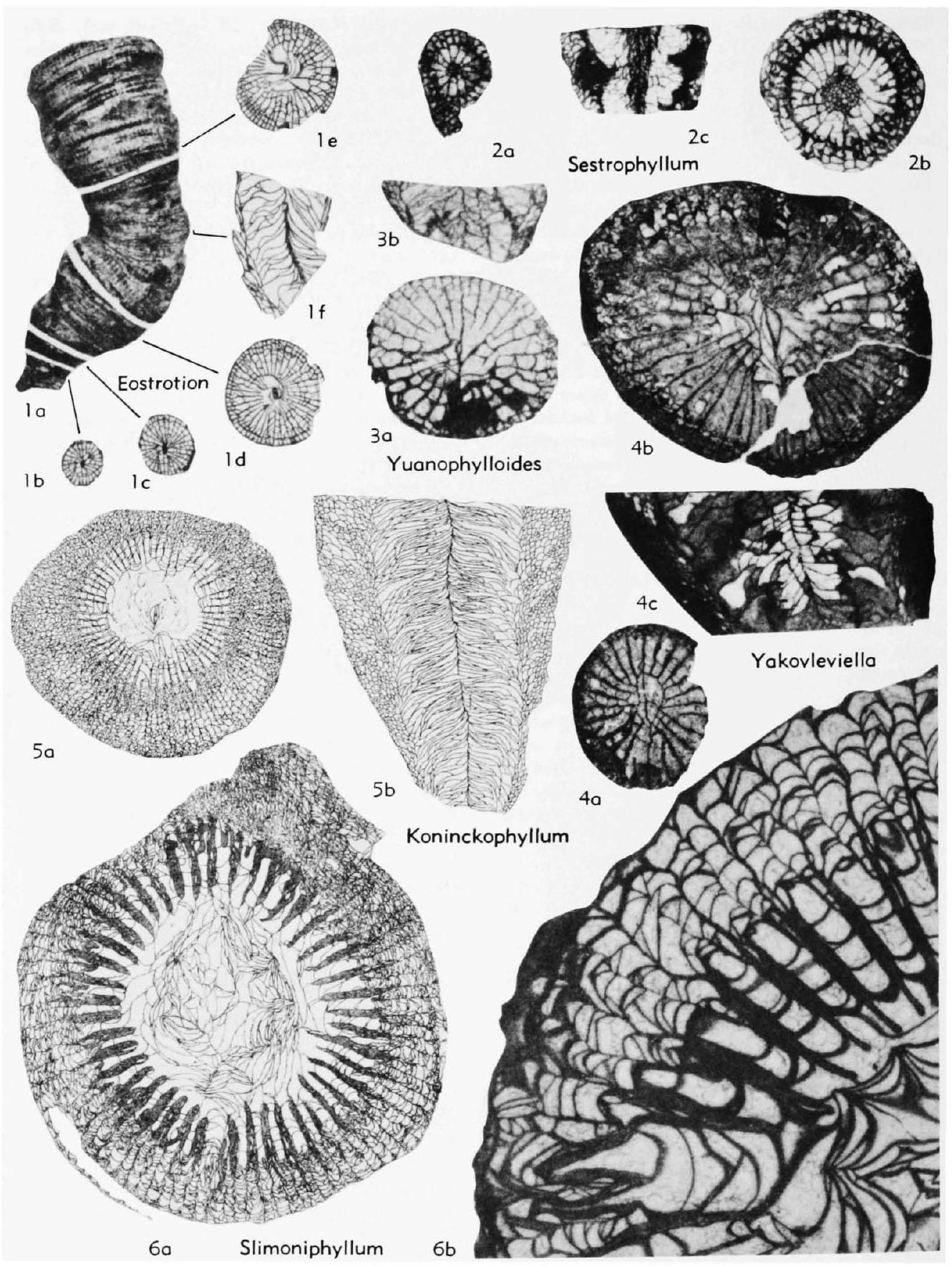 Fig. 240,5a,b. *K. magnificum, lectotype, Charlestown Main Ls., Scot., Charlestown; a,b, transv., long. secs., X 1.0 (Thomson, 1883).
Synonyms
Geographic Distribution
Eu.(Brit.I.- ?Belg.-Pol.- ?USSR-N.Zemlya)-N.Afr.(Alg.)-Asia (?Kazakh.); Miss., N.Am.(Nova Scotia-Texas-Ark)
Age Range
Beginning Stage in Treatise Usage:
L.Carb.
Beginning International Stage:
Tournaisian
Fraction Up In Beginning Stage:
0
Beginning Date:
359.3
Ending Stage in Treatise Usage:
U.Carb.(Namur.)
Ending International Stage:
Bashkirian
Fraction Up In Ending Stage:
48.4
Ending Date:
319.4
Description
Solitary ?(or weakly dendroid); septa numerous, major septa long but amplexoid, may be thickened in periaxial tabularium, especially in cardinal quadrants; minor septa long and continuous or discontinuous, leaving inosculating dissepiments; septa may bear lateral dissepiments or be otherwise structurally modified; fossula indenting dissepimentarium and with short cardinal septum in late stages; in early stages with clisiophylloid or dibunophylloid axial structure, the medial plate continuous with cardinal and counter septa; in late stages axial structure reduced to lathlike columella supported by conical tabellae or absent; tabular floors broad cones or broad and flat with downturned edges; dissepimentarium commonly wide [see also FEDOROWSKI, 1971, p. 78; SE- MENOFF-TIAN-CHANSKY, 1974, p. 107].
References
Museum or Author Information
Classification
Phylum:
Cnidaria
Class:
Anthozoa
Subclass:
Rugosa
Order:
Stauriida
Suborder:
Aulophyllina
Family:
Aulophyllidae
Subfamily:
Dibunophyllinae
Formal Genus Name and Reference:
Koninckophyllum THOMSON & NICHOLSON, 1876a, p. 297
Type Species:
K. magnificum; SD THOMSON, 1883, p. 419; +T1037, KM, Glasgow, lectotype by HILL, 1938-1941, p. 89
Images
(Click to enlarge in a new window)
Fig. 240,5a,b. *K. magnificum, lectotype, Charlestown Main Ls., Scot., Charlestown; a,b, transv., long. secs., X 1.0 (Thomson, 1883).
Synonyms
Geographic Distribution
Eu.(Brit.I.- ?Belg.-Pol.- ?USSR-N.Zemlya)-N.Afr.(Alg.)-Asia (?Kazakh.); Miss., N.Am.(Nova Scotia-Texas-Ark)
Age Range
Beginning Stage in Treatise Usage:
L.Carb.
Beginning International Stage:
Tournaisian
Fraction Up In Beginning Stage:
0
Beginning Date:
359.3
Ending Stage in Treatise Usage:
U.Carb.(Namur.)
Ending International Stage:
Bashkirian
Fraction Up In Ending Stage:
48.4
Ending Date:
319.4
Description
Solitary ?(or weakly dendroid); septa numerous, major septa long but amplexoid, may be thickened in periaxial tabularium, especially in cardinal quadrants; minor septa long and continuous or discontinuous, leaving inosculating dissepiments; septa may bear lateral dissepiments or be otherwise structurally modified; fossula indenting dissepimentarium and with short cardinal septum in late stages; in early stages with clisiophylloid or dibunophylloid axial structure, the medial plate continuous with cardinal and counter septa; in late stages axial structure reduced to lathlike columella supported by conical tabellae or absent; tabular floors broad cones or broad and flat with downturned edges; dissepimentarium commonly wide [see also FEDOROWSKI, 1971, p. 78; SE- MENOFF-TIAN-CHANSKY, 1974, p. 107].