
Welcome to the Cnidaria subsite on Invertebrate Paleontology!
Please enter a genera name to retrieve more information.

Lophophyllidium
Classification
Phylum:
Cnidaria
Class:
Anthozoa
Subclass:
Rugosa
Order:
Stauriida
Suborder:
Plerophyllina
Family:
Lophophyllidae
Formal Genus Name and Reference:
Lophophyllidium GRABAU, 1928, p. 98
Type Species:
Cyathaxonia prolifera MCCHESNEY, 1860, p. 75, OD; +neotype, W46064a (?or 4064a), ISGS, Urbana; by JEFFORDS, 1942, p.219, probably lost, fide FEDOROWSKI, 1974a, p. 442
Images
(Click to enlarge in a new window)
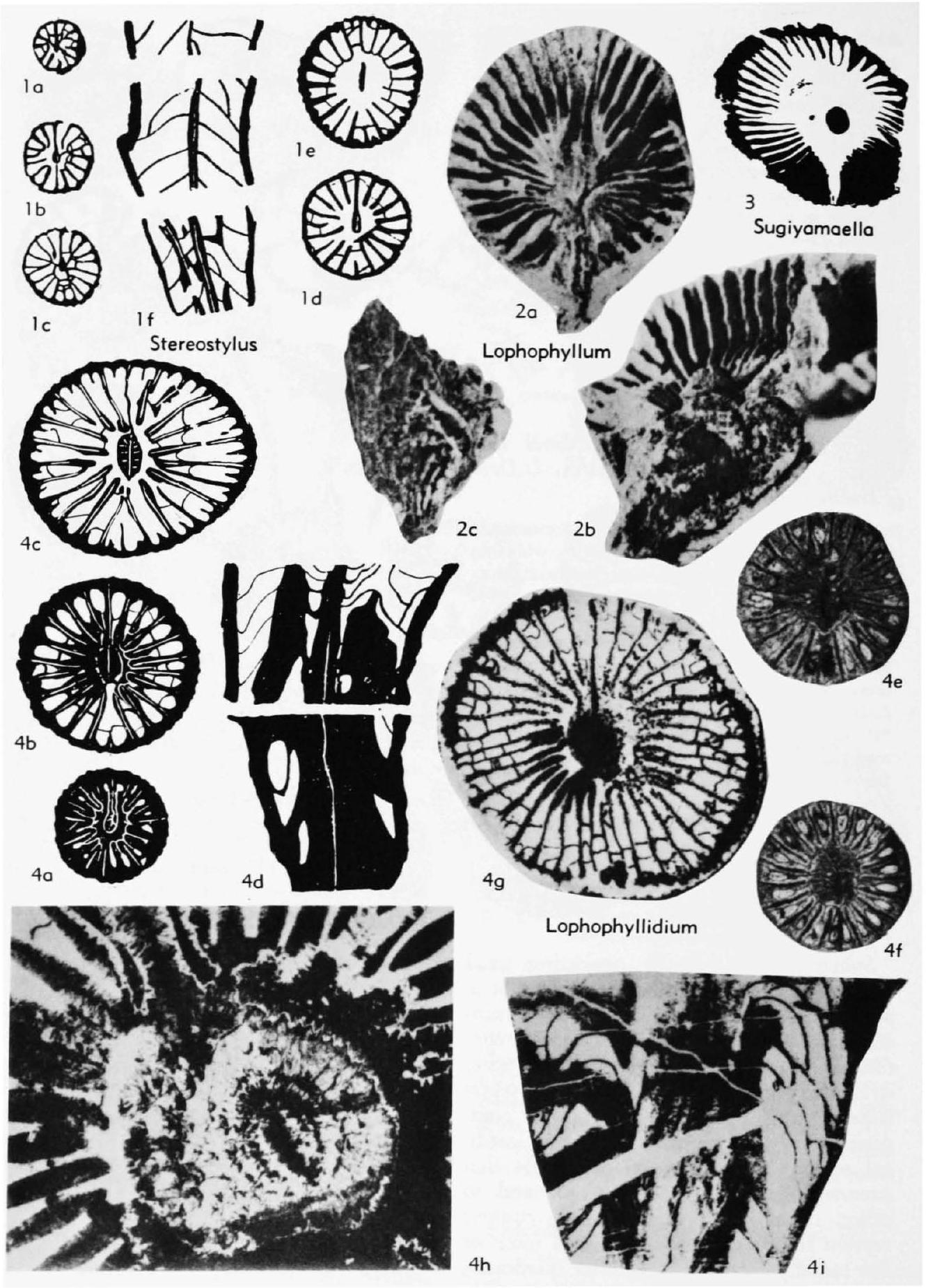 Fig. 219,4a-d. *L. prolifcrum (Mc-CHESNEY), neotype, Penn. (Missour.), Ill., near Springfield; a-c, transv., d, long. sees., X3.0 (Jeffords, 1942). --Fig. 219,4e,f. ?L. pavlovi (FOMICHEV), holotype; e,f, transv. sees., X3.0 (Fornichev, 1953a). --Fig. 219,4g-i. L. cambodgense (FONTAINE); g,h, holotype, transv. sees., X3.3, X9.0; i, another specimen, Pnom Takream, long. sec., X3.0 (Fontaine, 1961).
Synonyms
Sinophyllum, ?Malonophyllum, ?Agarikophyllum, Agaricophyllum, ? Gerthophyllum, Khmerophyllum
Geographic Distribution
N.Am.(Ill.-Ark.-Okla.-Kans.-Ohio-N.Mex.-Texas-Alaska-C. Am.-Guat.)-S.Am.(Peru -Venez.); U. Carb.-Perm., Eu. (Spain-USSR-Aus.)-W. Australia-Asia(China-Japan Viet Nam-Camb.-Burma- Iran)
Age Range
Beginning Stage in Treatise Usage:
Penn.
Beginning International Stage:
Bashkirian
Fraction Up In Beginning Stage:
0
Beginning Date:
323.4
Ending Stage in Treatise Usage:
Perm.
Ending International Stage:
Changhsingian
Fraction Up In Ending Stage:
100
Ending Date:
251.9
Description
Solitary, columella lathlike and without radiating septal lamellae, continuous with counter septum except in late stages and in calice, where it projects, cardinal septum short except in earliest stages, in open fossula to which younger septa of cardinal quadrants are pinnate, position of fossula variable in type species, commonly on concave side, other major septa subequal and commonly rhopaloid, in late stages withdrawn from axis, in early stages septa are thickened, and alar, counter-lateral, and metasepta are joined to each other and to columella, alar fossulae are prominent, cardinal septum is short in large fossula, and counter septum long, minor septa rudimentary or short, tabulae declined from columella, no dissepiments [see also FEDOROWSKI, 1974a, p. 441, and FLiiGEL, 1972, p. 74].
References
Museum or Author Information
Classification
Phylum:
Cnidaria
Class:
Anthozoa
Subclass:
Rugosa
Order:
Stauriida
Suborder:
Plerophyllina
Family:
Lophophyllidae
Formal Genus Name and Reference:
Lophophyllidium GRABAU, 1928, p. 98
Type Species:
Cyathaxonia prolifera MCCHESNEY, 1860, p. 75, OD; +neotype, W46064a (?or 4064a), ISGS, Urbana; by JEFFORDS, 1942, p.219, probably lost, fide FEDOROWSKI, 1974a, p. 442
Images
(Click to enlarge in a new window)
Fig. 219,4a-d. *L. prolifcrum (Mc-CHESNEY), neotype, Penn. (Missour.), Ill., near Springfield; a-c, transv., d, long. sees., X3.0 (Jeffords, 1942). --Fig. 219,4e,f. ?L. pavlovi (FOMICHEV), holotype; e,f, transv. sees., X3.0 (Fornichev, 1953a). --Fig. 219,4g-i. L. cambodgense (FONTAINE); g,h, holotype, transv. sees., X3.3, X9.0; i, another specimen, Pnom Takream, long. sec., X3.0 (Fontaine, 1961).
Synonyms
Sinophyllum, ?Malonophyllum, ?Agarikophyllum, Agaricophyllum, ? Gerthophyllum, Khmerophyllum
Geographic Distribution
N.Am.(Ill.-Ark.-Okla.-Kans.-Ohio-N.Mex.-Texas-Alaska-C. Am.-Guat.)-S.Am.(Peru -Venez.); U. Carb.-Perm., Eu. (Spain-USSR-Aus.)-W. Australia-Asia(China-Japan Viet Nam-Camb.-Burma- Iran)
Age Range
Beginning Stage in Treatise Usage:
Penn.
Beginning International Stage:
Bashkirian
Fraction Up In Beginning Stage:
0
Beginning Date:
323.4
Ending Stage in Treatise Usage:
Perm.
Ending International Stage:
Changhsingian
Fraction Up In Ending Stage:
100
Ending Date:
251.9
Description
Solitary, columella lathlike and without radiating septal lamellae, continuous with counter septum except in late stages and in calice, where it projects, cardinal septum short except in earliest stages, in open fossula to which younger septa of cardinal quadrants are pinnate, position of fossula variable in type species, commonly on concave side, other major septa subequal and commonly rhopaloid, in late stages withdrawn from axis, in early stages septa are thickened, and alar, counter-lateral, and metasepta are joined to each other and to columella, alar fossulae are prominent, cardinal septum is short in large fossula, and counter septum long, minor septa rudimentary or short, tabulae declined from columella, no dissepiments [see also FEDOROWSKI, 1974a, p. 441, and FLiiGEL, 1972, p. 74].