
Welcome to the Cnidaria subsite on Invertebrate Paleontology!
Please enter a genera name to retrieve more information.

Metriophyllum
Classification
Phylum:
Cnidaria
Class:
Anthozoa
Subclass:
Rugosa
Order:
Stauriida
Suborder:
Metriophyllina
Family:
Metriophyllidae
Formal Genus Name and Reference:
Metriophyllum MILNE-EDWARDS & HAIME, 1850, p. lxix
Type Species:
M. bouchardi; OD; +specimen figured MILNE-EDWARDS & HAlME, 1851, p. 318, p!. 7, fig. 1, la; lectotype by LANG, SMITH, & THOMAS, 1940, p. 84, specimen lost fide HOLWILL, 1964, p. 112
Images
(Click to enlarge in a new window)
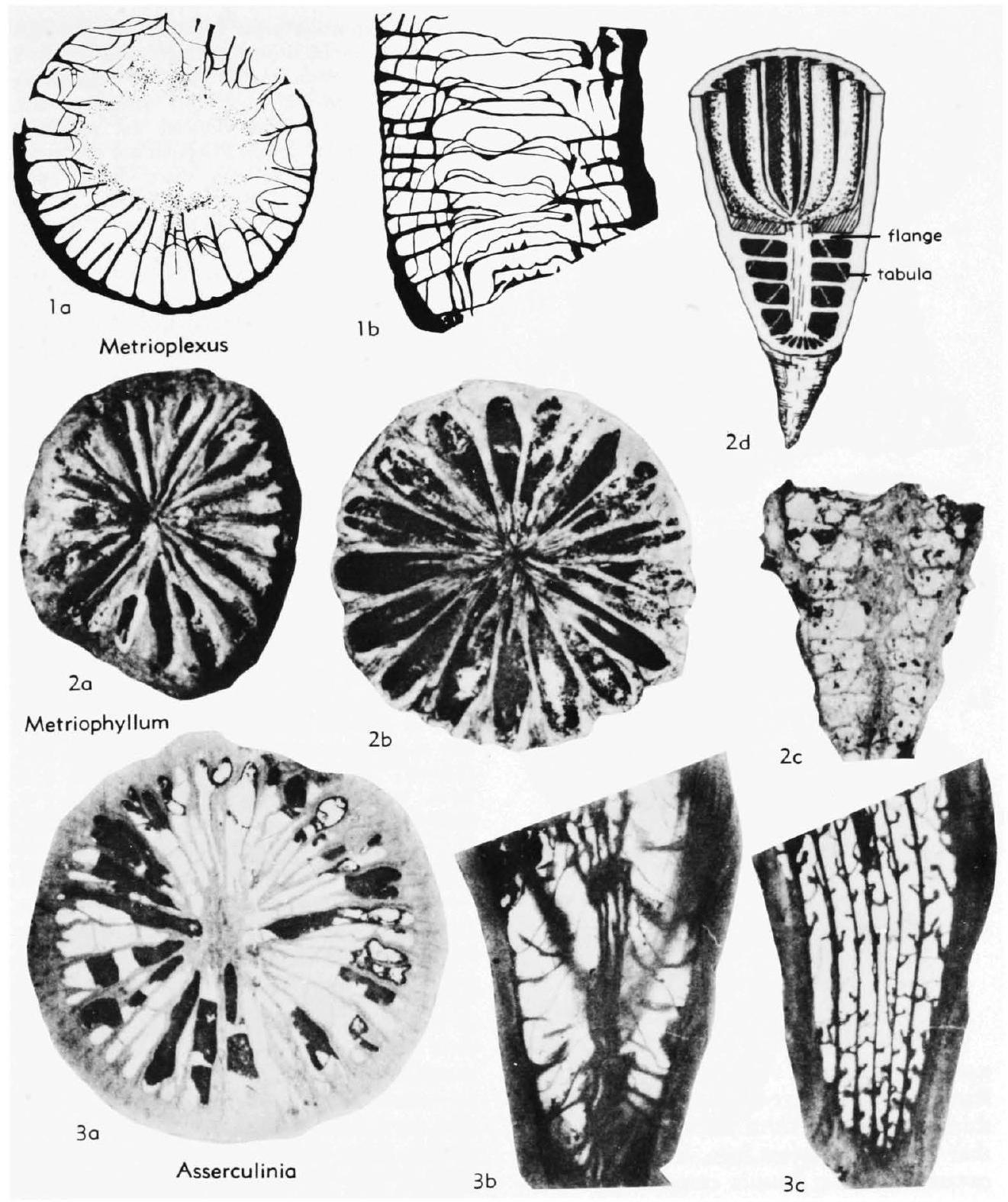 Fig. 113, 2a-d. *M. bouchardi; U.Dev.(Frasn.), France, Ferques, near Boulogne; a, calical view, X5.4; b, transv. sec., X8.0; c, long. sec., X4.0; d, diagram. (Holwill, 1964).
Synonyms
Haplophyllum
Geographic Distribution
Australia(Vict.); M.Dev.- U.Dev., Eu.(France-Ger.-U.K.)-N.Am.(N.Y.)-Australia(W.Australia)-Asia(China-Indoch.); ?Miss.,
N.Am.(Mo.); ?L.Perm., Eu.(Urals)
Age Range
Beginning Stage in Treatise Usage:
L.Dev.
Beginning International Stage:
Lochkovian
Fraction Up In Beginning Stage:
0
Beginning Date:
419
Ending Stage in Treatise Usage:
L.Dev.
Ending International Stage:
Emsian
Fraction Up In Ending Stage:
100
Ending Date:
394.3
Description
Small, solitary, turbinate to ceratoid, erect or slightly curved with cardinal side convex; with narrow peripheral stereozone and without dissepiments; major septa with horizontal flanges (parallel to epithecal growth rings) with upturned lateral edges alternating in level in neighboring septa; axial ends of major septa uniting at axis, but axial structure thus formed not projecting from base of calice; cardinal septum not shortened; minor septa including Km short, below calice reduced to wall, not contratingent; tabulae thin and sloping downward from axis [see HOLWILL, 1964, p. 109].
References
Museum or Author Information
Classification
Phylum:
Cnidaria
Class:
Anthozoa
Subclass:
Rugosa
Order:
Stauriida
Suborder:
Metriophyllina
Family:
Metriophyllidae
Formal Genus Name and Reference:
Metriophyllum MILNE-EDWARDS & HAIME, 1850, p. lxix
Type Species:
M. bouchardi; OD; +specimen figured MILNE-EDWARDS & HAlME, 1851, p. 318, p!. 7, fig. 1, la; lectotype by LANG, SMITH, & THOMAS, 1940, p. 84, specimen lost fide HOLWILL, 1964, p. 112
Images
(Click to enlarge in a new window)
Fig. 113, 2a-d. *M. bouchardi; U.Dev.(Frasn.), France, Ferques, near Boulogne; a, calical view, X5.4; b, transv. sec., X8.0; c, long. sec., X4.0; d, diagram. (Holwill, 1964).
Synonyms
Haplophyllum
Geographic Distribution
Australia(Vict.); M.Dev.- U.Dev., Eu.(France-Ger.-U.K.)-N.Am.(N.Y.)-Australia(W.Australia)-Asia(China-Indoch.); ?Miss.,
N.Am.(Mo.); ?L.Perm., Eu.(Urals)
Age Range
Beginning Stage in Treatise Usage:
L.Dev.
Beginning International Stage:
Lochkovian
Fraction Up In Beginning Stage:
0
Beginning Date:
419
Ending Stage in Treatise Usage:
L.Dev.
Ending International Stage:
Emsian
Fraction Up In Ending Stage:
100
Ending Date:
394.3
Description
Small, solitary, turbinate to ceratoid, erect or slightly curved with cardinal side convex; with narrow peripheral stereozone and without dissepiments; major septa with horizontal flanges (parallel to epithecal growth rings) with upturned lateral edges alternating in level in neighboring septa; axial ends of major septa uniting at axis, but axial structure thus formed not projecting from base of calice; cardinal septum not shortened; minor septa including Km short, below calice reduced to wall, not contratingent; tabulae thin and sloping downward from axis [see HOLWILL, 1964, p. 109].