
Welcome to the Cnidaria subsite on Invertebrate Paleontology!
Please enter a genera name to retrieve more information.

Microcyclus
Classification
Phylum:
Cnidaria
Class:
Anthozoa
Subclass:
Rugosa
Order:
Stauriida
Suborder:
Metriophyllina
Family:
Hadrophyllidae
Formal Genus Name and Reference:
Microcyclus Meek & WORTHEN, 1868, p. 420
Type Species:
M. discus; M; +not traced
Images
(Click to enlarge in a new window)
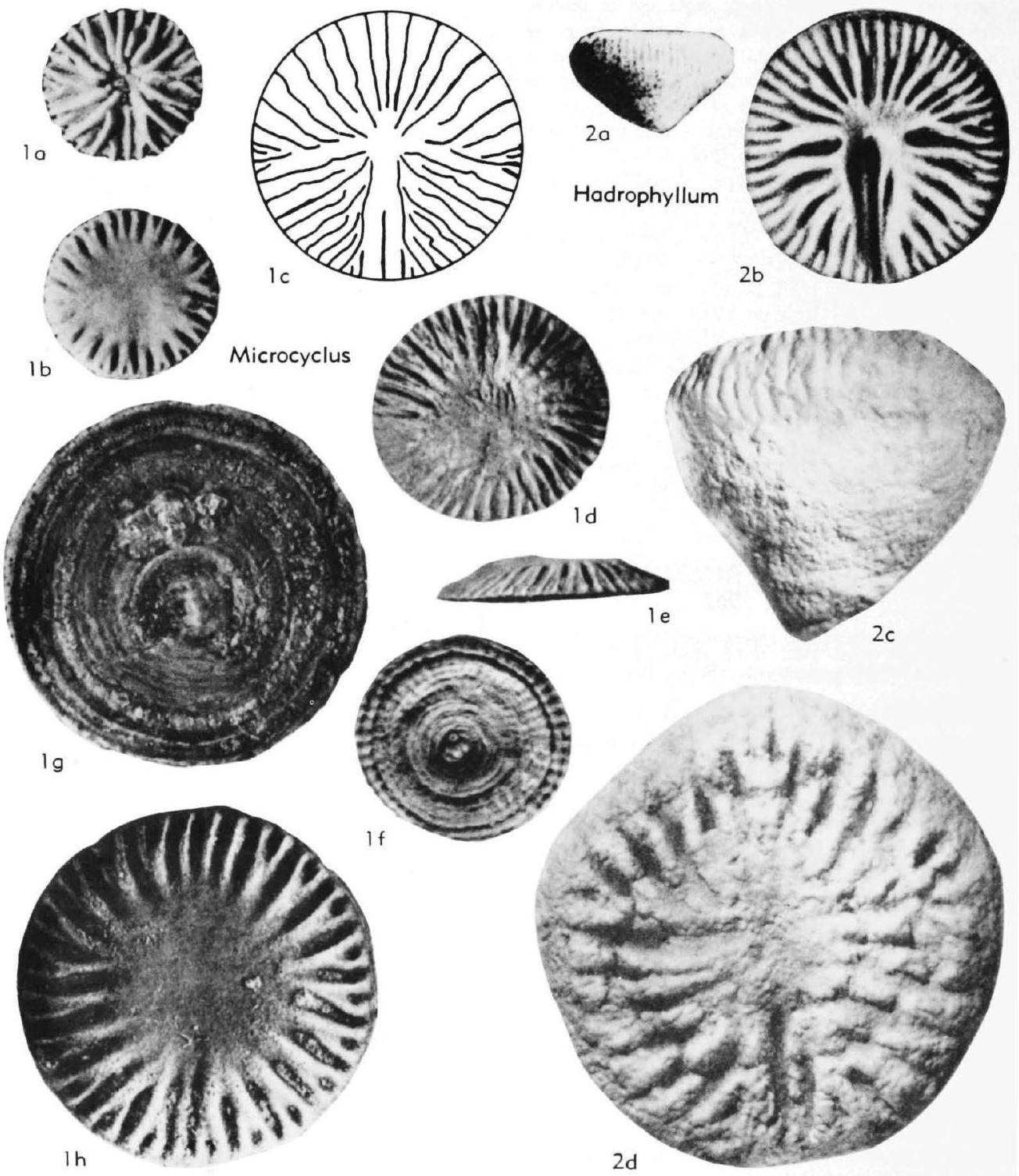 Fig. 123,1a-h. *M. discus, topotypes, ?Hamilton Gr., St. Laurent Ls., Ill., N. end of Backbone Ridge, Grand Tower, a, b, calical views, X2.0, c, diagram. transv. sec., X3.0 (Frauenfelter & Engstrom, 1970), d-f, calical, side, and basal views, X1.5 (Stauffer, 1952), g, h, basal, calical views, X3.0 (Plusquellec, 1971).
Synonyms
Geographic Distribution
N.Am.(Ill.-Mo.-Ont.)-N. Afr.(Alg.)-Eu.(Ger.)
Age Range
Beginning Stage in Treatise Usage:
M.Dev.
Beginning International Stage:
Eifelian
Fraction Up In Beginning Stage:
0
Beginning Date:
394.3
Ending Stage in Treatise Usage:
M.Dev.
Ending International Stage:
Givetian
Fraction Up In Ending Stage:
100
Ending Date:
378.9
Description
Solitary, small, discoid, profile lenticular and sharp-edged, epithecate surface subhorizontal, major and minor septa long, dilated and contiguous, those of cardinal quadrants arranged pinnately about open, parallel-sided fossula, those of counter quadrants directed at angles to less distinct, parallel-sided alar fossulae, cardinal and commonly also counter septum short in late stages, minor septa may appear contraclined or contratingent in calice, but Km commonly longer and radial, septal trabeculae indistinct, no tabulae [see FRAUENFELTER & ENGSTROM, 1970, p. 1085; PLUSQUELLEC, 1971, p. 129; WEYER, 1975a, p. 15].
References
Museum or Author Information
Classification
Phylum:
Cnidaria
Class:
Anthozoa
Subclass:
Rugosa
Order:
Stauriida
Suborder:
Metriophyllina
Family:
Hadrophyllidae
Formal Genus Name and Reference:
Microcyclus Meek & WORTHEN, 1868, p. 420
Type Species:
M. discus; M; +not traced
Images
(Click to enlarge in a new window)
Fig. 123,1a-h. *M. discus, topotypes, ?Hamilton Gr., St. Laurent Ls., Ill., N. end of Backbone Ridge, Grand Tower, a, b, calical views, X2.0, c, diagram. transv. sec., X3.0 (Frauenfelter & Engstrom, 1970), d-f, calical, side, and basal views, X1.5 (Stauffer, 1952), g, h, basal, calical views, X3.0 (Plusquellec, 1971).
Synonyms
Geographic Distribution
N.Am.(Ill.-Mo.-Ont.)-N. Afr.(Alg.)-Eu.(Ger.)
Age Range
Beginning Stage in Treatise Usage:
M.Dev.
Beginning International Stage:
Eifelian
Fraction Up In Beginning Stage:
0
Beginning Date:
394.3
Ending Stage in Treatise Usage:
M.Dev.
Ending International Stage:
Givetian
Fraction Up In Ending Stage:
100
Ending Date:
378.9
Description
Solitary, small, discoid, profile lenticular and sharp-edged, epithecate surface subhorizontal, major and minor septa long, dilated and contiguous, those of cardinal quadrants arranged pinnately about open, parallel-sided fossula, those of counter quadrants directed at angles to less distinct, parallel-sided alar fossulae, cardinal and commonly also counter septum short in late stages, minor septa may appear contraclined or contratingent in calice, but Km commonly longer and radial, septal trabeculae indistinct, no tabulae [see FRAUENFELTER & ENGSTROM, 1970, p. 1085; PLUSQUELLEC, 1971, p. 129; WEYER, 1975a, p. 15].