
Welcome to the Cnidaria subsite on Invertebrate Paleontology!
Please enter a genera name to retrieve more information.

Nipponophyllum
Classification
Phylum:
Cnidaria
Class:
Anthozoa
Subclass:
Rugosa
Order:
Cystiphyllida
Family:
Holmophyllidae
Formal Genus Name and Reference:
Nipponophyllum SUGIYAMA, 1940, p. 116
Type Species:
N. giganteum, OD, †63005, TohU, Sendai
Images
(Click to enlarge in a new window)
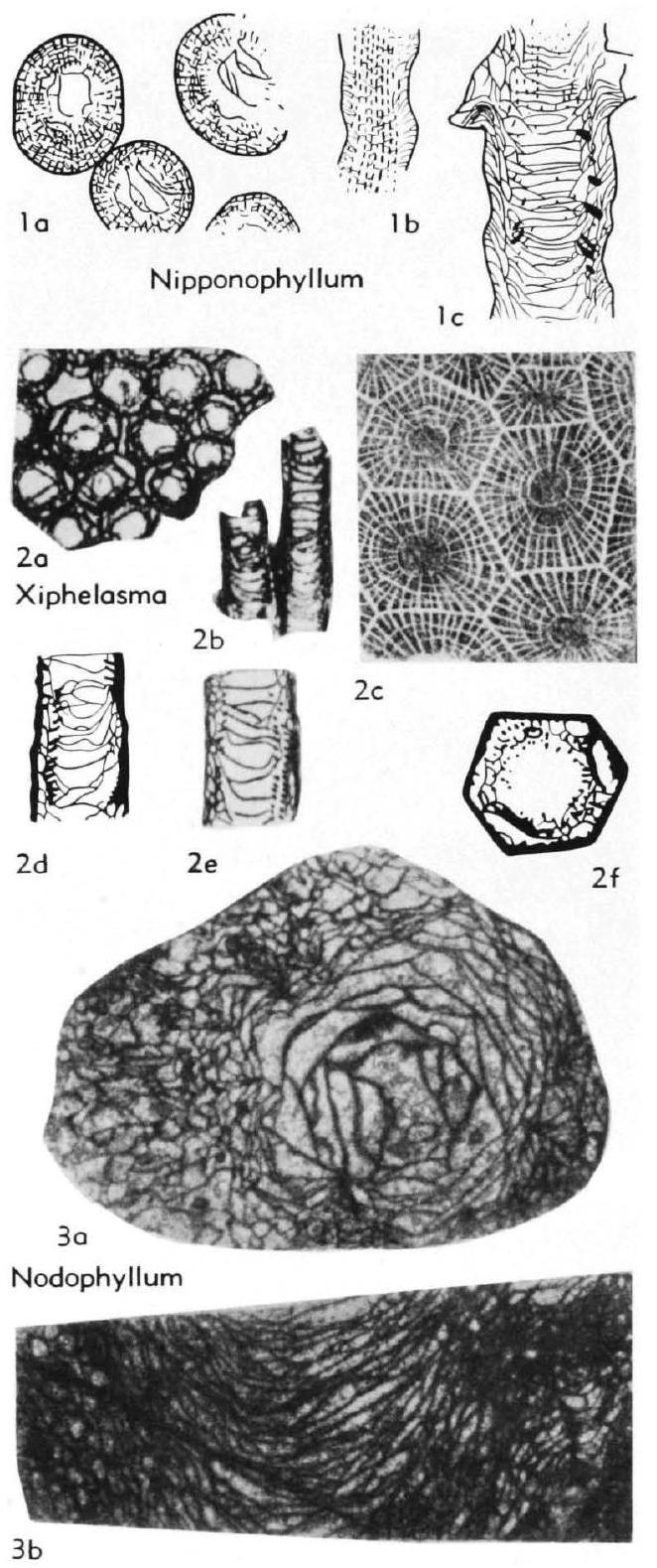 Fig. 49,1a-c. *N. giganteum, holotype, U.Sil., Halysites Ls., Japan, Higuti-zawa in Kiwauti, a-c, transv., long., tang. secs., X1 (Sugiyama, 1940).
Synonyms
Baeophyllum
Geographic Distribution
Asia(Salair)-?Australia(New S.Wales); V.Sil., Asia(Japan-Tadzhik.- E.Urals)-Australia(New S.Wales)
Age Range
Beginning Stage in Treatise Usage:
M.Sil.
Beginning International Stage:
Sheinwoodian
Fraction Up In Beginning Stage:
0
Beginning Date:
432.93
Ending Stage in Treatise Usage:
M.Sil.
Ending International Stage:
Homerian
Fraction Up In Ending Stage:
100
Ending Date:
426.74
Description
Corallum fasciculate, epithecal scales in some, major and minor septa subequal, somewhat withdrawn from axis, acanthine, trabeculae either discrete throughout or in part contiguous in laminar segments, ?monacanthine, tabulae subhorizontal or sagging, complete or incomplete, more or less sharply demarcated from plates of moderately wide dissepimentarium, dissepimentarium with shallow dissepiments that may each extend across more than one interseptal loculus and that, in many, are horizontally based so that calice has flat or everted platform. [see also McLEAN, 1975a, p. 183].
References
Sugiyama, Toshio, 1940, Stratigraphical and palaeontological notes of the Gotlandian deposits of the Kitakami Mountainland: Tohoku Univ., Sci. Rep., ser. 2 (geol.), v. 21, no. 2, p. 81-146, text-fig. 1-6, pl. 13-33.
Museum or Author Information
Classification
Phylum:
Cnidaria
Class:
Anthozoa
Subclass:
Rugosa
Order:
Cystiphyllida
Family:
Holmophyllidae
Formal Genus Name and Reference:
Nipponophyllum SUGIYAMA, 1940, p. 116
Type Species:
N. giganteum, OD, †63005, TohU, Sendai
Images
(Click to enlarge in a new window)
Fig. 49,1a-c. *N. giganteum, holotype, U.Sil., Halysites Ls., Japan, Higuti-zawa in Kiwauti, a-c, transv., long., tang. secs., X1 (Sugiyama, 1940).
Synonyms
Baeophyllum
Geographic Distribution
Asia(Salair)-?Australia(New S.Wales); V.Sil., Asia(Japan-Tadzhik.- E.Urals)-Australia(New S.Wales)
Age Range
Beginning Stage in Treatise Usage:
M.Sil.
Beginning International Stage:
Sheinwoodian
Fraction Up In Beginning Stage:
0
Beginning Date:
432.93
Ending Stage in Treatise Usage:
M.Sil.
Ending International Stage:
Homerian
Fraction Up In Ending Stage:
100
Ending Date:
426.74
Description
Corallum fasciculate, epithecal scales in some, major and minor septa subequal, somewhat withdrawn from axis, acanthine, trabeculae either discrete throughout or in part contiguous in laminar segments, ?monacanthine, tabulae subhorizontal or sagging, complete or incomplete, more or less sharply demarcated from plates of moderately wide dissepimentarium, dissepimentarium with shallow dissepiments that may each extend across more than one interseptal loculus and that, in many, are horizontally based so that calice has flat or everted platform. [see also McLEAN, 1975a, p. 183].
References
Sugiyama, Toshio, 1940, Stratigraphical and palaeontological notes of the Gotlandian deposits of the Kitakami Mountainland: Tohoku Univ., Sci. Rep., ser. 2 (geol.), v. 21, no. 2, p. 81-146, text-fig. 1-6, pl. 13-33.