
Welcome to the Cnidaria subsite on Invertebrate Paleontology!
Please enter a genera name to retrieve more information.

Palaeophyllum
Classification
Phylum:
Cnidaria
Class:
Anthozoa
Subclass:
Rugosa
Order:
Stauriida
Suborder:
Stauriina
Family:
Stauriidae
Formal Genus Name and Reference:
Palaeophyllum BILLINGS, 1858, p. 168
Type Species:
P. rugosum, M, 11379, GSC, Ottawa, lectotype by LAMBE, 1899, p. 218
Images
(Click to enlarge in a new window)
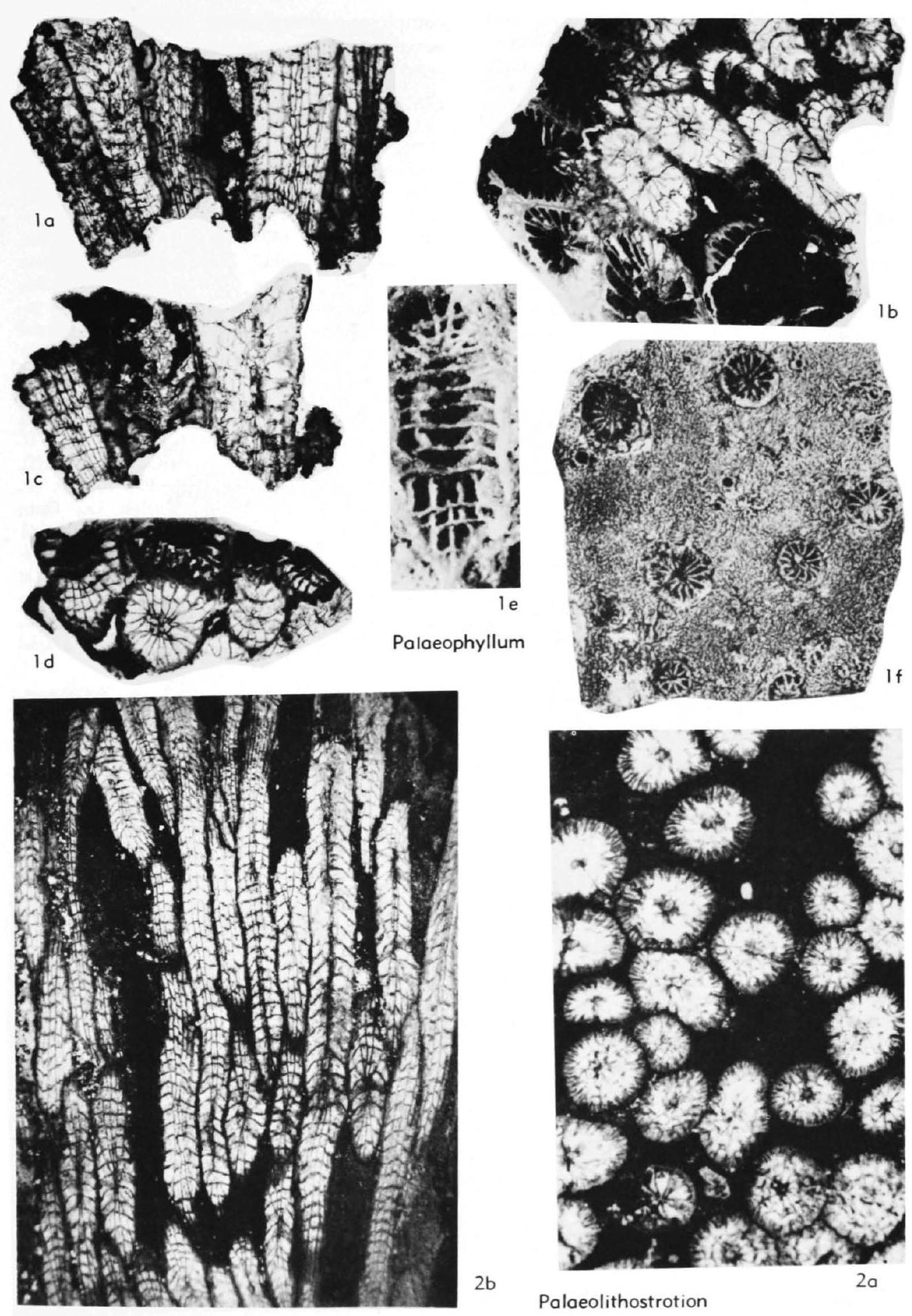 Fig. 74,1a-d. *P. rugosum, lectotype, Blackriv. or lowermost Trenton., Can., L.St. John, Little Discharge, a,c, long. secs., b,d, oblique, transv. secs., all X2 (Hill, 1961). --Fig. 74,1e,f. ?P. varioseptatum (STEARN), M.Sil., Cedar Lake F., Manit.; e, holotype, long. natural sec., X4; f, paratype, from type locality, transv. sec., X2 (Stearn, 1956).
Synonyms
Paleophyllum, ?Synamplexoides
Geographic Distribution
N. Am. (Que.-Manit.-Ont. Texas-N. Mex.-Cal.) -Eu. (Nor.-Est.-Urals)-Asia (Sib.Platf.-?Shoria Mts.-Sinkiang)-Australia(New S.Wales); L.Sil., N. Am. (Greenl.)-Eu. (Nor.-Est.)-Asia (Hupei-Sib. Platf.-Altay-Sayan); M.Sil., Australia(New S. Wales)-N.Am. (Cal.-Yukon-Manit.-N.Y)
Age Range
Beginning Stage in Treatise Usage:
M.Ord.
Beginning International Stage:
Dapingian
Fraction Up In Beginning Stage:
0
Beginning Date:
471.26
Ending Stage in Treatise Usage:
U.Ord.
Ending International Stage:
Hirnantian
Fraction Up In Ending Stage:
100
Ending Date:
443.07
Description
Corallum phacelocerioid or phaceloid, commonly with marginal (lateral) increase, corallites with narrow peripheral stereozone formed by thickening of peripheral ends of septa, short minor septa alternate with long and somewhat wavy major septa that thin rapidly just inside stereozone, then attenuate more slowly as they approach axis, which they reach or almost reach their axial edges being without paliform lobes; tabulae complete, commonly with axial depression and slightly downturned edges; dissepiments absent; cardinal fossula not distinct.
References
Museum or Author Information
Classification
Phylum:
Cnidaria
Class:
Anthozoa
Subclass:
Rugosa
Order:
Stauriida
Suborder:
Stauriina
Family:
Stauriidae
Formal Genus Name and Reference:
Palaeophyllum BILLINGS, 1858, p. 168
Type Species:
P. rugosum, M, 11379, GSC, Ottawa, lectotype by LAMBE, 1899, p. 218
Images
(Click to enlarge in a new window)
Fig. 74,1a-d. *P. rugosum, lectotype, Blackriv. or lowermost Trenton., Can., L.St. John, Little Discharge, a,c, long. secs., b,d, oblique, transv. secs., all X2 (Hill, 1961). --Fig. 74,1e,f. ?P. varioseptatum (STEARN), M.Sil., Cedar Lake F., Manit.; e, holotype, long. natural sec., X4; f, paratype, from type locality, transv. sec., X2 (Stearn, 1956).
Synonyms
Paleophyllum, ?Synamplexoides
Geographic Distribution
N. Am. (Que.-Manit.-Ont. Texas-N. Mex.-Cal.) -Eu. (Nor.-Est.-Urals)-Asia (Sib.Platf.-?Shoria Mts.-Sinkiang)-Australia(New S.Wales); L.Sil., N. Am. (Greenl.)-Eu. (Nor.-Est.)-Asia (Hupei-Sib. Platf.-Altay-Sayan); M.Sil., Australia(New S. Wales)-N.Am. (Cal.-Yukon-Manit.-N.Y)
Age Range
Beginning Stage in Treatise Usage:
M.Ord.
Beginning International Stage:
Dapingian
Fraction Up In Beginning Stage:
0
Beginning Date:
471.26
Ending Stage in Treatise Usage:
U.Ord.
Ending International Stage:
Hirnantian
Fraction Up In Ending Stage:
100
Ending Date:
443.07
Description
Corallum phacelocerioid or phaceloid, commonly with marginal (lateral) increase, corallites with narrow peripheral stereozone formed by thickening of peripheral ends of septa, short minor septa alternate with long and somewhat wavy major septa that thin rapidly just inside stereozone, then attenuate more slowly as they approach axis, which they reach or almost reach their axial edges being without paliform lobes; tabulae complete, commonly with axial depression and slightly downturned edges; dissepiments absent; cardinal fossula not distinct.