
Welcome to the Cnidaria subsite on Invertebrate Paleontology!
Please enter a genera name to retrieve more information.

Paleofavosites
Classification
Phylum:
Cnidaria
Class:
Anthozoa
Subclass:
Tabulata
Order:
Favositida
Suborder:
Favositina
Superfamily:
Favositicae
Family:
Favositidae
Subfamily:
Paleofavositinae
Formal Genus Name and Reference:
Paleofavosites TWENHOFEL, 1914, p. 24
Type Species:
Favosites asper d'Orbigny, 1850, p. 49, OD, †GSb37263728 (3 parts of corallum), GSM, London, fide Oekentorp, 1976, p. 169, =Favosites alveolaris "de Blainville" LONSDALE, 1839, pl. 15 bis, fig. 1, non Goldfuss
Images
(Click to enlarge in a new window)
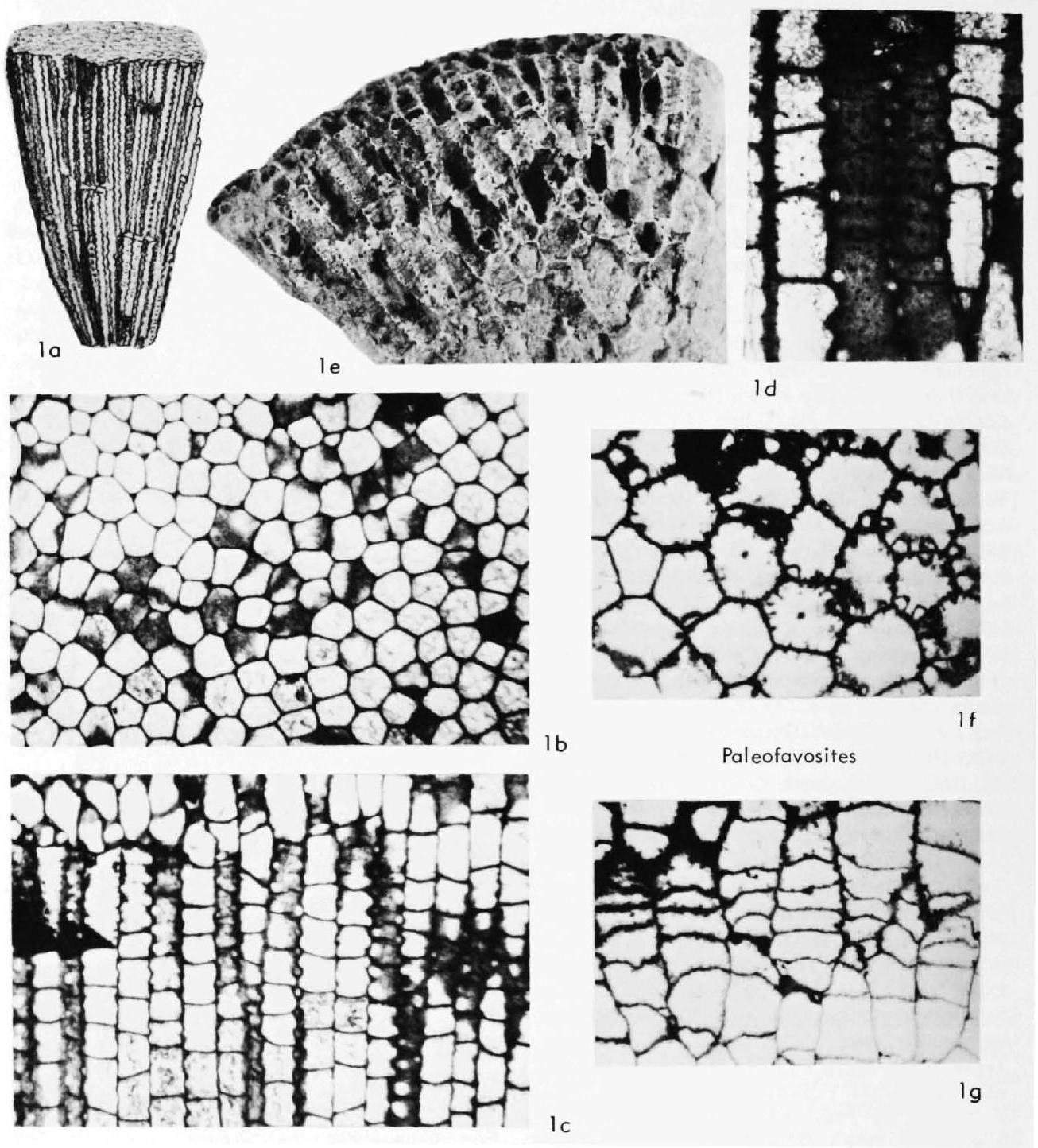 Fig. 361,1a-d. *P. asper (D'Orbigny), holotype, M.Sil.(Wenlock. ), U.K., Leinthall Earls, near Ludlow, a, ext. view, X1.0 (Lonsdale, 1839), b, transv. sec., X5.0, c,d, long. secs., X5.0, X10.7, showing tangential section of wall with spines and mural pores (Oekentorp, 1976, photographs courtesy of K. Oekentorp).
Synonyms
Calamopora, Palaeofavosites
Geographic Distribution
Eu. (Urals), U.Ord.-U. Sil.(low.Ludlov. ), Eu.(G.Brit.-Gotl.-Est.-Podolia-Czech.)-Asia(N. & Sev.Zemlya-Taymyr-Sib.Platf.NE. USSR-Afghan.-Uzbek.-Kazakh.-Salair-Altay-Tuva-China)-N. Am. (Arctic-Alaska-Manit.-Ont.-Anticosti-N.Mex.-Texas)-Australia(New S.Wales-Tasm.)
Age Range
Beginning Stage in Treatise Usage:
Up.M.Ord.
Beginning International Stage:
Dapingian
Fraction Up In Beginning Stage:
0
Beginning Date:
471.26
Ending Stage in Treatise Usage:
U. Sil.(low.Ludlov.)
Ending International Stage:
Ludfordian
Fraction Up In Ending Stage:
100
Ending Date:
422.73
Description
Corallum massive, corallites prismatic, thin-walled, mural pores at edges of faces of prisms, alternating in position on either side of the angle giving characteristic wavy appearance to longitudinal section through an angle, each pore opens into two corallites only, septa each represented by a longitudinal row of discrete spines directed upward and inward, tabulae thin, commonly complete and subhorizontal.
References
Museum or Author Information
Classification
Phylum:
Cnidaria
Class:
Anthozoa
Subclass:
Tabulata
Order:
Favositida
Suborder:
Favositina
Superfamily:
Favositicae
Family:
Favositidae
Subfamily:
Paleofavositinae
Formal Genus Name and Reference:
Paleofavosites TWENHOFEL, 1914, p. 24
Type Species:
Favosites asper d'Orbigny, 1850, p. 49, OD, †GSb37263728 (3 parts of corallum), GSM, London, fide Oekentorp, 1976, p. 169, =Favosites alveolaris "de Blainville" LONSDALE, 1839, pl. 15 bis, fig. 1, non Goldfuss
Images
(Click to enlarge in a new window)
Fig. 361,1a-d. *P. asper (D'Orbigny), holotype, M.Sil.(Wenlock. ), U.K., Leinthall Earls, near Ludlow, a, ext. view, X1.0 (Lonsdale, 1839), b, transv. sec., X5.0, c,d, long. secs., X5.0, X10.7, showing tangential section of wall with spines and mural pores (Oekentorp, 1976, photographs courtesy of K. Oekentorp).
Synonyms
Calamopora, Palaeofavosites
Geographic Distribution
Eu. (Urals), U.Ord.-U. Sil.(low.Ludlov. ), Eu.(G.Brit.-Gotl.-Est.-Podolia-Czech.)-Asia(N. & Sev.Zemlya-Taymyr-Sib.Platf.NE. USSR-Afghan.-Uzbek.-Kazakh.-Salair-Altay-Tuva-China)-N. Am. (Arctic-Alaska-Manit.-Ont.-Anticosti-N.Mex.-Texas)-Australia(New S.Wales-Tasm.)
Age Range
Beginning Stage in Treatise Usage:
Up.M.Ord.
Beginning International Stage:
Dapingian
Fraction Up In Beginning Stage:
0
Beginning Date:
471.26
Ending Stage in Treatise Usage:
U. Sil.(low.Ludlov.)
Ending International Stage:
Ludfordian
Fraction Up In Ending Stage:
100
Ending Date:
422.73
Description
Corallum massive, corallites prismatic, thin-walled, mural pores at edges of faces of prisms, alternating in position on either side of the angle giving characteristic wavy appearance to longitudinal section through an angle, each pore opens into two corallites only, septa each represented by a longitudinal row of discrete spines directed upward and inward, tabulae thin, commonly complete and subhorizontal.