
Welcome to the Cnidaria subsite on Invertebrate Paleontology!
Please enter a genera name to retrieve more information.

Peneckiella
Classification
Phylum:
Cnidaria
Class:
Anthozoa
Subclass:
Rugosa
Order:
Stauriida
Suborder:
Columnariina
Family:
Phillipsastreidae
Subfamily:
Group 4
Formal Genus Name and Reference:
Peneckiella SOSHKINA, 1939, p. 23
Type Species:
*Diphyphyllum
minus ROEMER, 1855, p. 29; OD; +117, BA, Clausthal-Zellerfeld
Images
(Click to enlarge in a new window)
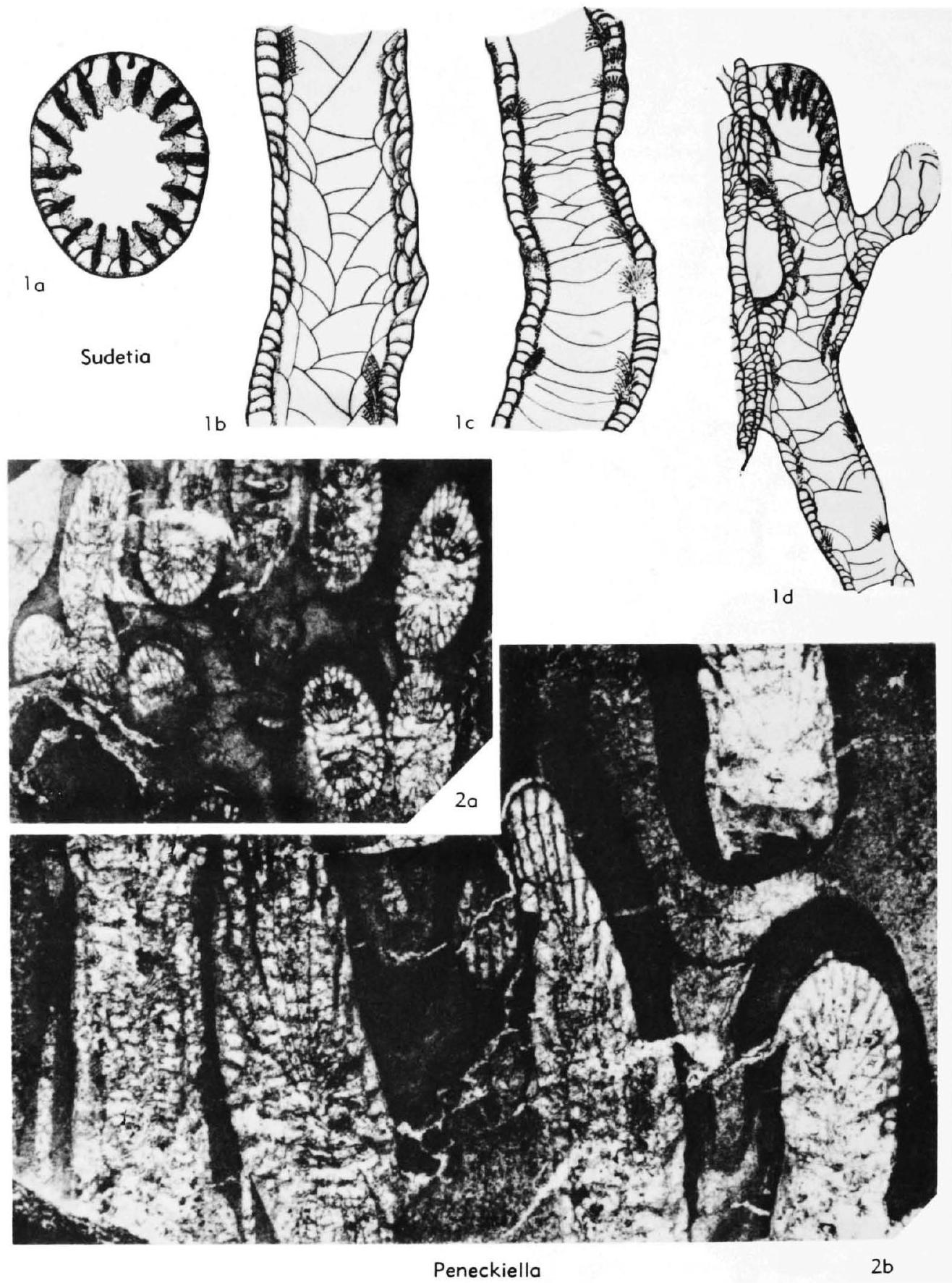 Fig. 186,2a,b. *P. minor (Roemer), holotype, Frasn., Iberg Ls., Ger., Winterburg near Bad Grund, a, b, oblique transv., long. secs., X3,X6 (Scrutton, 1968).
Synonyms
Penenckiella, Phacellophyllum
Geographic Distribution
Australia(New S.Wales), ?M.Dev.(Givet.), W.Australia-N.Am.(Wash.), U. Dev. (Frasn.), Eu. (Ger.-U.K.-Pol.)-W. Australia
Age Range
Beginning Stage in Treatise Usage:
L. Dev.(Ems.)
Beginning International Stage:
Emsian
Fraction Up In Beginning Stage:
0
Beginning Date:
410.51
Ending Stage in Treatise Usage:
L. Dev.(Ems.)
Ending International Stage:
Emsian
Fraction Up In Ending Stage:
100
Ending Date:
394.3
Description
Phaceloid, septa noncarinate but thickened especially at inner edge of dissepimentarium, which is narrow and commonly of one series of globose plates flattened above, each with its inner edge curved down in three-fourths hemisphere to meet plate next below and its outer edge abutting wall at level higher than base of inner edge (peneckielloid), rarely one or a few horseshoe dissepiments are found, septal trabecular fans may occur with zone of divergence at axis of curvature of upper surface of dissepiments, trabeculae rhipidacanths, tabulae commonly in one series and complete, may be flat-topped domes, peripheral tabellae declined adaxially may occur [HILL & JELL, 1970b, p. 30; SCRUTTON, 1968, p.271]
References
Museum or Author Information
Classification
Phylum:
Cnidaria
Class:
Anthozoa
Subclass:
Rugosa
Order:
Stauriida
Suborder:
Columnariina
Family:
Phillipsastreidae
Subfamily:
Group 4
Formal Genus Name and Reference:
Peneckiella SOSHKINA, 1939, p. 23
Type Species:
*Diphyphyllum
minus ROEMER, 1855, p. 29; OD; +117, BA, Clausthal-Zellerfeld
Images
(Click to enlarge in a new window)
Fig. 186,2a,b. *P. minor (Roemer), holotype, Frasn., Iberg Ls., Ger., Winterburg near Bad Grund, a, b, oblique transv., long. secs., X3,X6 (Scrutton, 1968).
Synonyms
Penenckiella, Phacellophyllum
Geographic Distribution
Australia(New S.Wales), ?M.Dev.(Givet.), W.Australia-N.Am.(Wash.), U. Dev. (Frasn.), Eu. (Ger.-U.K.-Pol.)-W. Australia
Age Range
Beginning Stage in Treatise Usage:
L. Dev.(Ems.)
Beginning International Stage:
Emsian
Fraction Up In Beginning Stage:
0
Beginning Date:
410.51
Ending Stage in Treatise Usage:
L. Dev.(Ems.)
Ending International Stage:
Emsian
Fraction Up In Ending Stage:
100
Ending Date:
394.3
Description
Phaceloid, septa noncarinate but thickened especially at inner edge of dissepimentarium, which is narrow and commonly of one series of globose plates flattened above, each with its inner edge curved down in three-fourths hemisphere to meet plate next below and its outer edge abutting wall at level higher than base of inner edge (peneckielloid), rarely one or a few horseshoe dissepiments are found, septal trabecular fans may occur with zone of divergence at axis of curvature of upper surface of dissepiments, trabeculae rhipidacanths, tabulae commonly in one series and complete, may be flat-topped domes, peripheral tabellae declined adaxially may occur [HILL & JELL, 1970b, p. 30; SCRUTTON, 1968, p.271]