
Welcome to the Cnidaria subsite on Invertebrate Paleontology!
Please enter a genera name to retrieve more information.

Phaulactis
Classification
Phylum:
Cnidaria
Class:
Anthozoa
Subclass:
Rugosa
Order:
Stauriida
Suborder:
Lykophyllina
Family:
Lykophyllidae
Formal Genus Name and Reference:
Phaulactis RYDER, 1926, p. 392
Type Species:
P. cyathophylloides, OD; tR25469, BM(NH), London; lectotype by LANG & SMITH, 1927, p. 489
Images
(Click to enlarge in a new window)
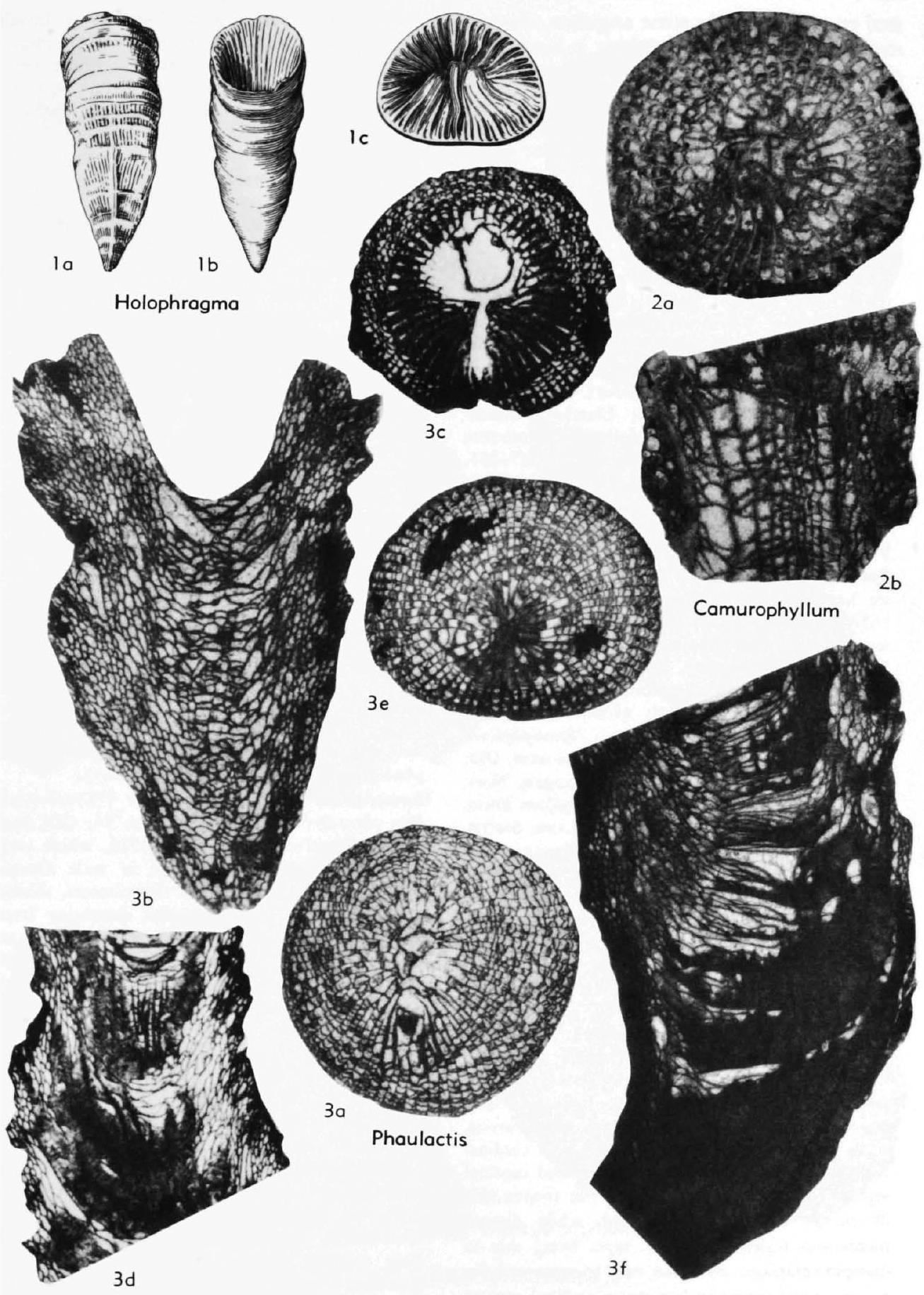 Fig. 159,3a. *P. cyathophylloides, lectotype, Wenlock., Slite Gr., Gotl., Vastergarn; a, transv. sec., X2.0 (Lang & Smith, 1927). --Fig. 159,3b. P. angu.fta (LONSDALE), holotype, U.K., Lickey; b, long. sec., X2.0 (Lang & Smith, 1927). --Fig. 159,3c,d. P. clarkei (WEDEKIND), holotype, Faro, NE. of God.; c,d, transv., long. sees., X 1.5 (Wedekind, 1927). --Fig. 159,3e,f. P. tabulatum (WEDEKIND), holotype, Gotl., Vastkinde, canal through bog S. of Brisund village; e,j, transv., long. sees., X2.0 (Hill, n; Cm54867).
Synonyms
Mesactis, Lykocystiphyllum, Lykophyllum, ?Neocystiphyllum, Semaiophyllum, ?Stratiphyllum, ?Hercophyllum, Semaeophyllum, Prodesmophyllum
Geographic Distribution
Eu. (U.K.-Nor.-Swed.-Podolia)-Asia (Sib. Platf.)-Australia(Queensl.)-N.Am.(Que.)
Age Range
Beginning Stage in Treatise Usage:
Sil.(Llandov.)
Beginning International Stage:
Rhuddanian
Fraction Up In Beginning Stage:
0
Beginning Date:
443.07
Ending Stage in Treatise Usage:
Sil.(Ludlov.)
Ending International Stage:
Ludfordian
Fraction Up In Ending Stage:
100
Ending Date:
422.73
Description
Solitary, in early stages all major septa strongly dilated and contiguous, cardinal septum very long, minor septa very short, in later stages dissepiments first appearing in single series, septal dilatation still pronounced in both cardinal and counter quadrants in tabularium, and cardinal septum shortening so that fossula (on convex side of curved corallum) is marked, while dissepimentarium widens elsewhere, septa being thin in dissepimentarium, dilatation may increase and decrease several times, in late stages cardinal septum may again lengthen but dilatation is slight in both cardinal and counter quadrants, septal arrangement in tabularium irregularly bilateral, each quadrant has individuality in variable curvature and length of major septa; fossula may invade dissepimentarium; tabular floors variable, concave, convex, or subhorizontal, of tabellae; dissepiments small, subglobose, concave toward axis in transverse section and curved or angulate [MINATO, 1961, p. 46].
References
Smith, Stanley, , \& Lang, W. D., , \& Ryder, T. A., 1926, The genus Corwenia, gen. nov.: Ann. Mag. Nat. Hist., ser. 9, v. 17, p. 149-159, pl. 5, 6.
Museum or Author Information
Classification
Phylum:
Cnidaria
Class:
Anthozoa
Subclass:
Rugosa
Order:
Stauriida
Suborder:
Lykophyllina
Family:
Lykophyllidae
Formal Genus Name and Reference:
Phaulactis RYDER, 1926, p. 392
Type Species:
P. cyathophylloides, OD; tR25469, BM(NH), London; lectotype by LANG & SMITH, 1927, p. 489
Images
(Click to enlarge in a new window)
Fig. 159,3a. *P. cyathophylloides, lectotype, Wenlock., Slite Gr., Gotl., Vastergarn; a, transv. sec., X2.0 (Lang & Smith, 1927). --Fig. 159,3b. P. angu.fta (LONSDALE), holotype, U.K., Lickey; b, long. sec., X2.0 (Lang & Smith, 1927). --Fig. 159,3c,d. P. clarkei (WEDEKIND), holotype, Faro, NE. of God.; c,d, transv., long. sees., X 1.5 (Wedekind, 1927). --Fig. 159,3e,f. P. tabulatum (WEDEKIND), holotype, Gotl., Vastkinde, canal through bog S. of Brisund village; e,j, transv., long. sees., X2.0 (Hill, n; Cm54867).
Synonyms
Mesactis, Lykocystiphyllum, Lykophyllum, ?Neocystiphyllum, Semaiophyllum, ?Stratiphyllum, ?Hercophyllum, Semaeophyllum, Prodesmophyllum
Geographic Distribution
Eu. (U.K.-Nor.-Swed.-Podolia)-Asia (Sib. Platf.)-Australia(Queensl.)-N.Am.(Que.)
Age Range
Beginning Stage in Treatise Usage:
Sil.(Llandov.)
Beginning International Stage:
Rhuddanian
Fraction Up In Beginning Stage:
0
Beginning Date:
443.07
Ending Stage in Treatise Usage:
Sil.(Ludlov.)
Ending International Stage:
Ludfordian
Fraction Up In Ending Stage:
100
Ending Date:
422.73
Description
Solitary, in early stages all major septa strongly dilated and contiguous, cardinal septum very long, minor septa very short, in later stages dissepiments first appearing in single series, septal dilatation still pronounced in both cardinal and counter quadrants in tabularium, and cardinal septum shortening so that fossula (on convex side of curved corallum) is marked, while dissepimentarium widens elsewhere, septa being thin in dissepimentarium, dilatation may increase and decrease several times, in late stages cardinal septum may again lengthen but dilatation is slight in both cardinal and counter quadrants, septal arrangement in tabularium irregularly bilateral, each quadrant has individuality in variable curvature and length of major septa; fossula may invade dissepimentarium; tabular floors variable, concave, convex, or subhorizontal, of tabellae; dissepiments small, subglobose, concave toward axis in transverse section and curved or angulate [MINATO, 1961, p. 46].
References
Smith, Stanley, , \& Lang, W. D., , \& Ryder, T. A., 1926, The genus Corwenia, gen. nov.: Ann. Mag. Nat. Hist., ser. 9, v. 17, p. 149-159, pl. 5, 6.