
Welcome to the Cnidaria subsite on Invertebrate Paleontology!
Please enter a genera name to retrieve more information.
Phillipsastrea
Classification
Phylum:
Cnidaria
Class:
Anthozoa
Subclass:
Rugosa
Order:
Stauriida
Suborder:
Columnariina
Family:
Phillipsastreidae
Subfamily:
Group 1
Formal Genus Name and Reference:
Phillipsastrea D'ORBIGNY, 1849, p. 12
Type Species:
Astrea (Siderastrea) hennahii Lonsdale, 1840, p. 697, SD Milne-Edwards & Haime, 1850, p. xxi, †6185, Geol. Soc. Coll., GSM, London, lectotype by Milne-Edwards & HATME, 1851, p. 421
Images
(Click to enlarge in a new window)
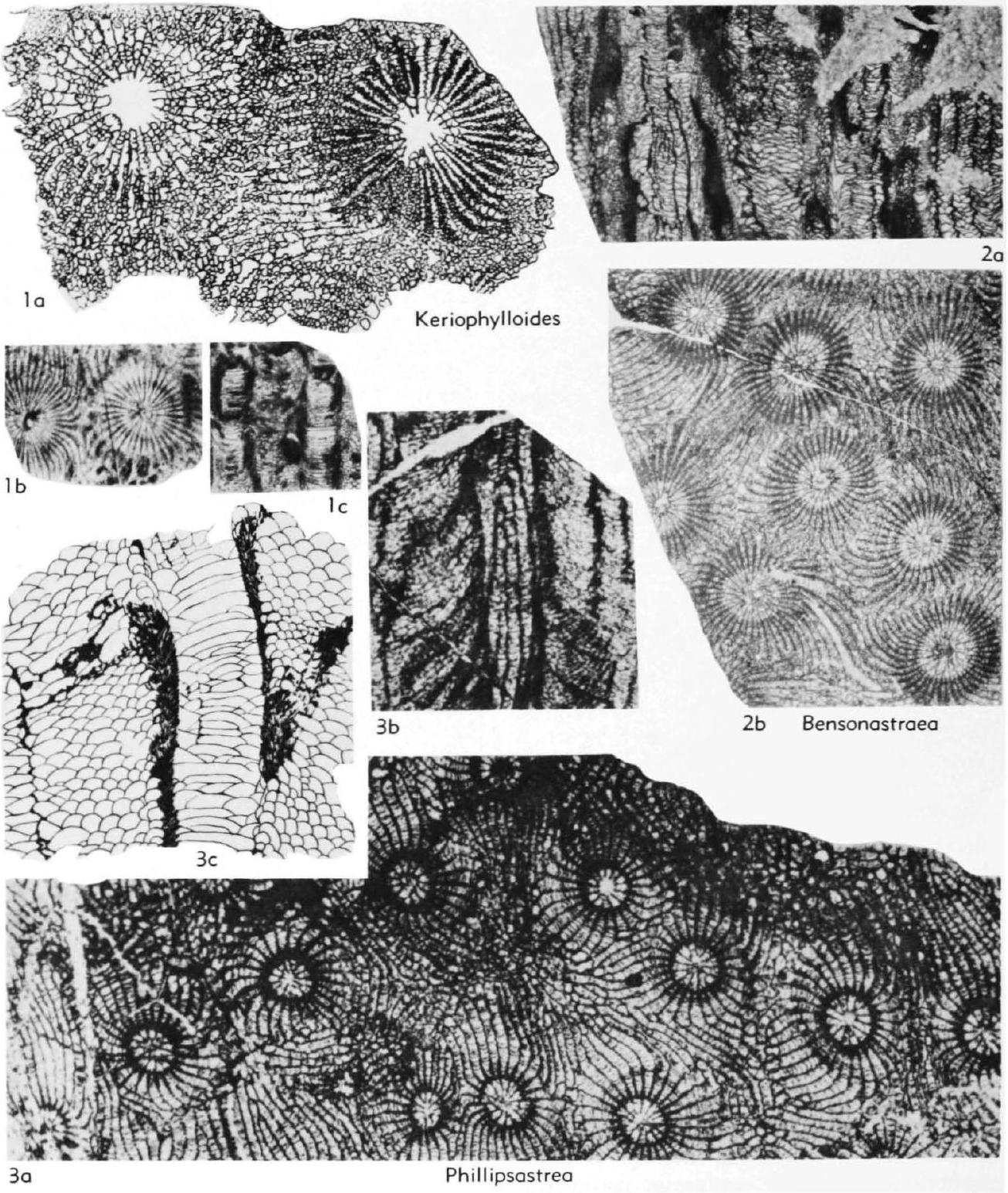 Fig. 181, 3a-c. *P. hennahi (Lonsdale), a,b, lectotype, up. Givet., U.K., Barton Quarry, near Torquay, transv., long. secs., X2.3,X3.0, c, another specimen, long. sec., X4.5 (Scrutton, 1968)
Synonyms
Phillipsastraea, ?Pachyphyllum, Smithia, Astrea hennahi, ?Streptastrea,?Pseudoacervularia, Streptastraea,?Keriophylloides
Geographic Distribution
Australia(Queensl.)Eu. (Spain), ?M.Dev., Australia(Queensl. ), L.Dev. (Siegen.-Ems. ), Australia(Vict.-New S.Wales)-Eu. (France), M.Dev., Eu. (U.K.-France)-Asia(Urals-Yunnan)-Australia(New S.Wales)-N.Am.(Wash. ), U.Dev.(Frasn. ), Eu. (U.K.-France-Ger.-Belg.-Pol.-Urals-Timan-Vaygash)-Asia (Armenia-Kuzbas-NE. USSR)-N.Am.(NW.Terr.-Alberta)
Age Range
Beginning Stage in Treatise Usage:
L.Dev.
Beginning International Stage:
Lochkovian
Fraction Up In Beginning Stage:
0
Beginning Date:
419
Ending Stage in Treatise Usage:
L.Dev.
Ending International Stage:
Emsian
Fraction Up In Ending Stage:
100
Ending Date:
394.3
Description
Thamnasterioid or in places astreoid or aphroid, pipe of small horseshoe dissepiments surrounds tabularium, and rhipidacanthine septal trabeculae are fanned over horseshoes, septa fusiform in transverse section, thickest at edge of tabularium, tabulae complete or incomplete, dissepimentarial floors reflexed from pipe of horseshoes [SCRUTTON, 1968, p. 210; JELL, 1969, p. 63].
References
Museum or Author Information
Classification
Phylum:
Cnidaria
Class:
Anthozoa
Subclass:
Rugosa
Order:
Stauriida
Suborder:
Columnariina
Family:
Phillipsastreidae
Subfamily:
Group 1
Formal Genus Name and Reference:
Phillipsastrea D'ORBIGNY, 1849, p. 12
Type Species:
Astrea (Siderastrea) hennahii Lonsdale, 1840, p. 697, SD Milne-Edwards & Haime, 1850, p. xxi, †6185, Geol. Soc. Coll., GSM, London, lectotype by Milne-Edwards & HATME, 1851, p. 421
Images
(Click to enlarge in a new window)
Fig. 181, 3a-c. *P. hennahi (Lonsdale), a,b, lectotype, up. Givet., U.K., Barton Quarry, near Torquay, transv., long. secs., X2.3,X3.0, c, another specimen, long. sec., X4.5 (Scrutton, 1968)
Synonyms
Phillipsastraea, ?Pachyphyllum, Smithia, Astrea hennahi, ?Streptastrea,?Pseudoacervularia, Streptastraea,?Keriophylloides
Geographic Distribution
Australia(Queensl.)Eu. (Spain), ?M.Dev., Australia(Queensl. ), L.Dev. (Siegen.-Ems. ), Australia(Vict.-New S.Wales)-Eu. (France), M.Dev., Eu. (U.K.-France)-Asia(Urals-Yunnan)-Australia(New S.Wales)-N.Am.(Wash. ), U.Dev.(Frasn. ), Eu. (U.K.-France-Ger.-Belg.-Pol.-Urals-Timan-Vaygash)-Asia (Armenia-Kuzbas-NE. USSR)-N.Am.(NW.Terr.-Alberta)
Age Range
Beginning Stage in Treatise Usage:
L.Dev.
Beginning International Stage:
Lochkovian
Fraction Up In Beginning Stage:
0
Beginning Date:
419
Ending Stage in Treatise Usage:
L.Dev.
Ending International Stage:
Emsian
Fraction Up In Ending Stage:
100
Ending Date:
394.3
Description
Thamnasterioid or in places astreoid or aphroid, pipe of small horseshoe dissepiments surrounds tabularium, and rhipidacanthine septal trabeculae are fanned over horseshoes, septa fusiform in transverse section, thickest at edge of tabularium, tabulae complete or incomplete, dissepimentarial floors reflexed from pipe of horseshoes [SCRUTTON, 1968, p. 210; JELL, 1969, p. 63].