
Welcome to the Cnidaria subsite on Invertebrate Paleontology!
Please enter a genera name to retrieve more information.
Pleurodictyum
Classification
Phylum:
Cnidaria
Class:
Anthozoa
Subclass:
Tabulata
Order:
Favositida
Suborder:
Favositina
Superfamily:
Favositicae
Family:
Micheliniidae
Subfamily:
Micheliniinae
Formal Genus Name and Reference:
Pleurodictyum GOLDFUSS, 1829, p. 113
Type Species:
P. problematicum; M; +missing from GOLDFUSS Coll., IP, Bonn
Images
(Click to enlarge in a new window)
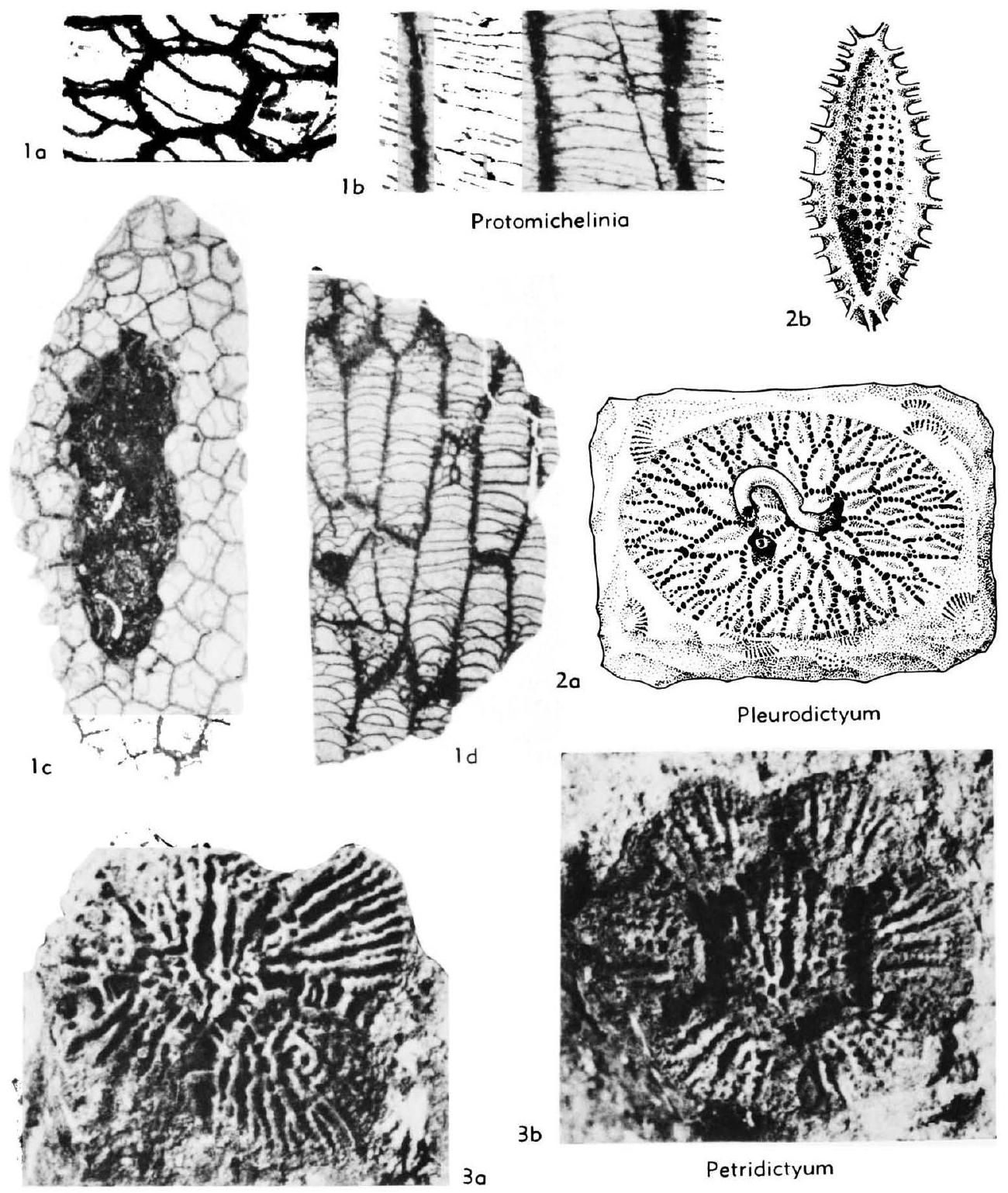 Fig. 377,2a,b. *P. problematicum, syn-type, L.Dev.(Eifel. or Nassauian), Ger.; a, ext. view of internal mold of proximal part of decalcified specimen, X1; b, one corallite, enl. (Goldfuss, 1829).
Synonyms
Ligulodictyum
Geographic Distribution
N.Am.(Ky.-Tenn.)-Australia(New S.Wales); L.Dev.-M.Dev., Eu.(Ger.-France-Belg.-U.K.) -Asia (Kazakh.-Tuva-Salair-R.Amur-Kolyma Basin-NE.USSR)-Australia(New S.Wales-Vict.)-N.Am. (Ind.-Ky.-Mich.-N.Y.)-N.Afr.(Moroc.-Sahaca-Alg.)
Age Range
Beginning Stage in Treatise Usage:
U.Sil. (Ludlov.)
Beginning International Stage:
Gorstian
Fraction Up In Beginning Stage:
0
Beginning Date:
426.74
Ending Stage in Treatise Usage:
U.Sil. (Ludlov.)
Ending International Stage:
Ludfordian
Fraction Up In Ending Stage:
100
Ending Date:
422.73
Description
Corallum cerioid, discoid or a low dome, with flat or slightly concave base covered with concentrically wrinkled holotheca; frequently with tube of commensal worm Hieetes CLARKE, 1908; corallites large, commonly short, prismatic, with walls bearing septal ridges or rows of spines, or spinose ridges; walls thick, pierced by numerous mural tunnels; tabulae typically absent, when present complete or incomplete, horizontal, convex or concave [see PLUSQUELLEC, 1965, p. 9].
References
Museum or Author Information
Classification
Phylum:
Cnidaria
Class:
Anthozoa
Subclass:
Tabulata
Order:
Favositida
Suborder:
Favositina
Superfamily:
Favositicae
Family:
Micheliniidae
Subfamily:
Micheliniinae
Formal Genus Name and Reference:
Pleurodictyum GOLDFUSS, 1829, p. 113
Type Species:
P. problematicum; M; +missing from GOLDFUSS Coll., IP, Bonn
Images
(Click to enlarge in a new window)
Fig. 377,2a,b. *P. problematicum, syn-type, L.Dev.(Eifel. or Nassauian), Ger.; a, ext. view of internal mold of proximal part of decalcified specimen, X1; b, one corallite, enl. (Goldfuss, 1829).
Synonyms
Ligulodictyum
Geographic Distribution
N.Am.(Ky.-Tenn.)-Australia(New S.Wales); L.Dev.-M.Dev., Eu.(Ger.-France-Belg.-U.K.) -Asia (Kazakh.-Tuva-Salair-R.Amur-Kolyma Basin-NE.USSR)-Australia(New S.Wales-Vict.)-N.Am. (Ind.-Ky.-Mich.-N.Y.)-N.Afr.(Moroc.-Sahaca-Alg.)
Age Range
Beginning Stage in Treatise Usage:
U.Sil. (Ludlov.)
Beginning International Stage:
Gorstian
Fraction Up In Beginning Stage:
0
Beginning Date:
426.74
Ending Stage in Treatise Usage:
U.Sil. (Ludlov.)
Ending International Stage:
Ludfordian
Fraction Up In Ending Stage:
100
Ending Date:
422.73
Description
Corallum cerioid, discoid or a low dome, with flat or slightly concave base covered with concentrically wrinkled holotheca; frequently with tube of commensal worm Hieetes CLARKE, 1908; corallites large, commonly short, prismatic, with walls bearing septal ridges or rows of spines, or spinose ridges; walls thick, pierced by numerous mural tunnels; tabulae typically absent, when present complete or incomplete, horizontal, convex or concave [see PLUSQUELLEC, 1965, p. 9].