
Welcome to the Cnidaria subsite on Invertebrate Paleontology!
Please enter a genera name to retrieve more information.

Radiastraea
Classification
Phylum:
Cnidaria
Class:
Anthozoa
Subclass:
Rugosa
Order:
Stauriida
Suborder:
Columnariina
Family:
Disphyllidae
Subfamily:
Paradisphyllinae
Formal Genus Name and Reference:
Radiastraea STUMM, 1937, p. 439
Type Species:
R. arachne, OD, † 94458, USNM, Washington
Images
(Click to enlarge in a new window)
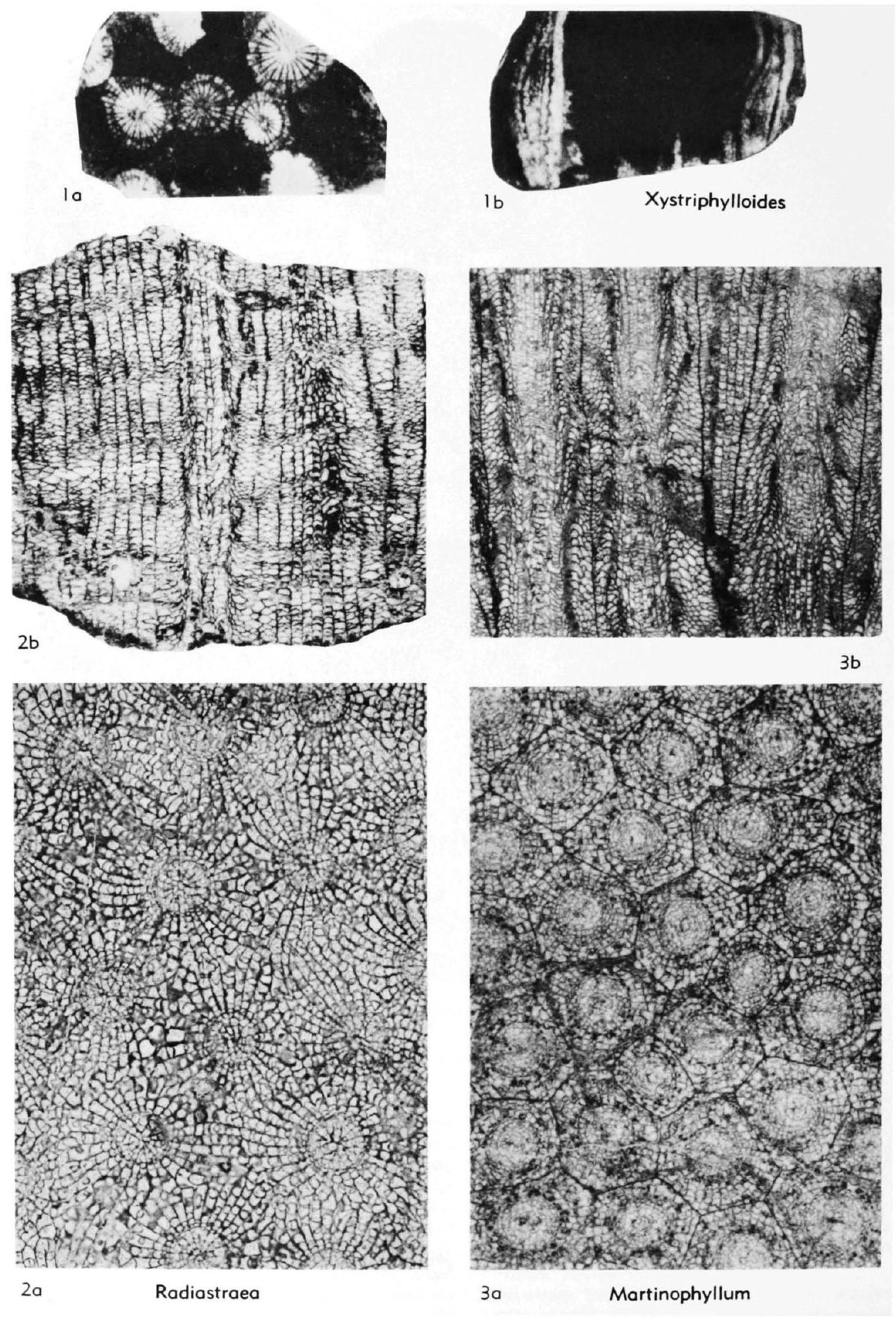 Fig. 175,2a,b. *R. arachne, holotype, L.Dev.(Zlich.), basal 500 ft. of Nevada Ls., Nev., Lone Mt., 18 mi. NW. of Eureka; a,b, transv., long. secs., X2 (Hill, n; photographs courtesy W. A. Oliver).
Synonyms
Geographic Distribution
N.Am.(Can.Arctic); L.Dev.(Ems.), N.Am.(Nev.)- Australia(Queensl.-New S.Wales); low.M.Dev., N.Am.(NW.Terr.-Nev.)
Age Range
Beginning Stage in Treatise Usage:
U.Sil.
Beginning International Stage:
Gorstian
Fraction Up In Beginning Stage:
0
Beginning Date:
426.74
Ending Stage in Treatise Usage:
U.Sil.
Ending International Stage:
Pridoli
Fraction Up In Ending Stage:
100
Ending Date:
419
Description
Thamnasterioid or astreoid, major and minor septa long attenuate, major septa almost reaching axis; tabulae complete or incomplete, with narrow axial zone of tabellae forming impersistent axial structure, and periaxial zone of subhorizontal tabellae; dissepiments numerous, small, horizontally based except at inner margin of dissepimentarium; trabecular arrangement within septa not known.
References
Stumm, E. C., 1937, The lower Middle Devonian tetracorals of the Nevada Limestone: J. Paleontol., v. 11, p. 423-443, pl. 53-55.
Museum or Author Information
Classification
Phylum:
Cnidaria
Class:
Anthozoa
Subclass:
Rugosa
Order:
Stauriida
Suborder:
Columnariina
Family:
Disphyllidae
Subfamily:
Paradisphyllinae
Formal Genus Name and Reference:
Radiastraea STUMM, 1937, p. 439
Type Species:
R. arachne, OD, † 94458, USNM, Washington
Images
(Click to enlarge in a new window)
Fig. 175,2a,b. *R. arachne, holotype, L.Dev.(Zlich.), basal 500 ft. of Nevada Ls., Nev., Lone Mt., 18 mi. NW. of Eureka; a,b, transv., long. secs., X2 (Hill, n; photographs courtesy W. A. Oliver).
Synonyms
Geographic Distribution
N.Am.(Can.Arctic); L.Dev.(Ems.), N.Am.(Nev.)- Australia(Queensl.-New S.Wales); low.M.Dev., N.Am.(NW.Terr.-Nev.)
Age Range
Beginning Stage in Treatise Usage:
U.Sil.
Beginning International Stage:
Gorstian
Fraction Up In Beginning Stage:
0
Beginning Date:
426.74
Ending Stage in Treatise Usage:
U.Sil.
Ending International Stage:
Pridoli
Fraction Up In Ending Stage:
100
Ending Date:
419
Description
Thamnasterioid or astreoid, major and minor septa long attenuate, major septa almost reaching axis; tabulae complete or incomplete, with narrow axial zone of tabellae forming impersistent axial structure, and periaxial zone of subhorizontal tabellae; dissepiments numerous, small, horizontally based except at inner margin of dissepimentarium; trabecular arrangement within septa not known.
References
Stumm, E. C., 1937, The lower Middle Devonian tetracorals of the Nevada Limestone: J. Paleontol., v. 11, p. 423-443, pl. 53-55.