
Welcome to the Cnidaria subsite on Invertebrate Paleontology!
Please enter a genera name to retrieve more information.
Radiophyllum
Classification
Phylum:
Cnidaria
Class:
Anthozoa
Subclass:
Rugosa
Order:
Stauriida
Suborder:
Cyathophyllina
Family:
Cyathophyllidae
Formal Genus Name and Reference:
Radiophyllum HILL, 1942b, p. 17
Type Species:
Entelophyllum arborescens Hill & JONES, 1940, p. 188, OD, † P6190, SU, Sydney
Images
(Click to enlarge in a new window)
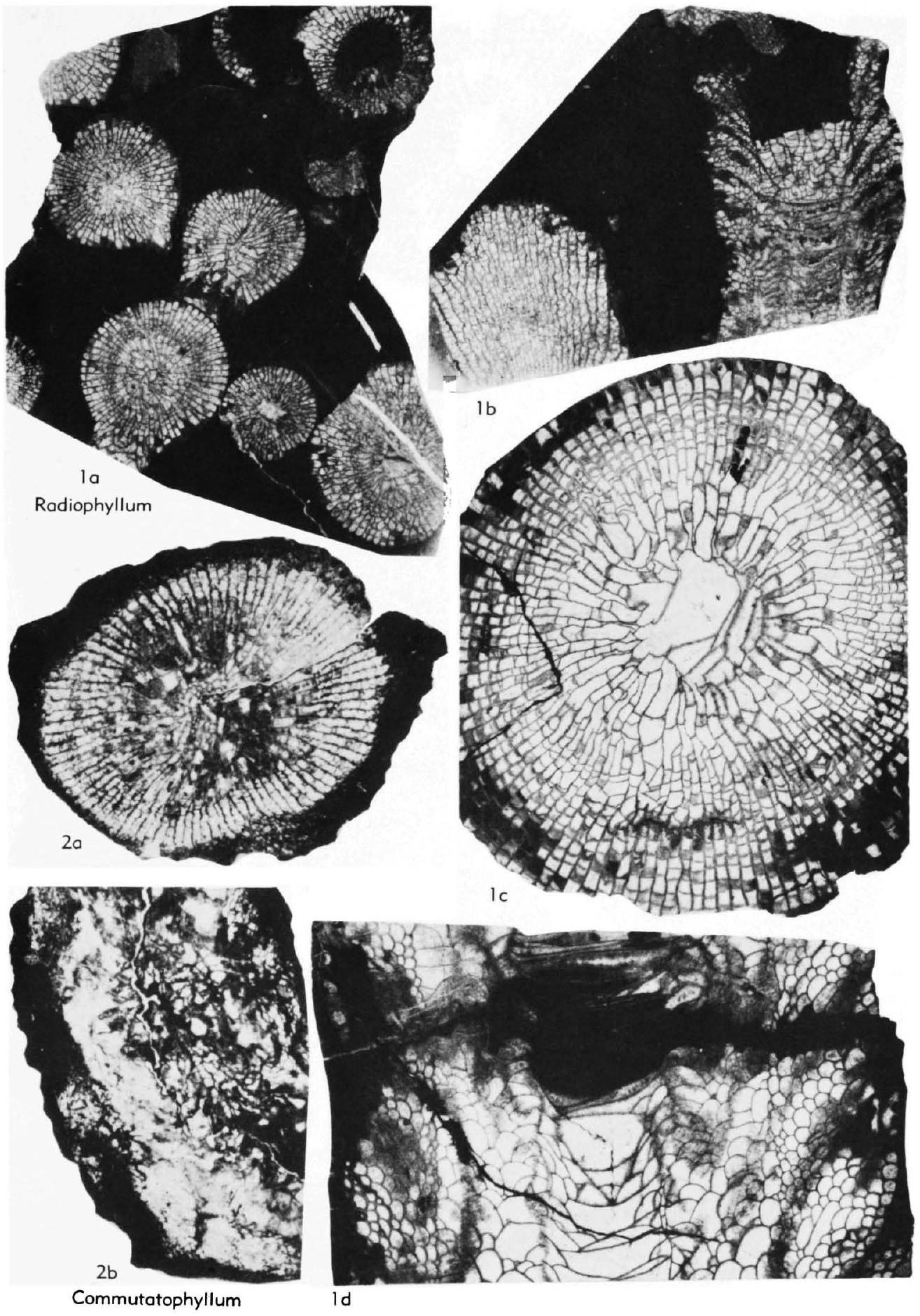 Fig. 194,la,b. *R. arborescens (HILL & JONES), topotype, late ?Siegen. or Ems., Garra F., Nora Cr., New S. Wales, near Molong; a,b, transv., long. sees., XI.5 (Hill, n; photographs courtesy D. Strusz, SU6189). --Fig. 194,lc,d. R. amplum (PEDDER), holotype, late Ems. or early Couvin., upper part of Sulcor Ls., New S. Wales, near Attunga; c,d, transv., long. sees., X 1.5 (Pedder, 1965a; photographs courtesy A. H.
Pedder).
Fig. 194,la,b. *R. arborescens (HILL & JONES), topotype, late ?Siegen. or Ems., Garra F., Nora Cr., New S. Wales, near Molong; a,b, transv., long. sees., XI.5 (Hill, n; photographs courtesy D. Strusz, SU6189). --Fig. 194,lc,d. R. amplum (PEDDER), holotype, late Ems. or early Couvin., upper part of Sulcor Ls., New S. Wales, near Attunga; c,d, transv., long. sees., X 1.5 (Pedder, 1965a; photographs courtesy A. H.
Pedder).
Synonyms
Stathmoelasma
Geographic Distribution
Asia (Kuzbas); L.Dev.(Siegen.-Ems.}-M.Dev.( Couvin.),
Australia(New S.Wales-Queensl.)-Asia(Amur R.-
Transcauc.)
Age Range
Beginning Stage in Treatise Usage:
L.Dev.(Gedinn.)
Beginning International Stage:
Lochkovian
Fraction Up In Beginning Stage:
0
Beginning Date:
419
Ending Stage in Treatise Usage:
L.Dev.(Gedinn.)
Ending International Stage:
Lochkovian
Fraction Up In Ending Stage:
100
Ending Date:
412.4
Description
Fasciculate or solitary, mature corallites large; septa numerous, straight or slightly flexuose, commonly thin but may be weakly fusiform in transverse section; carinae absent or alternate and weakly developed; major septa subequal, may reach axis but commonl withdrawn, cardinal septum may be shorter; tabularial floors domed when septa are longest, but shaped like hat with central dent and outturned or upturned brim when septa somewhat withdrawn, tabulae commonly incomplete; when septa strongly withdrawn tabulae may be complete and mesa-shaped; dissepimentarium wide, floors fairlysteeply declined adaxially, dissepiments subglobose to globose, commonly small and subequal [STRUSZ & JELL, 1970, p. 122].
References
Museum or Author Information
Classification
Phylum:
Cnidaria
Class:
Anthozoa
Subclass:
Rugosa
Order:
Stauriida
Suborder:
Cyathophyllina
Family:
Cyathophyllidae
Formal Genus Name and Reference:
Radiophyllum HILL, 1942b, p. 17
Type Species:
Entelophyllum arborescens Hill & JONES, 1940, p. 188, OD, † P6190, SU, Sydney
Images
(Click to enlarge in a new window)
Fig. 194,la,b. *R. arborescens (HILL & JONES), topotype, late ?Siegen. or Ems., Garra F., Nora Cr., New S. Wales, near Molong; a,b, transv., long. sees., XI.5 (Hill, n; photographs courtesy D. Strusz, SU6189). --Fig. 194,lc,d. R. amplum (PEDDER), holotype, late Ems. or early Couvin., upper part of Sulcor Ls., New S. Wales, near Attunga; c,d, transv., long. sees., X 1.5 (Pedder, 1965a; photographs courtesy A. H.
Pedder).
Synonyms
Stathmoelasma
Geographic Distribution
Asia (Kuzbas); L.Dev.(Siegen.-Ems.}-M.Dev.( Couvin.),
Australia(New S.Wales-Queensl.)-Asia(Amur R.-
Transcauc.)
Age Range
Beginning Stage in Treatise Usage:
L.Dev.(Gedinn.)
Beginning International Stage:
Lochkovian
Fraction Up In Beginning Stage:
0
Beginning Date:
419
Ending Stage in Treatise Usage:
L.Dev.(Gedinn.)
Ending International Stage:
Lochkovian
Fraction Up In Ending Stage:
100
Ending Date:
412.4
Description
Fasciculate or solitary, mature corallites large; septa numerous, straight or slightly flexuose, commonly thin but may be weakly fusiform in transverse section; carinae absent or alternate and weakly developed; major septa subequal, may reach axis but commonl withdrawn, cardinal septum may be shorter; tabularial floors domed when septa are longest, but shaped like hat with central dent and outturned or upturned brim when septa somewhat withdrawn, tabulae commonly incomplete; when septa strongly withdrawn tabulae may be complete and mesa-shaped; dissepimentarium wide, floors fairlysteeply declined adaxially, dissepiments subglobose to globose, commonly small and subequal [STRUSZ & JELL, 1970, p. 122].