
Welcome to the Cnidaria subsite on Invertebrate Paleontology!
Please enter a genera name to retrieve more information.
Siphonodendron
Classification
Phylum:
Cnidaria
Class:
Anthozoa
Subclass:
Rugosa
Order:
Stauriida
Suborder:
Lithostrotionina
Family:
Lithostrotionidae
Subfamily:
Lithostrotioninae
Formal Genus Name and Reference:
Siphonodendron MCCOY, 1849, p. 127, diagnosed and figured but no species named
Type Species:
S. aggregatum McCoy, 1851b, p. 108, SD Chi, 1931, p. 26, invalid nom. subst. pro Lithodendron pauciradialis McCov, 1844, p. 189, *, Griffith Coll., NM, Dublin, lectotype by HILL, 1938-1941, p. 169, L.Carb., Lower Limestone, Magheramore, Tobercurry, Co. Sligo, Eire
Images
(Click to enlarge in a new window)
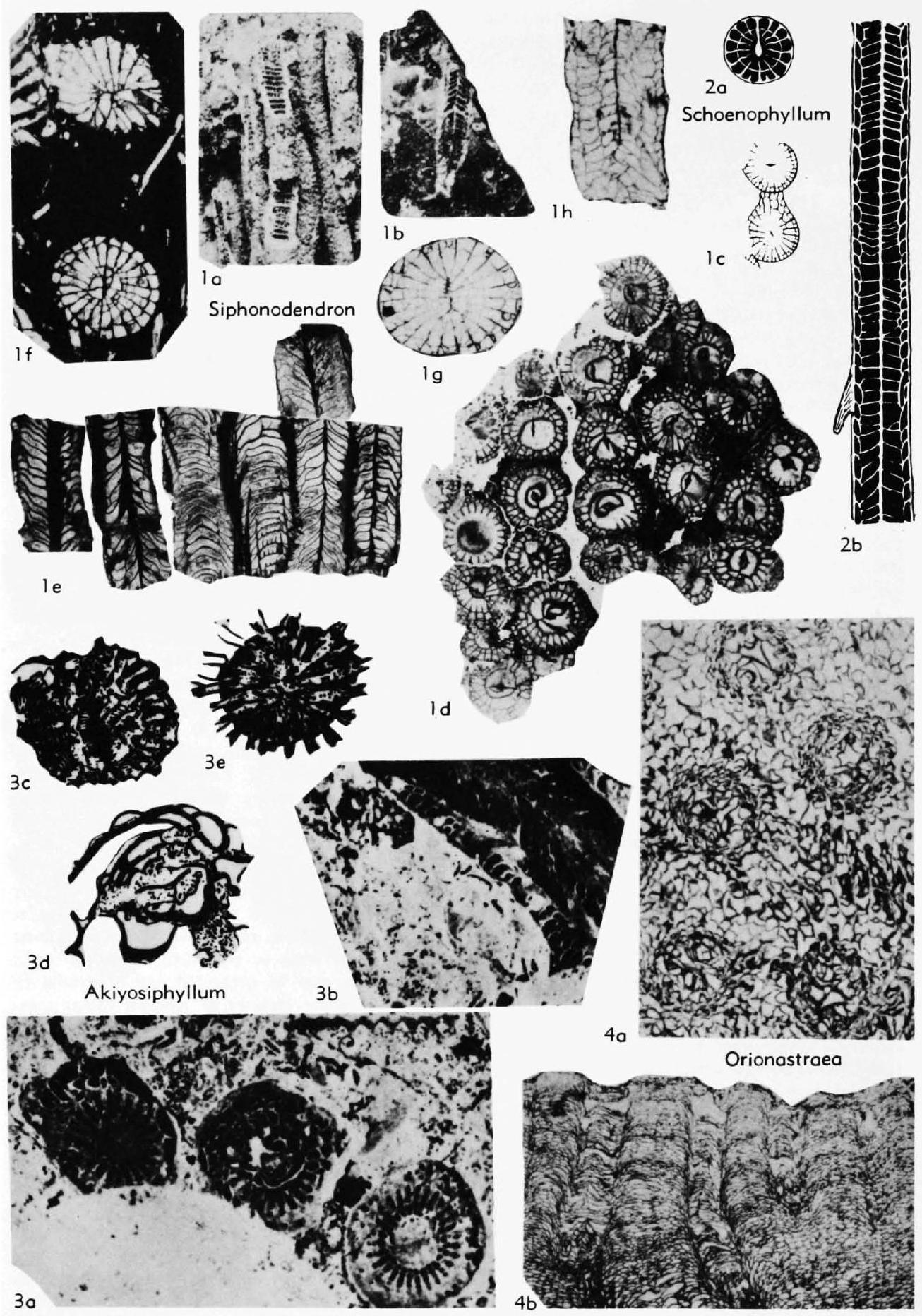 Fig. 249,1a-c. * S. pauciradiale (McCov), lectotype, a,b, ext. views, X1, c, transv. sec., X2 (Hill, 1938-1941). --Fig. 249,1d,e. S.aggregatum, L.Carb., D2, Merionethshire, Corwen; d,e, transv., long. sees., X2 (Hill, n; A1996, SM, Cambridge). --Fig. 129,lf-h. ?S. intermedium (CHI), holotype; f-h, transv., long. sees., X3 (Chi, 1931).
Synonyms
Cystidendron, ?Stylostrotion
Geographic Distribution
Eu. (Brit. I.-Belg.-France-Ger.-Pol.-USSR)-N. Afr. (W. Sahara-Alg. )-Asia (Turkey-E. Urals-Kazakh.-Kuzbas - Tibet - China - Indoch. - Japan - Taymyr -NE.USSR)-Australia(Queensl.-New S.Wales), *. Miss.(Meramec.-Chester. ), N.Am. (E.USA-W.USA-W.Can.-Alaska), U.Carb., Eu.(USSR-Czech. )-Asia (China)
Age Range
Beginning Stage in Treatise Usage:
L.Carb.
Beginning International Stage:
Tournaisian
Fraction Up In Beginning Stage:
0
Beginning Date:
359.3
Ending Stage in Treatise Usage:
U.Carb.(Namur.)
Ending International Stage:
Bashkirian
Fraction Up In Ending Stage:
48.4
Ending Date:
319.4
Description
Fasciculate, increase predominantly lateral, corallites with columella thinly lenticular in transverse section, continuous with both counter and cardinal septa or with counter septum only, major septa may be connected with columella by crests on upper surfaces of tabulae, minor septa short to long, tabular floors conical, tabulae complete or incomplete when tabellae are commonly in only indistinctly bounded axial and periaxial zones, dissepimentarium normally concentric, diphymorphic corallites in which columella fails and tabulae become domed or nearly flat may occur within normal coralla, cardinal fossula not distinct.
References
Museum or Author Information
Classification
Phylum:
Cnidaria
Class:
Anthozoa
Subclass:
Rugosa
Order:
Stauriida
Suborder:
Lithostrotionina
Family:
Lithostrotionidae
Subfamily:
Lithostrotioninae
Formal Genus Name and Reference:
Siphonodendron MCCOY, 1849, p. 127, diagnosed and figured but no species named
Type Species:
S. aggregatum McCoy, 1851b, p. 108, SD Chi, 1931, p. 26, invalid nom. subst. pro Lithodendron pauciradialis McCov, 1844, p. 189, *, Griffith Coll., NM, Dublin, lectotype by HILL, 1938-1941, p. 169, L.Carb., Lower Limestone, Magheramore, Tobercurry, Co. Sligo, Eire
Images
(Click to enlarge in a new window)
Fig. 249,1a-c. * S. pauciradiale (McCov), lectotype, a,b, ext. views, X1, c, transv. sec., X2 (Hill, 1938-1941). --Fig. 249,1d,e. S.aggregatum, L.Carb., D2, Merionethshire, Corwen; d,e, transv., long. sees., X2 (Hill, n; A1996, SM, Cambridge). --Fig. 129,lf-h. ?S. intermedium (CHI), holotype; f-h, transv., long. sees., X3 (Chi, 1931).
Synonyms
Cystidendron, ?Stylostrotion
Geographic Distribution
Eu. (Brit. I.-Belg.-France-Ger.-Pol.-USSR)-N. Afr. (W. Sahara-Alg. )-Asia (Turkey-E. Urals-Kazakh.-Kuzbas - Tibet - China - Indoch. - Japan - Taymyr -NE.USSR)-Australia(Queensl.-New S.Wales), *. Miss.(Meramec.-Chester. ), N.Am. (E.USA-W.USA-W.Can.-Alaska), U.Carb., Eu.(USSR-Czech. )-Asia (China)
Age Range
Beginning Stage in Treatise Usage:
L.Carb.
Beginning International Stage:
Tournaisian
Fraction Up In Beginning Stage:
0
Beginning Date:
359.3
Ending Stage in Treatise Usage:
U.Carb.(Namur.)
Ending International Stage:
Bashkirian
Fraction Up In Ending Stage:
48.4
Ending Date:
319.4
Description
Fasciculate, increase predominantly lateral, corallites with columella thinly lenticular in transverse section, continuous with both counter and cardinal septa or with counter septum only, major septa may be connected with columella by crests on upper surfaces of tabulae, minor septa short to long, tabular floors conical, tabulae complete or incomplete when tabellae are commonly in only indistinctly bounded axial and periaxial zones, dissepimentarium normally concentric, diphymorphic corallites in which columella fails and tabulae become domed or nearly flat may occur within normal coralla, cardinal fossula not distinct.