
Welcome to the Cnidaria subsite on Invertebrate Paleontology!
Please enter a genera name to retrieve more information.

Siphonophrentis
Classification
Phylum:
Cnidaria
Class:
Anthozoa
Subclass:
Rugosa
Order:
Stauriida
Suborder:
Stauriina
Family:
Amplexidae
Formal Genus Name and Reference:
Siphonophrentis O'CONNELL, 1914, p. 187
Type Species:
Caryophyllia gigantea LESUEUR, 1820-1821, p. 296, OD; +not traced; M.Dev., Waren near Utica, N.Y.; =Turbinolia buceros var. elongata Rafinesque & Clifford, 1820, p. 233, fide Stumm, 1965, p. 23, †8616, UMMP, Ann Arbor, neotype by Stumm, 1965, p. 23
Images
(Click to enlarge in a new window)
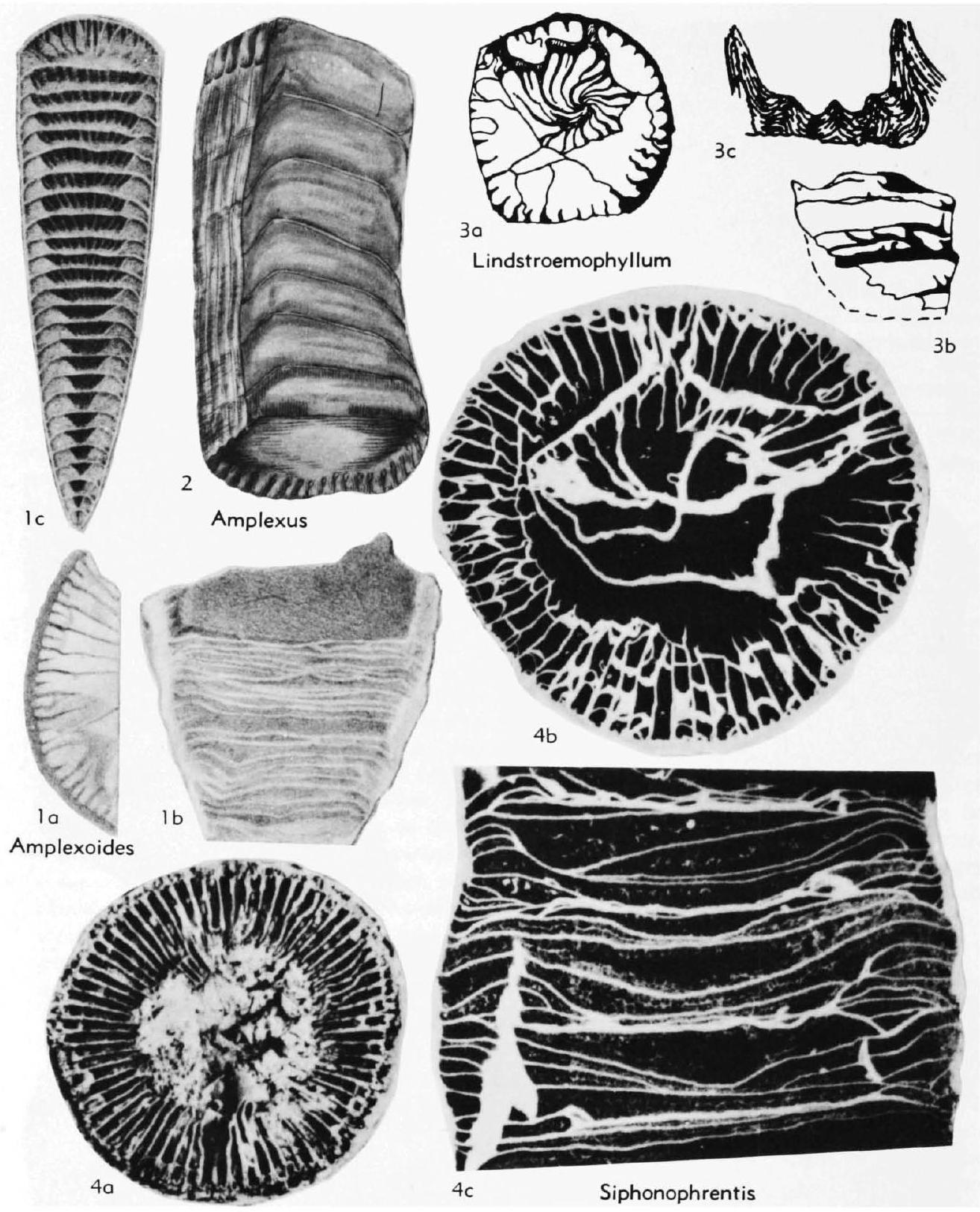 Fig. 79,4a-c. *S. elongata (RAFINESQUE & CLIFFORD); a, neotype, M.Dev., Jeffersonville Ls., Falls of the Ohio, ealieal view, X1; b,c, topotype, long., transv. sees., X1.5 (Stumm, 1965).
Synonyms
Geographic Distribution
N.Am.(N.Y.); M.Detl., N.Am.(N.Y.-Ind.- Ky.-Ohio-Ont.)-Eu. (Eng.-Spain)-N. Afr. (Moroc.-Spanish Sahara)
Age Range
Beginning Stage in Treatise Usage:
L.Dev.
Beginning International Stage:
Lochkovian
Fraction Up In Beginning Stage:
0
Beginning Date:
419
Ending Stage in Treatise Usage:
L.Dev.
Ending International Stage:
Emsian
Fraction Up In Ending Stage:
100
Ending Date:
394.3
Description
Solitary, large, ceratoid to cylindrical, major septa long, numerous, amplexoid, minor septa short longitudinal ridges, their peripheral edges thickened and contiguous with those of major septa to form narrow stereozone, tabulae slightly convex, flat or depressed axially, depressed at fossula with short cardinal septum, no axial structure, no dissepiments. [Sensu STUMM, 1965, p. 23; neotype requires study by thin section before generic and subfamily names may be safely used.]
References
O'Connell, Marjorie, 1914, Revision of the genus Zaphrentis: New York Acad. Sci., Ann., v. 23, p. 177-192.
Museum or Author Information
Classification
Phylum:
Cnidaria
Class:
Anthozoa
Subclass:
Rugosa
Order:
Stauriida
Suborder:
Stauriina
Family:
Amplexidae
Formal Genus Name and Reference:
Siphonophrentis O'CONNELL, 1914, p. 187
Type Species:
Caryophyllia gigantea LESUEUR, 1820-1821, p. 296, OD; +not traced; M.Dev., Waren near Utica, N.Y.; =Turbinolia buceros var. elongata Rafinesque & Clifford, 1820, p. 233, fide Stumm, 1965, p. 23, †8616, UMMP, Ann Arbor, neotype by Stumm, 1965, p. 23
Images
(Click to enlarge in a new window)
Fig. 79,4a-c. *S. elongata (RAFINESQUE & CLIFFORD); a, neotype, M.Dev., Jeffersonville Ls., Falls of the Ohio, ealieal view, X1; b,c, topotype, long., transv. sees., X1.5 (Stumm, 1965).
Synonyms
Geographic Distribution
N.Am.(N.Y.); M.Detl., N.Am.(N.Y.-Ind.- Ky.-Ohio-Ont.)-Eu. (Eng.-Spain)-N. Afr. (Moroc.-Spanish Sahara)
Age Range
Beginning Stage in Treatise Usage:
L.Dev.
Beginning International Stage:
Lochkovian
Fraction Up In Beginning Stage:
0
Beginning Date:
419
Ending Stage in Treatise Usage:
L.Dev.
Ending International Stage:
Emsian
Fraction Up In Ending Stage:
100
Ending Date:
394.3
Description
Solitary, large, ceratoid to cylindrical, major septa long, numerous, amplexoid, minor septa short longitudinal ridges, their peripheral edges thickened and contiguous with those of major septa to form narrow stereozone, tabulae slightly convex, flat or depressed axially, depressed at fossula with short cardinal septum, no axial structure, no dissepiments. [Sensu STUMM, 1965, p. 23; neotype requires study by thin section before generic and subfamily names may be safely used.]
References
O'Connell, Marjorie, 1914, Revision of the genus Zaphrentis: New York Acad. Sci., Ann., v. 23, p. 177-192.