
Welcome to the Cnidaria subsite on Invertebrate Paleontology!
Please enter a genera name to retrieve more information.
Stauria
Classification
Phylum:
Cnidaria
Class:
Anthozoa
Subclass:
Rugosa
Order:
Stauriida
Suborder:
Stauriina
Family:
Stauriidae
Formal Genus Name and Reference:
Stauria Milne-Edwards & HAIME, 1850, p. Ixiv
Type Species:
* S. astreiformis, species not described or figured until Milne-Edwards & Haime, 1851, p. 316, †?unfigured ?syntype, Z115a, in Milne-Edwards & Haime Coll., MN, Paris, +lectotype by Lang, Smith, & Thomas, 1940, p. 122, not traced; =Madrepora favosa LINNÉ, 1758, p. 796, +not traced
Images
(Click to enlarge in a new window)
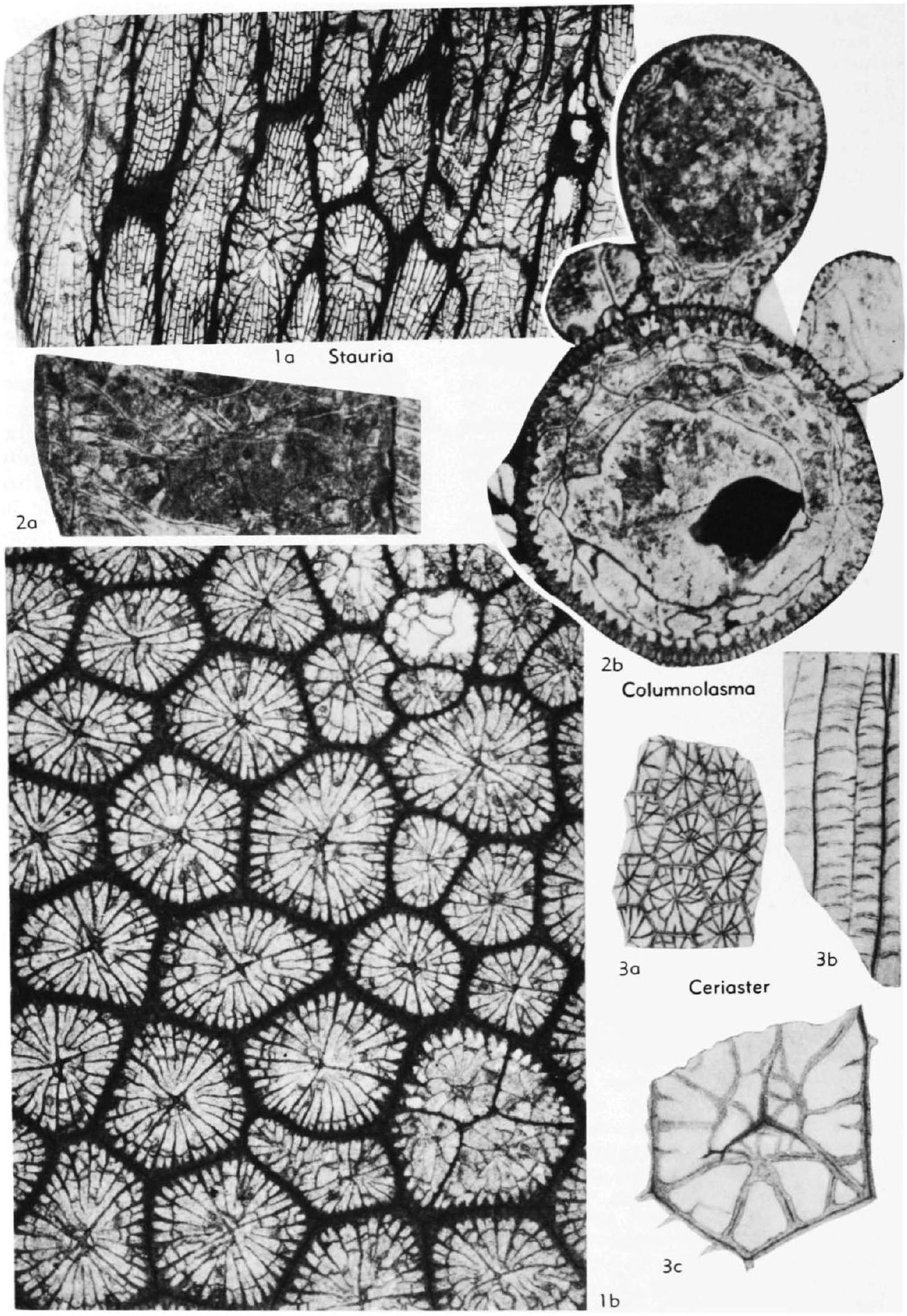 Fig. 68,la,b. *S. favosa (LINNE), M.Sil., Slite Gr., Gotl., Bogeklint; a,b, oblique, transv. secs., X2, X4 (Hill, n; UQF34301).
Synonyms
Geographic Distribution
M.Sil., Asia(Kweichow); M.Sil., Eu.(Gotl.)
Age Range
Beginning Stage in Treatise Usage:
L. Sil.
Beginning International Stage:
Rhuddanian
Fraction Up In Beginning Stage:
0
Beginning Date:
443.07
Ending Stage in Treatise Usage:
L. Sil.
Ending International Stage:
Homerian
Fraction Up In Ending Stage:
100
Ending Date:
426.74
Description
Cerioid, or partly phaceloid, commonly four, in some three peripheral and parricidal offsets arise simultaneously, their dividing walls arranged in cross at axis, two opposite walls commonly growing above counter and cardinal septa, major septa reaching almost to axis, minor septa short, dissepiments in up to two series, or sparse and isolated, in some disrupting minor septa; tabulae subhorizontal or slightly convex, complete or with some tabellae [see SMITH & RYDER, 1927, p. 337]
References
Haime, Jules, 1850, Polypiers: in P. E. P. Verneuil, Note sur les fossiles dévoniens du district de Sabero (Léon): Soc. Géol. France, Bull., sér. 2, v. 7, p. 161-162.
Museum or Author Information
Classification
Phylum:
Cnidaria
Class:
Anthozoa
Subclass:
Rugosa
Order:
Stauriida
Suborder:
Stauriina
Family:
Stauriidae
Formal Genus Name and Reference:
Stauria Milne-Edwards & HAIME, 1850, p. Ixiv
Type Species:
* S. astreiformis, species not described or figured until Milne-Edwards & Haime, 1851, p. 316, †?unfigured ?syntype, Z115a, in Milne-Edwards & Haime Coll., MN, Paris, +lectotype by Lang, Smith, & Thomas, 1940, p. 122, not traced; =Madrepora favosa LINNÉ, 1758, p. 796, +not traced
Images
(Click to enlarge in a new window)
Fig. 68,la,b. *S. favosa (LINNE), M.Sil., Slite Gr., Gotl., Bogeklint; a,b, oblique, transv. secs., X2, X4 (Hill, n; UQF34301).
Synonyms
Geographic Distribution
M.Sil., Asia(Kweichow); M.Sil., Eu.(Gotl.)
Age Range
Beginning Stage in Treatise Usage:
L. Sil.
Beginning International Stage:
Rhuddanian
Fraction Up In Beginning Stage:
0
Beginning Date:
443.07
Ending Stage in Treatise Usage:
L. Sil.
Ending International Stage:
Homerian
Fraction Up In Ending Stage:
100
Ending Date:
426.74
Description
Cerioid, or partly phaceloid, commonly four, in some three peripheral and parricidal offsets arise simultaneously, their dividing walls arranged in cross at axis, two opposite walls commonly growing above counter and cardinal septa, major septa reaching almost to axis, minor septa short, dissepiments in up to two series, or sparse and isolated, in some disrupting minor septa; tabulae subhorizontal or slightly convex, complete or with some tabellae [see SMITH & RYDER, 1927, p. 337]
References
Haime, Jules, 1850, Polypiers: in P. E. P. Verneuil, Note sur les fossiles dévoniens du district de Sabero (Léon): Soc. Géol. France, Bull., sér. 2, v. 7, p. 161-162.