
Welcome to the Cnidaria subsite on Invertebrate Paleontology!
Please enter a genera name to retrieve more information.

Tachylasma
Classification
Phylum:
Cnidaria
Class:
Anthozoa
Subclass:
Rugosa
Order:
Stauriida
Suborder:
Plerophyllina
Family:
Pentaphyllidae
Subfamily:
Pentaphyllinae
Formal Genus Name and Reference:
Tachylasma GRABAU, 1922, p. 34
Type Species:
T. cha, OD; +142, Geol. Survey China, ?Peking
Images
(Click to enlarge in a new window)
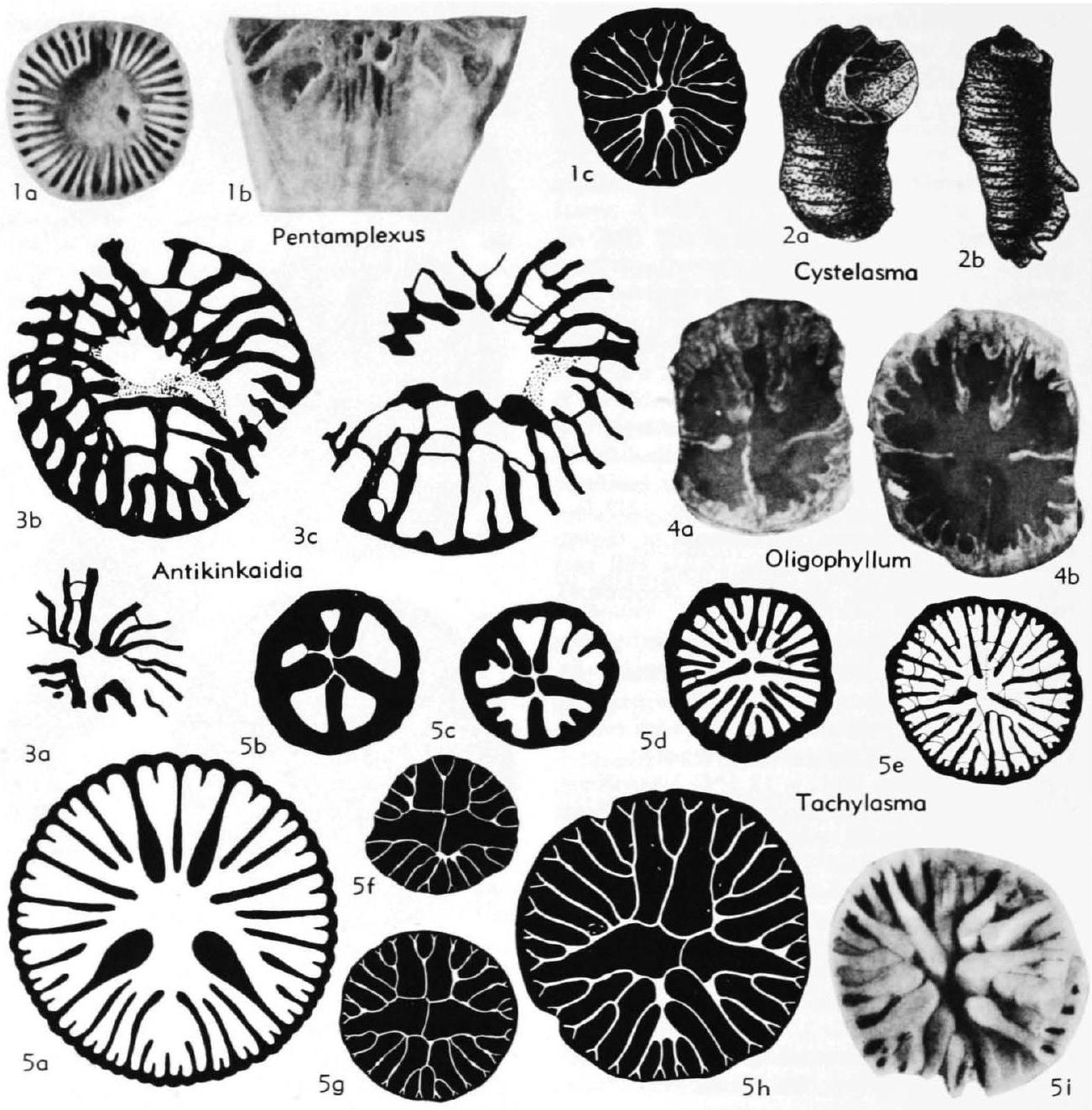 Fig. 217,5a. *T. cha, holotype, is. China; diagram. transv. sec., X3.0 (Grabau, 1922). --Fig. 217,5b-e. T. variabile (SCHINDEWOLF), L.Perm., Bitauni, Timor; b-e, transv. sees.,
XS.O, X3.8, X2.0, Xl.4 (Schindewolf, 1942). --Fig. 217,5f-i. ?T. crassiseptum (SCHlNDEWOLF), holotype, Bitauni; f-h, transv. sees., X2.0; i, calical view, X 1.5 (Schindewolf, 1942).
Fig. 217,5a. *T. cha, holotype, is. China; diagram. transv. sec., X3.0 (Grabau, 1922). --Fig. 217,5b-e. T. variabile (SCHINDEWOLF), L.Perm., Bitauni, Timor; b-e, transv. sees.,
XS.O, X3.8, X2.0, Xl.4 (Schindewolf, 1942). --Fig. 217,5f-i. ?T. crassiseptum (SCHlNDEWOLF), holotype, Bitauni; f-h, transv. sees., X2.0; i, calical view, X 1.5 (Schindewolf, 1942).
Synonyms
Ufimia, ?Prionophyllum
Geographic Distribution
Asia(China-Timor)
Age Range
Beginning Stage in Treatise Usage:
Perm.
Beginning International Stage:
Asselian
Fraction Up In Beginning Stage:
0
Beginning Date:
298.89
Ending Stage in Treatise Usage:
Perm.
Ending International Stage:
Changhsingian
Fraction Up In Ending Stage:
100
Ending Date:
251.9
Description
Solitary, small, four protosepta (alar and coumer-lateral) longest, tallest, and most rhopaloid; counter septum thin but moderately long and rhopaloid, cardinal septum greatly shortened; metasepta unequal, some- what rhopaloid, those in midquadrant stronger than others; minor septa very short; tabulae sparse; early stages in type species unknown. [SCHINOE- WOLF (1942, p. 195) noted pentaphylloid early stages in his new Permian tachylasmoid species Pentaphyllum (Tachylasma) variable, and (1942, p. 53) thought it possible that the Permian Tachylasma cha and more probably T. elongatum GRABAU, 1922, has this type of early stage, rather than the zaphrentoid early stages found in homeomorphic U[imia, a supposition that is tentatively accepted in this Treatise.]
References
Museum or Author Information
Classification
Phylum:
Cnidaria
Class:
Anthozoa
Subclass:
Rugosa
Order:
Stauriida
Suborder:
Plerophyllina
Family:
Pentaphyllidae
Subfamily:
Pentaphyllinae
Formal Genus Name and Reference:
Tachylasma GRABAU, 1922, p. 34
Type Species:
T. cha, OD; +142, Geol. Survey China, ?Peking
Images
(Click to enlarge in a new window)
Fig. 217,5a. *T. cha, holotype, is. China; diagram. transv. sec., X3.0 (Grabau, 1922). --Fig. 217,5b-e. T. variabile (SCHINDEWOLF), L.Perm., Bitauni, Timor; b-e, transv. sees.,
XS.O, X3.8, X2.0, Xl.4 (Schindewolf, 1942). --Fig. 217,5f-i. ?T. crassiseptum (SCHlNDEWOLF), holotype, Bitauni; f-h, transv. sees., X2.0; i, calical view, X 1.5 (Schindewolf, 1942).
Synonyms
Ufimia, ?Prionophyllum
Geographic Distribution
Asia(China-Timor)
Age Range
Beginning Stage in Treatise Usage:
Perm.
Beginning International Stage:
Asselian
Fraction Up In Beginning Stage:
0
Beginning Date:
298.89
Ending Stage in Treatise Usage:
Perm.
Ending International Stage:
Changhsingian
Fraction Up In Ending Stage:
100
Ending Date:
251.9
Description
Solitary, small, four protosepta (alar and coumer-lateral) longest, tallest, and most rhopaloid; counter septum thin but moderately long and rhopaloid, cardinal septum greatly shortened; metasepta unequal, some- what rhopaloid, those in midquadrant stronger than others; minor septa very short; tabulae sparse; early stages in type species unknown. [SCHINOE- WOLF (1942, p. 195) noted pentaphylloid early stages in his new Permian tachylasmoid species Pentaphyllum (Tachylasma) variable, and (1942, p. 53) thought it possible that the Permian Tachylasma cha and more probably T. elongatum GRABAU, 1922, has this type of early stage, rather than the zaphrentoid early stages found in homeomorphic U[imia, a supposition that is tentatively accepted in this Treatise.]