
Welcome to the Cnidaria subsite on Invertebrate Paleontology!
Please enter a genera name to retrieve more information.

Tryplasma
Classification
Phylum:
Cnidaria
Class:
Anthozoa
Subclass:
Rugosa
Order:
Cystiphyllida
Family:
Tryplasmatidae
Subfamily:
Tryplasmatinae
Formal Genus Name and Reference:
Tryplasma LONSDALE, 1845, p. 613
Type Species:
T. aequabile SD ETHERIDGE, 1907, p. 42; tneotype, 1, colI. 486, IGG, Novosibirsk; by IVANOVSKIY & SHURYGINA, 1975, p. 15
Images
(Click to enlarge in a new window)
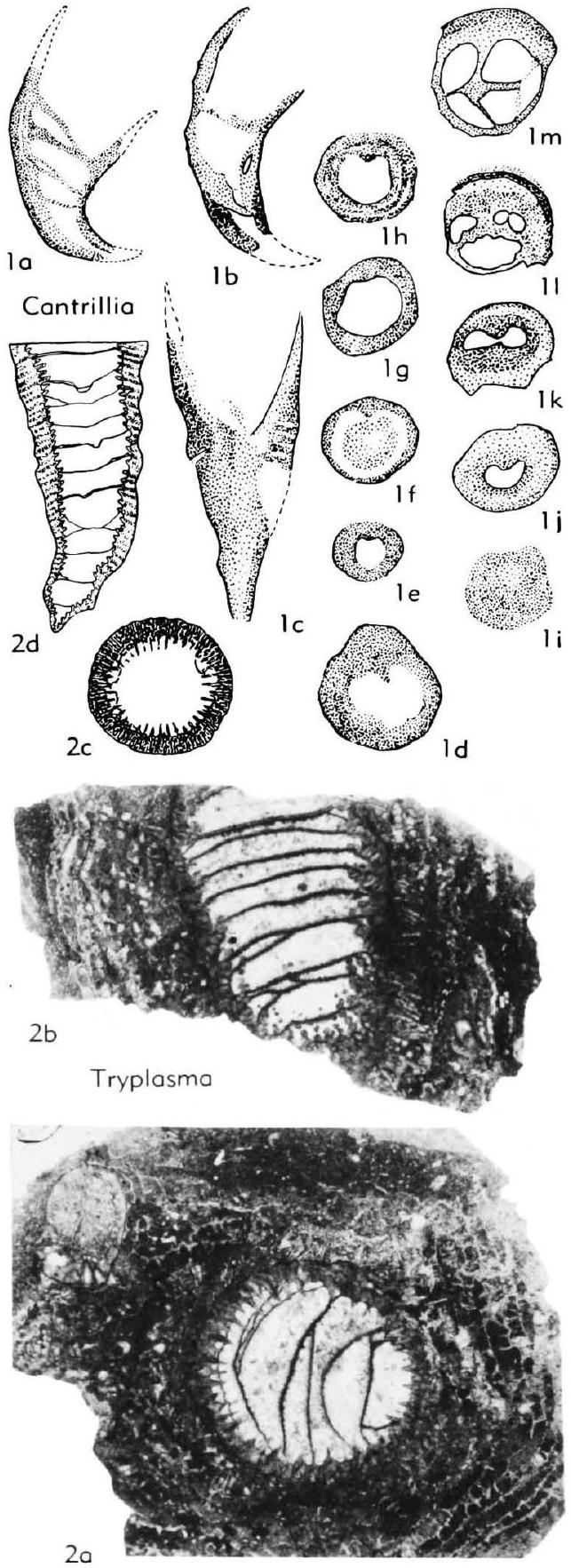 Fig. 40,2a,b. *T. aequabile, neotype, L.Dev. (or Eifel., fide Ivanovskiy, written commun. ), R. Kavka, E. slope of Urals, a, b, trans., long. secs., X2.7 (Hill, n, photographs courtesy A. B. Ivanovskiy).-Fig. 40,2c,d. T. loveni (MilneEdwards& Haime), M.Sil., U.K., Knowle Quarry, Wenlock Edge, c, d, transv., long. secs., X1 (after Hill, 1936).
Synonyms
Pholidophyllum, Scarithodes, Spiniferina, Acanthodes, Pholadophyllum
Geographic Distribution
U.Ord.(Vormsi.), Eu. (Est.-Swed.-Urals), Sil.-L. Dev., cosmop., ?M.Dev.(Eifel.), Asia(E.Urals)
Age Range
Beginning Stage in Treatise Usage:
U.Ord.(Vormsi.)
Beginning International Stage:
Katian
Fraction Up In Beginning Stage:
42.2
Beginning Date:
449.57
Ending Stage in Treatise Usage:
U.Ord.(Vormsi.)
Ending International Stage:
Katian
Fraction Up In Ending Stage:
54.9
Ending Date:
448.61
Description
Corallum solitary or with one or more parricidal offsets from calice but not forming fasciculate coralla, may have epithecal scales, with a narrow peripheral stereozone of contiguous laminar bases of commonly short rhabdacanthine, holacanthine, or dimorphacanthine septa, trabeculae being free distally, tabulae complete and commonly subhorizontal, some with median notch, dissepiments absent [see IVANOVSKIY & SHURYGINA, 1975, p. 15].
References
Museum or Author Information
Classification
Phylum:
Cnidaria
Class:
Anthozoa
Subclass:
Rugosa
Order:
Cystiphyllida
Family:
Tryplasmatidae
Subfamily:
Tryplasmatinae
Formal Genus Name and Reference:
Tryplasma LONSDALE, 1845, p. 613
Type Species:
T. aequabile SD ETHERIDGE, 1907, p. 42; tneotype, 1, colI. 486, IGG, Novosibirsk; by IVANOVSKIY & SHURYGINA, 1975, p. 15
Images
(Click to enlarge in a new window)
Fig. 40,2a,b. *T. aequabile, neotype, L.Dev. (or Eifel., fide Ivanovskiy, written commun. ), R. Kavka, E. slope of Urals, a, b, trans., long. secs., X2.7 (Hill, n, photographs courtesy A. B. Ivanovskiy).-Fig. 40,2c,d. T. loveni (MilneEdwards& Haime), M.Sil., U.K., Knowle Quarry, Wenlock Edge, c, d, transv., long. secs., X1 (after Hill, 1936).
Synonyms
Pholidophyllum, Scarithodes, Spiniferina, Acanthodes, Pholadophyllum
Geographic Distribution
U.Ord.(Vormsi.), Eu. (Est.-Swed.-Urals), Sil.-L. Dev., cosmop., ?M.Dev.(Eifel.), Asia(E.Urals)
Age Range
Beginning Stage in Treatise Usage:
U.Ord.(Vormsi.)
Beginning International Stage:
Katian
Fraction Up In Beginning Stage:
42.2
Beginning Date:
449.57
Ending Stage in Treatise Usage:
U.Ord.(Vormsi.)
Ending International Stage:
Katian
Fraction Up In Ending Stage:
54.9
Ending Date:
448.61
Description
Corallum solitary or with one or more parricidal offsets from calice but not forming fasciculate coralla, may have epithecal scales, with a narrow peripheral stereozone of contiguous laminar bases of commonly short rhabdacanthine, holacanthine, or dimorphacanthine septa, trabeculae being free distally, tabulae complete and commonly subhorizontal, some with median notch, dissepiments absent [see IVANOVSKIY & SHURYGINA, 1975, p. 15].