
Welcome to the Cnidaria subsite on Invertebrate Paleontology!
Please enter a genera name to retrieve more information.

Ufimia
Classification
Phylum:
Cnidaria
Class:
Anthozoa
Subclass:
Rugosa
Order:
Stauriida
Suborder:
Plerophyllina
Family:
Plerophyllidae
Subfamily:
Plerophyllinae
Formal Genus Name and Reference:
Ufimia SHTUKENBERG, 1895, p. 27
Type Species:
U. carbonaria; M; 121 and probably 23/45, SHTUKENBERG Coil., LGI, Leningrad, plus unnumbered piece in Univ. Kazan; lectotype by FEDOROWSKI, 1973, p. 112
Images
(Click to enlarge in a new window)
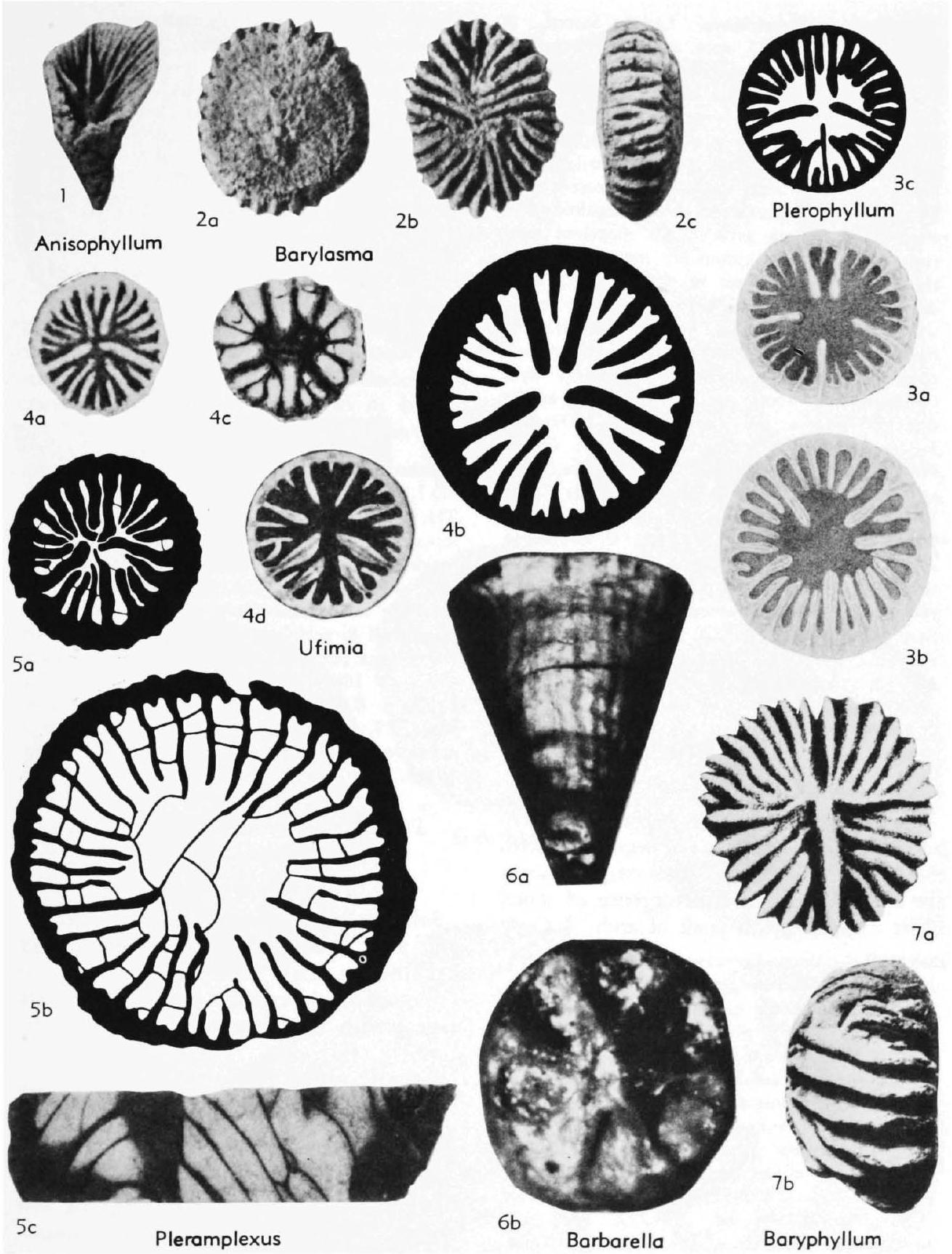 Fig. 214,4a,b. *U. carbonaria, syntype, L.Carb., USSR, R. Ufa, a, transv. sec. through base of calice, enl., b, diagram. septal plan drawn from Shtukenberg's figure by Schindewolf (1942), X4 (Shtukenberg, 1895). --Fig. 214,4c,d. U. tachyblasta (Hudson), holotype, ?occurrence, c, d, transv. secs., X5,X2 (Hudson, 1936b).
Synonyms
Rhopalolasma, ?Plerophyllum
Geographic Distribution
L.Dev.(up. Ems.), Eu.(Ger.), M.Dev., Eu.(Spain), U.Dev. (Famenn.), Eu.(Ger.-Pol.), L.Carb., Eu.(U.K.-Ger.-USSR), U.Carb., Eu.(Donbas-Spain), Perm., Eu. (Urals)-Asia (Timor-Nakhichev.-NW. Iran), ?Perm. (China)
Age Range
Beginning Stage in Treatise Usage:
L.Dev.(up. Ems.)
Beginning International Stage:
Emsian
Fraction Up In Beginning Stage:
66
Beginning Date:
399.81
Ending Stage in Treatise Usage:
L.Dev.(up. Ems.)
Ending International Stage:
Emsian
Fraction Up In Ending Stage:
100
Ending Date:
394.3
Description
Solitary, small, in late stages with four septa (alar and counter-lateral) longer, taller, thicker, and more rhopaloid than others, early stages zaphrentoid, rhopaloid axial ends of major septa commonly conjunct in axial region in middle stages of development, withdrawing and becoming free axially in late stages, with smooth distal edges, longest and strongest metasepta commonly mid-quadrant, counter and cardinal septa shorten progressively, minor septa rudimentary to short, tabular floors tall, axially depressed domes, no dissepiments.
References
Museum or Author Information
Classification
Phylum:
Cnidaria
Class:
Anthozoa
Subclass:
Rugosa
Order:
Stauriida
Suborder:
Plerophyllina
Family:
Plerophyllidae
Subfamily:
Plerophyllinae
Formal Genus Name and Reference:
Ufimia SHTUKENBERG, 1895, p. 27
Type Species:
U. carbonaria; M; 121 and probably 23/45, SHTUKENBERG Coil., LGI, Leningrad, plus unnumbered piece in Univ. Kazan; lectotype by FEDOROWSKI, 1973, p. 112
Images
(Click to enlarge in a new window)
Fig. 214,4a,b. *U. carbonaria, syntype, L.Carb., USSR, R. Ufa, a, transv. sec. through base of calice, enl., b, diagram. septal plan drawn from Shtukenberg's figure by Schindewolf (1942), X4 (Shtukenberg, 1895). --Fig. 214,4c,d. U. tachyblasta (Hudson), holotype, ?occurrence, c, d, transv. secs., X5,X2 (Hudson, 1936b).
Synonyms
Rhopalolasma, ?Plerophyllum
Geographic Distribution
L.Dev.(up. Ems.), Eu.(Ger.), M.Dev., Eu.(Spain), U.Dev. (Famenn.), Eu.(Ger.-Pol.), L.Carb., Eu.(U.K.-Ger.-USSR), U.Carb., Eu.(Donbas-Spain), Perm., Eu. (Urals)-Asia (Timor-Nakhichev.-NW. Iran), ?Perm. (China)
Age Range
Beginning Stage in Treatise Usage:
L.Dev.(up. Ems.)
Beginning International Stage:
Emsian
Fraction Up In Beginning Stage:
66
Beginning Date:
399.81
Ending Stage in Treatise Usage:
L.Dev.(up. Ems.)
Ending International Stage:
Emsian
Fraction Up In Ending Stage:
100
Ending Date:
394.3
Description
Solitary, small, in late stages with four septa (alar and counter-lateral) longer, taller, thicker, and more rhopaloid than others, early stages zaphrentoid, rhopaloid axial ends of major septa commonly conjunct in axial region in middle stages of development, withdrawing and becoming free axially in late stages, with smooth distal edges, longest and strongest metasepta commonly mid-quadrant, counter and cardinal septa shorten progressively, minor septa rudimentary to short, tabular floors tall, axially depressed domes, no dissepiments.