
Welcome to the Cnidaria subsite on Invertebrate Paleontology!
Please enter a genera name to retrieve more information.

Vesiculophyllum
Classification
Phylum:
Cnidaria
Class:
Anthozoa
Subclass:
Rugosa
Order:
Stauriida
Suborder:
Caniniina
Family:
Uraliniidae
Formal Genus Name and Reference:
Vesiculophyllum EASTON, 1944b, p. 52
Type Species:
Chonophyllum sedaliense White, 1880, p. 157, OD, * probably destroyed by fire, fide Easton, 1944b, p. 53, IVANOVSKIY, 1976, p. 181, ?invalidly chose 3506 Geol. Survey Illinois as lectotype
Images
(Click to enlarge in a new window)
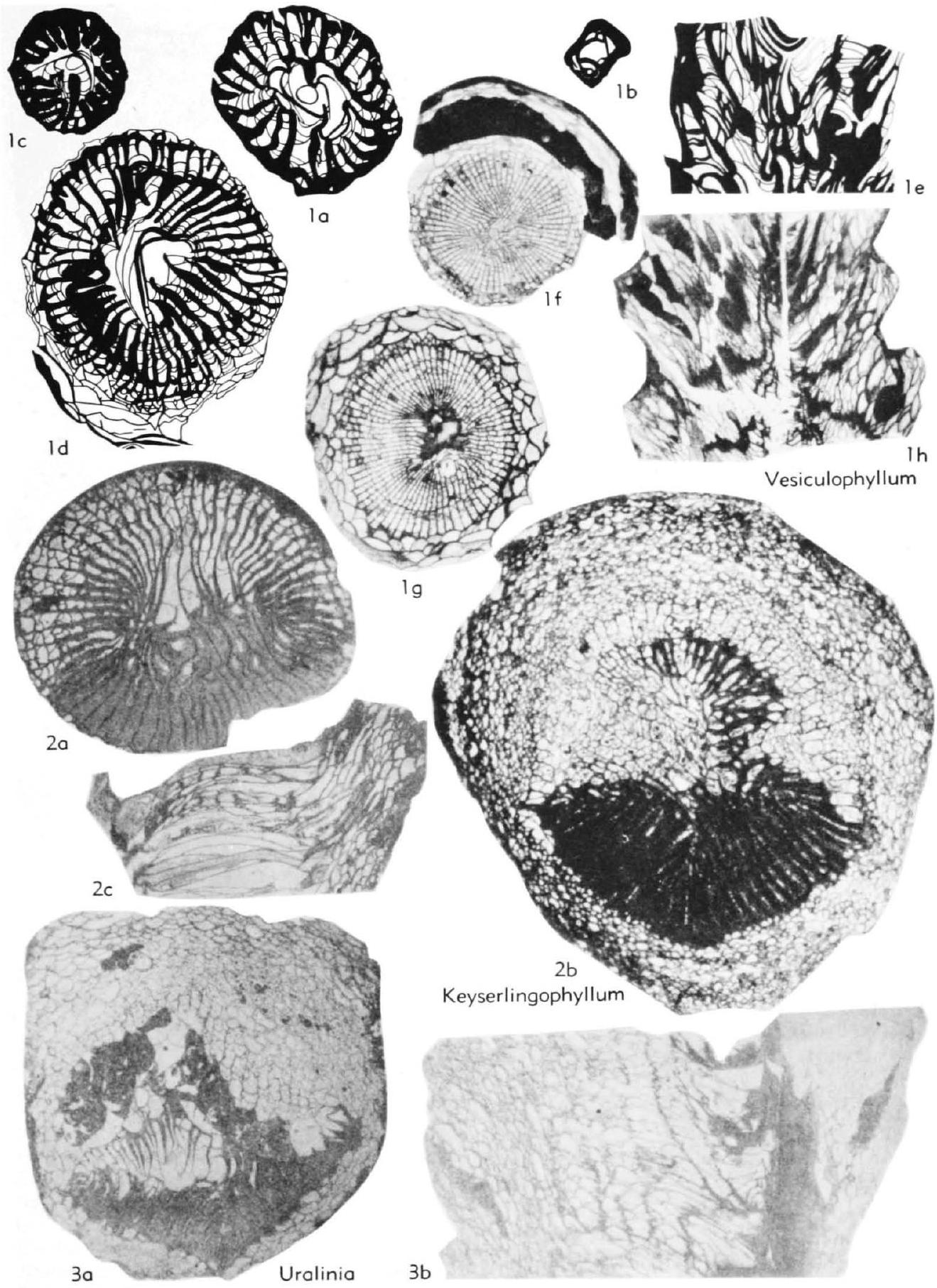 Fig. 229,1a-e. V. sedaliense (White), Chouteau Ls., Ill., a-d, transv., e, long. secs., X2.7 (Easton, 1944b). --Fig. 229, 1f-h. V. dux (Sutherland), f, holotype, B.C., Kakwa-Jarvis Lakes area, transv. sec., X0.7; g,h, another specimen, NW.Terr., Laird region, transv., long. secs., X0.7 (Sutherland, 1954).
Synonyms
Faviphyllum?
Geographic Distribution
Miss., N.Am. (III.Miss. - Iowa - Nev. - Cal. - Ariz. - Mont. - Mex. -Alberta-B.C.-NW.Terr.)
Age Range
Beginning Stage in Treatise Usage:
Miss.
Beginning International Stage:
Tournaisian
Fraction Up In Beginning Stage:
0
Beginning Date:
359.3
Ending Stage in Treatise Usage:
Miss.
Ending International Stage:
Serpukhovian
Fraction Up In Ending Stage:
100
Ending Date:
323.4
Description
Large, solitary, cylindrical, with numerous septa that commonly reach axis but may be short, septal plan bilateral, palmate or radial, cardinal septum long or short, in more or less marked fossula, counter septum commonly short, septa dilated, in late stages dilatation confined to axial region, minor septa impersistent, dissepimentarium wide, an outer transeptal (lonsdaleoid) zone and an inner zone with anguloconcentric dissepiments, tabular floors deeply concave, tabulae incomplete [see SANDO, 1960, p. 179].
References
Museum or Author Information
Classification
Phylum:
Cnidaria
Class:
Anthozoa
Subclass:
Rugosa
Order:
Stauriida
Suborder:
Caniniina
Family:
Uraliniidae
Formal Genus Name and Reference:
Vesiculophyllum EASTON, 1944b, p. 52
Type Species:
Chonophyllum sedaliense White, 1880, p. 157, OD, * probably destroyed by fire, fide Easton, 1944b, p. 53, IVANOVSKIY, 1976, p. 181, ?invalidly chose 3506 Geol. Survey Illinois as lectotype
Images
(Click to enlarge in a new window)
Fig. 229,1a-e. V. sedaliense (White), Chouteau Ls., Ill., a-d, transv., e, long. secs., X2.7 (Easton, 1944b). --Fig. 229, 1f-h. V. dux (Sutherland), f, holotype, B.C., Kakwa-Jarvis Lakes area, transv. sec., X0.7; g,h, another specimen, NW.Terr., Laird region, transv., long. secs., X0.7 (Sutherland, 1954).
Synonyms
Faviphyllum?
Geographic Distribution
Miss., N.Am. (III.Miss. - Iowa - Nev. - Cal. - Ariz. - Mont. - Mex. -Alberta-B.C.-NW.Terr.)
Age Range
Beginning Stage in Treatise Usage:
Miss.
Beginning International Stage:
Tournaisian
Fraction Up In Beginning Stage:
0
Beginning Date:
359.3
Ending Stage in Treatise Usage:
Miss.
Ending International Stage:
Serpukhovian
Fraction Up In Ending Stage:
100
Ending Date:
323.4
Description
Large, solitary, cylindrical, with numerous septa that commonly reach axis but may be short, septal plan bilateral, palmate or radial, cardinal septum long or short, in more or less marked fossula, counter septum commonly short, septa dilated, in late stages dilatation confined to axial region, minor septa impersistent, dissepimentarium wide, an outer transeptal (lonsdaleoid) zone and an inner zone with anguloconcentric dissepiments, tabular floors deeply concave, tabulae incomplete [see SANDO, 1960, p. 179].