
Welcome to the Cnidaria subsite on Invertebrate Paleontology!
Please enter a genera name to retrieve more information.

Zaphrentites
Classification
Phylum:
Cnidaria
Class:
Anthozoa
Subclass:
Rugosa
Order:
Stauriida
Suborder:
Stereolasmatina
Family:
Hapsiphyllidae
Subfamily:
Hapsiphyllinae
Formal Genus Name and Reference:
Zaphrentites HUDSON, 1941, p. 309, non Zaphrentiles VON BUBNOFF, 1926, p. 150, nom. null.
Type Species:
Zaphentis parallela CARRUTHERS, 1910, p. 533, OD, †GSM PF1256(56567), IGS, Leeds
Images
(Click to enlarge in a new window)
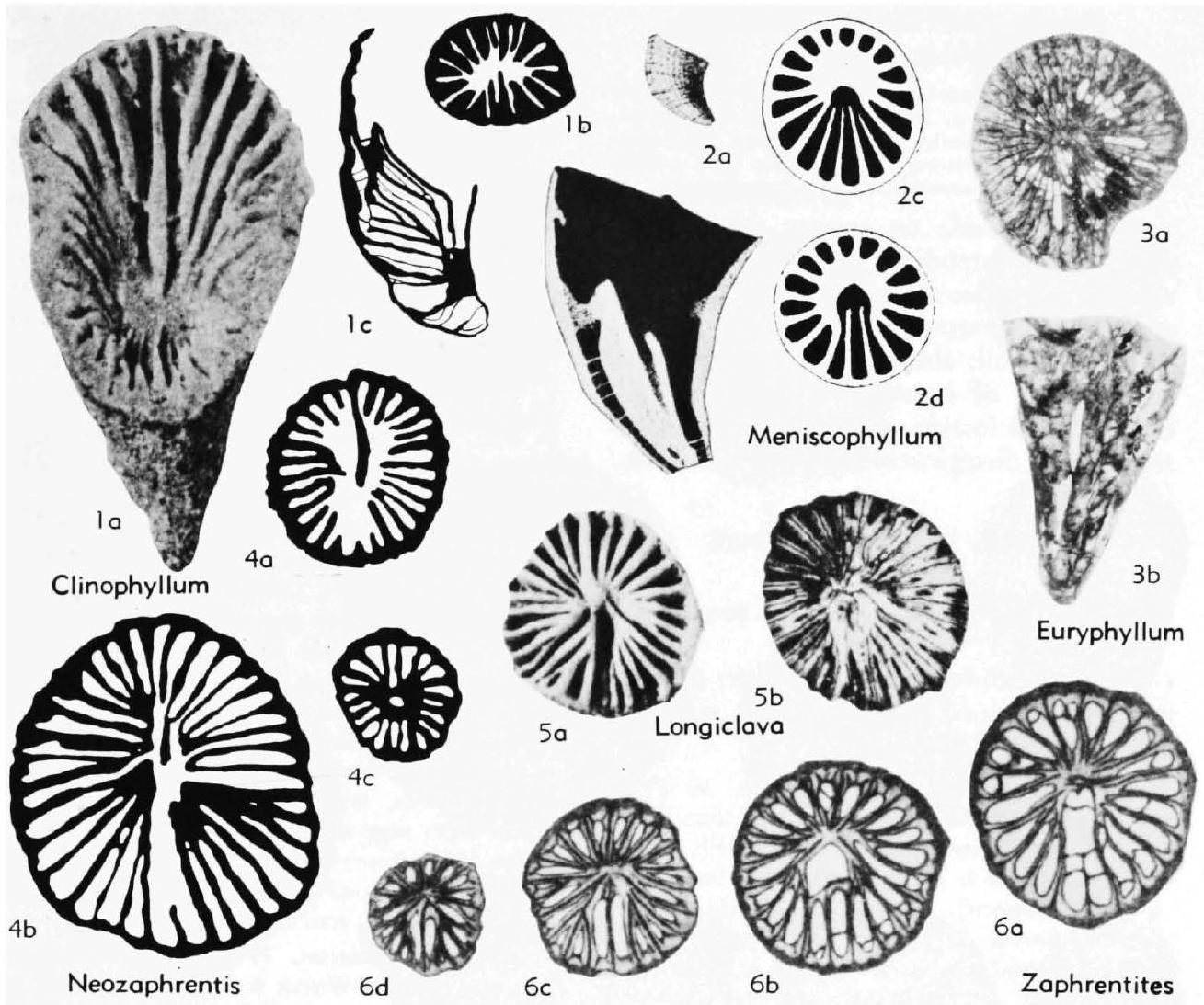 Fig.207,6a-d. *Z. parallellls (CARRUTHERS), L.Carb(Tournais.), Cementstone Gr., top band of Is., Scot., Larriston Quarry, Liddesdale; a-d, transv. secs., X4 (Carruthers, 1910).
Synonyms
Cypellophyllum, Craterophyllum, Crataniophyllum, Parastereophrentis
Geographic Distribution
Eu.(Spain, as ?Hapsiphyllum -simplex KULLMAN, 1965, p.
106); L.Carb.-U.Carb.(Tournais.-Namur.), Eu. (Brit. I.-Belg.-Russ.Platf.-Urals-Donbas)-Asia(Kuz-bas-Kazakh.); L.Miss.-L.Penn., N.Am
Age Range
Beginning Stage in Treatise Usage:
M.Dev.
Beginning International Stage:
Eifelian
Fraction Up In Beginning Stage:
0
Beginning Date:
394.3
Ending Stage in Treatise Usage:
M.Dev.
Ending International Stage:
Givetian
Fraction Up In Ending Stage:
100
Ending Date:
378.9
Description
Small, conical, slightly curved, with strong longitudinal ribbing, cardinal fossula on concave side; in early forms and early stages cardinal fossula closed, expanding adaxially, and major septa pinnately arranged with respect to cardinal and alar fossulae; in later forms and later stages cardinal septum shortened and septa withdrawn from fossula, first in cardinal quad- rants, then in counter quadrants, so that radial arrangement supercedes pinnate arrangement; minor septa very short or immersed in wall; tabulae incomplete, floors conical, with highest point at inner edge of fossula.
References
Museum or Author Information
Classification
Phylum:
Cnidaria
Class:
Anthozoa
Subclass:
Rugosa
Order:
Stauriida
Suborder:
Stereolasmatina
Family:
Hapsiphyllidae
Subfamily:
Hapsiphyllinae
Formal Genus Name and Reference:
Zaphrentites HUDSON, 1941, p. 309, non Zaphrentiles VON BUBNOFF, 1926, p. 150, nom. null.
Type Species:
Zaphentis parallela CARRUTHERS, 1910, p. 533, OD, †GSM PF1256(56567), IGS, Leeds
Images
(Click to enlarge in a new window)
Fig.207,6a-d. *Z. parallellls (CARRUTHERS), L.Carb(Tournais.), Cementstone Gr., top band of Is., Scot., Larriston Quarry, Liddesdale; a-d, transv. secs., X4 (Carruthers, 1910).
Synonyms
Cypellophyllum, Craterophyllum, Crataniophyllum, Parastereophrentis
Geographic Distribution
Eu.(Spain, as ?Hapsiphyllum -simplex KULLMAN, 1965, p.
106); L.Carb.-U.Carb.(Tournais.-Namur.), Eu. (Brit. I.-Belg.-Russ.Platf.-Urals-Donbas)-Asia(Kuz-bas-Kazakh.); L.Miss.-L.Penn., N.Am
Age Range
Beginning Stage in Treatise Usage:
M.Dev.
Beginning International Stage:
Eifelian
Fraction Up In Beginning Stage:
0
Beginning Date:
394.3
Ending Stage in Treatise Usage:
M.Dev.
Ending International Stage:
Givetian
Fraction Up In Ending Stage:
100
Ending Date:
378.9
Description
Small, conical, slightly curved, with strong longitudinal ribbing, cardinal fossula on concave side; in early forms and early stages cardinal fossula closed, expanding adaxially, and major septa pinnately arranged with respect to cardinal and alar fossulae; in later forms and later stages cardinal septum shortened and septa withdrawn from fossula, first in cardinal quad- rants, then in counter quadrants, so that radial arrangement supercedes pinnate arrangement; minor septa very short or immersed in wall; tabulae incomplete, floors conical, with highest point at inner edge of fossula.